By Jon Selvaraj, co-founder of Vista TechWerx and builder of BidWERX. Last updated September 2026.
Quick answer: To become a federal contractor you need an active, free registration in SAM.gov, which issues your Unique Entity ID and CAGE code and records your NAICS codes, banking details, and representations and certifications. That registration is the "federal contractor registry" people search for. Beyond it, you need NAICS codes that match your work, an honest read of your size status, and the basics that make you credible: a capability statement and, over time, past performance.
Key takeaways
- There is one registry that matters: SAM.gov. Registering there is free, and it is the gate for every federal prime contract. There is no separate paid registry worth your money.
- The formal requirements are mostly paperwork and accuracy, not certifications. What trips firms up is mismatched records and lapsed renewals, not missing credentials.
- Your NAICS codes and the size standards attached to them decide whether you count as a small business, and that decides which set-aside opportunities you can compete for.
- Meeting the requirements makes you eligible. It does not make you competitive. Eligibility is the floor, and most registered firms never get beyond it.
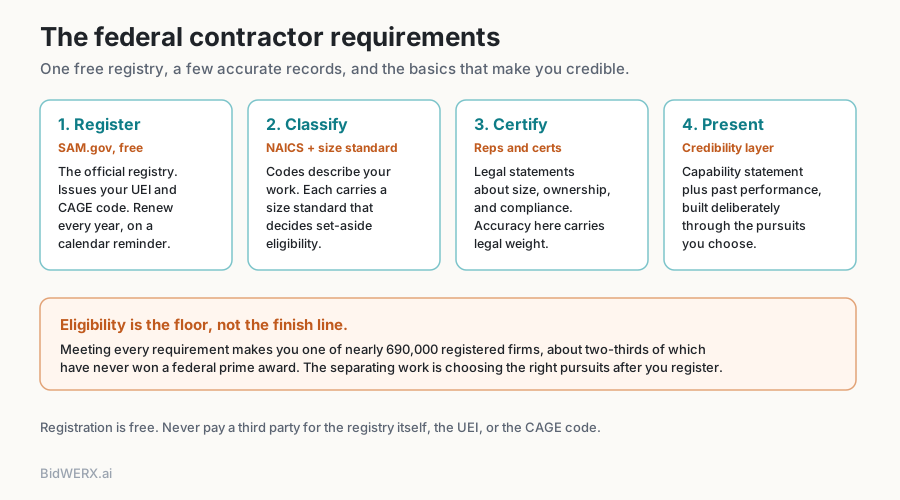
Search for federal contractor requirements and you will find a swamp of listicles, many of them written by services that would like to charge you for things the government does for free. The actual requirements are shorter than you think, and most of them are about getting your own records straight. Here is the list, in the order you will meet it, and an honest note about what the list does not do for you.
The registry question, answered first
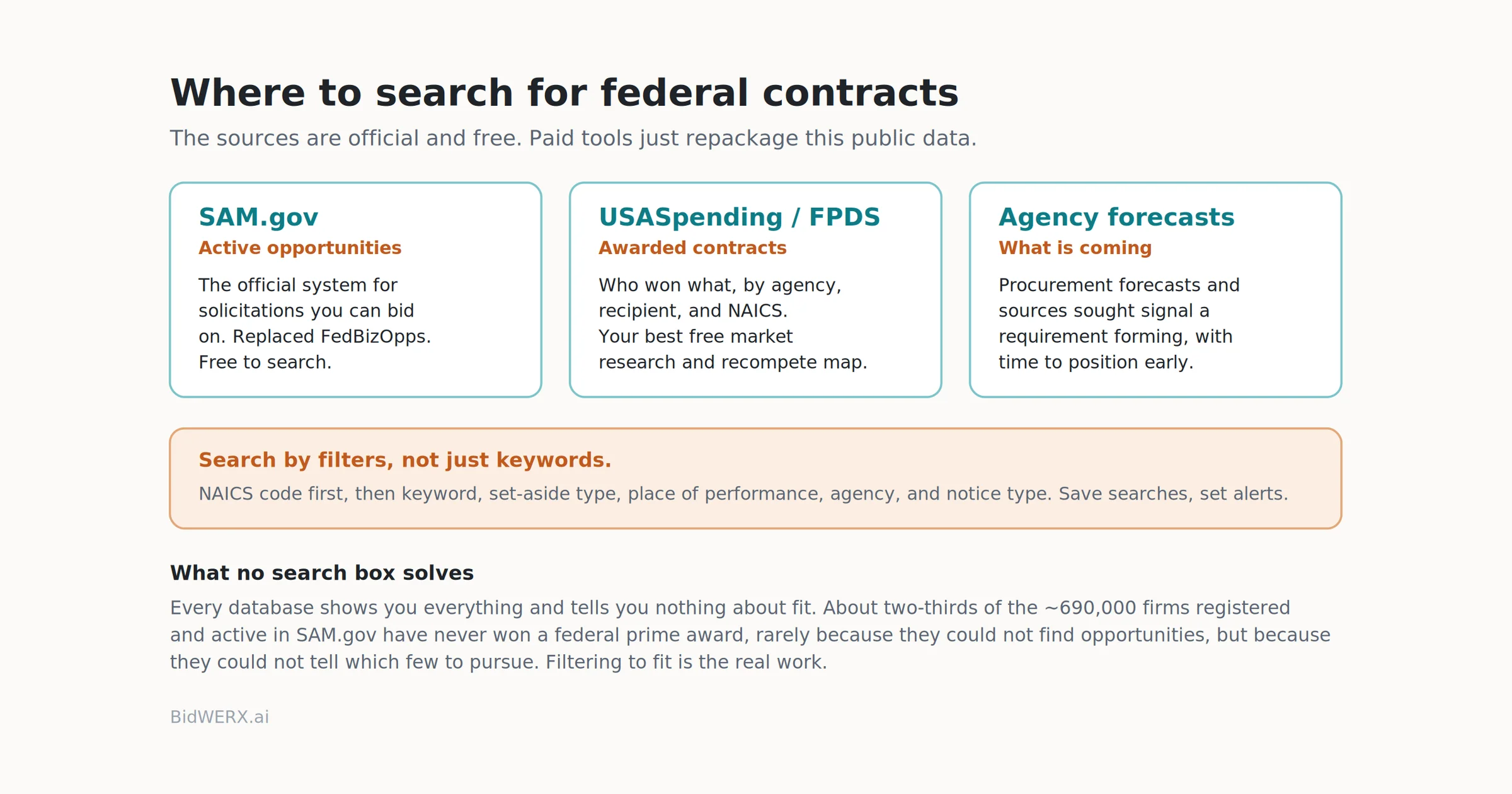
A lot of people searching this topic are really asking one thing: is there a federal contractor registry I need to be in? Yes, and it is SAM.gov, the System for Award Management. It is the government's official registry of entities that want to do business with it, registration is free, and an active SAM.gov registration is required before any agency can award you a prime contract. That is the whole answer. Third parties may offer to register you for a fee, and some firms find that convenient, but the registry itself charges nothing and you can complete it yourself. We wrote a full walkthrough in how to register in SAM.gov.
The core registration set: UEI, CAGE, and reps and certs
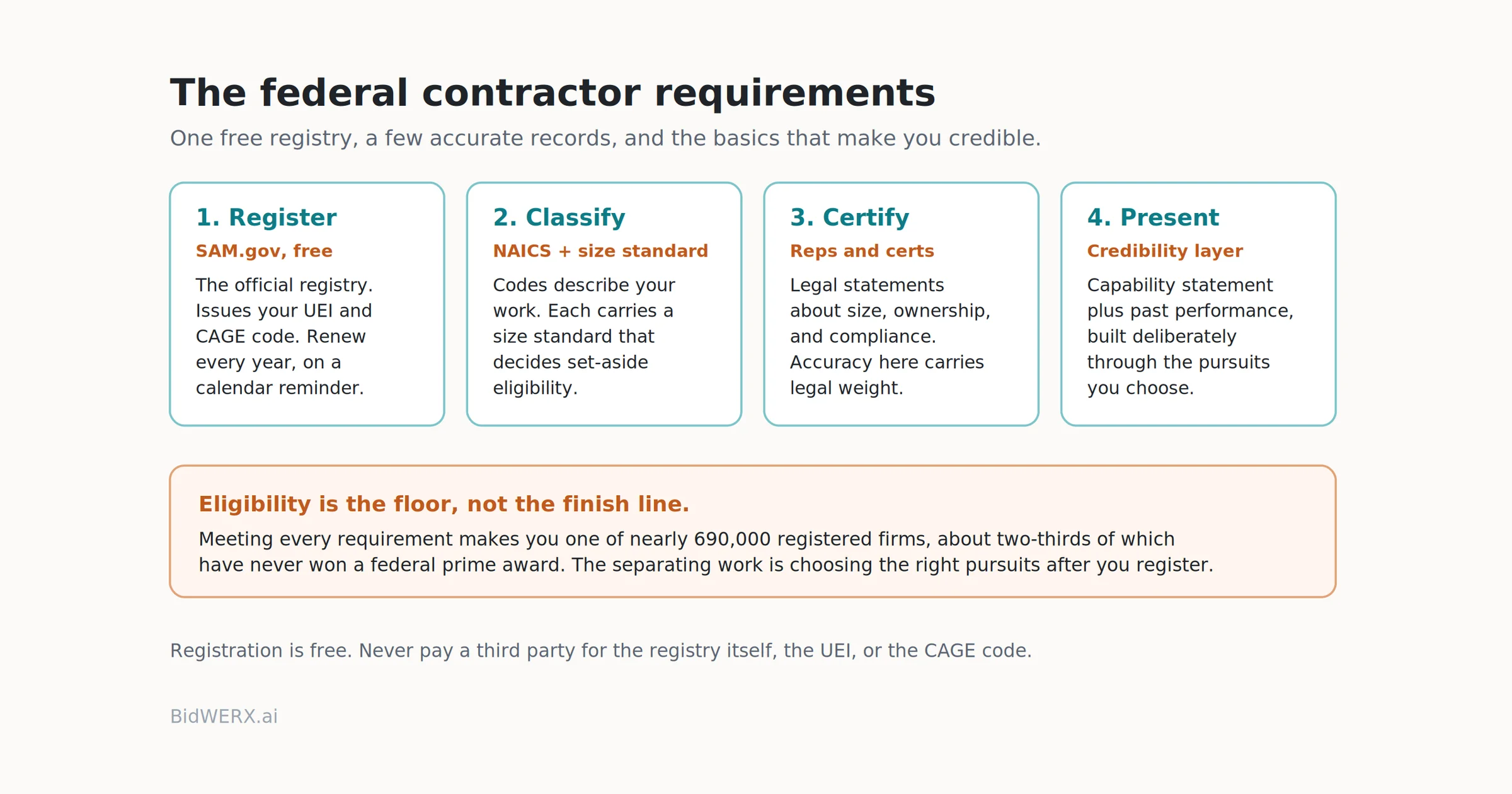
Registering in SAM.gov produces the identifiers and records that every solicitation will ask about. Your Unique Entity ID is the 12-character identifier the government uses to track your entity, issued inside SAM.gov at no cost. Your CAGE code is assigned during registration for domestic entities, with no separate application. Your banking details enable electronic payment. And your representations and certifications, the reps and certs, are the set of legal statements about your business, its ownership, its size status, and its compliance posture that you complete as part of registration and that carry real legal weight.
The requirement hiding inside all of this is accuracy. Your legal business name, physical address, and EIN must match your IRS and official records exactly, because mismatches are the most common cause of stalled registrations. And the registration must be renewed annually, because an expired registration makes you ineligible on the day a good solicitation drops. Put the renewal on a calendar about sixty days before it lapses.
NAICS codes and size standards
Your NAICS codes describe what your business does, and you can hold several. They matter twice. First, they are how you filter opportunities to your line of work when you search for federal contracts. Second, each NAICS code carries a size standard, set by the Small Business Administration, that defines how large a firm can be, in revenue or employees, and still count as small in that line of work.
Size status is not a certificate you frame on the wall. It is a representation you make against the size standard of the specific NAICS code on a specific solicitation, and it determines whether you can compete for small-business set-asides. A meaningful share of federal contracting is reserved for small businesses and for firms holding socioeconomic designations, so knowing your status honestly, code by code, is a requirement in practice even though nobody mails you a badge for it.
Beyond registration: the credibility layer
Everything above makes you eligible. The next layer is what makes an agency take you seriously, and while no regulation requires it, the market does.
A capability statement is the one-page document GovCon runs on: who you are, what you do, your codes and identifiers, your differentiators, and your contact information. Contracting officers and potential teaming partners will ask for it, and not having one marks you as brand new. Past performance is the record of work you have delivered, and it is the currency of credibility in federal evaluations. New firms do not have federal past performance yet, which is normal. You build it deliberately, through smaller awards, subcontracting, and teaming, and every pursuit you choose should be chosen partly for the record it leaves behind.
Compliance comes with the contract
One more category deserves an honest mention. Federal contracts carry clauses, and clauses carry obligations: labor standards, employment verification, reporting, and domain-specific rules that vary by agency and by the nature of the work. You do not need to master all of it before registering, because the applicable clauses arrive with each solicitation and contract, and reading them is part of deciding whether to bid. Treat this paragraph as a pointer rather than a checklist, and treat the clauses themselves as things to read carefully, with professional advice where the stakes warrant it. This article is information, not legal advice.
What the requirements do not do
Here is the part the listicles leave out. Meeting every requirement on this page makes you one of the nearly 690,000 firms registered and active in SAM.gov, and in our analysis, about two-thirds of those firms have not won a single federal prime award in the last thirteen years (FY2014 to FY2026). Eligible is the floor. The work that separates the winners starts after registration: finding the opportunities that genuinely fit your firm, qualifying hard, and pursuing few and well.
That is the stage BidWERX is built for. Find surfaces the opportunities that match your firm, and FitScore gives you a relative read on how well each one fits, so your newly eligible firm spends its limited pursuit time where it has a real case. FitScore is a relative fit indicator to help you prioritize, not a prediction that you will win. If your registration is done and the question is what to pursue, you can start a free BidWERX trial.
Jon Selvaraj is the co-founder of Vista TechWerx and the builder of BidWERX, a readiness and decision tool for small firms pursuing federal work. He writes about the operating discipline behind winning government business.
Related reading: how to register in SAM.gov · what are federal contracts · how to find and search federal contract opportunities.
Frequently Asked Questions
What are the requirements to become a federal contractor?
An active, free SAM.gov registration, which issues your Unique Entity ID and CAGE code and records your banking details and representations and certifications. You also need NAICS codes that describe your work and an accurate size representation against each code's standard. Beyond eligibility, a capability statement and past performance are what make you credible.
Is there a federal contractor registry?
Yes: SAM.gov, the System for Award Management, is the federal government's official registry of entities eligible for awards. Registration is free and required before any agency can award you a prime contract. Third-party services that charge to register you are optional conveniences, not a separate registry, and you can register yourself at no cost.
Do I need special certifications to win federal contracts?
No certification is required simply to compete. Small-business status is a representation against the SBA size standard for a solicitation's NAICS code, not a certificate. Socioeconomic designations can open set-aside opportunities for eligible firms, and specific contracts may impose their own requirements, but there is no baseline credential every contractor must hold.
How much does it cost to become a federal contractor?
Registration itself is free. SAM.gov, your Unique Entity ID, and your CAGE code cost nothing, and anyone charging for the registration itself is charging for convenience. The real costs are time: keeping records accurate, renewing annually, building a capability statement, and the pursuit costs of actually bidding on work.