Partner Network
Org starter and above
Build your teaming ecosystem. Widen the pool of opportunities you can win.
Some opportunities need capabilities you don't have — and some of your best pursuits are ones you'd never chase alone, but could win as a team.
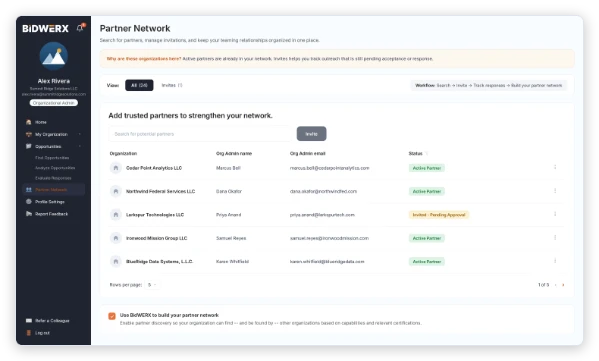
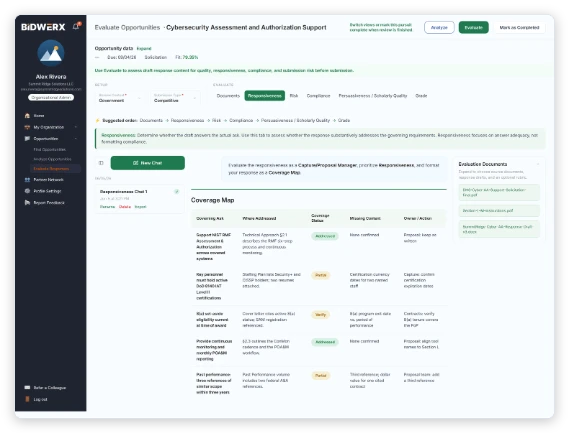
Add the partners you already team with to your Partner Network, and BidWERX matches their capabilities against live opportunities right alongside your own profile. Opportunities you'd screen out solo — because you don't hold every required capability — surface as pursuits you could win together, expanding your pipeline instead of shrinking it. It works the other direction on any single opportunity, too: where the solicitation calls for a capability no one on your team has, BidWERX flags the gap and surfaces Partner Network members who fill it — a targeted match on the pursuit in front of you, not a directory to scroll. And when other organizations pursue opportunities you'd fit, your profile can surface you as a potential teaming partner. BidWERX handles the discovery and matching. The teaming relationship happens between you and the partner, outside the platform.
→
Add your teaming ecosystem — BidWERX matches your partners to opportunities and widens your pursuit pool
→
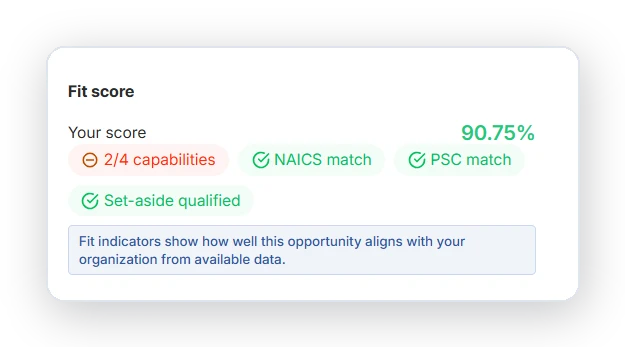
Automatic gap matching at the opportunity level
→
Passive discovery — on by default, switchable off, no unsolicited inbox noise
→
One-step email invitation to partners, whether or not they're already on BidWERX
Org Starter and above. Not available on Contributor, Individual, or Team Starter. Partner Network is discovery and matching only; BidWERX does not manage teaming agreements or facilitate joint proposal work.