By Jon Selvaraj
Quick answer: Federal business development is the work you do before a solicitation drops: choosing the agencies and buyers you can realistically win with, building relationships early, and deciding what to pursue. For a small team, most of the discipline is in saying no. You win more by chasing fewer, better opportunities and preparing for them sooner.
Key takeaways
- BD in the federal market is mostly positioning. By the time an RFP posts, the winner has usually been working the requirement for months, and the rest of the field is filling a seat.
- A small team's scarcest resource is proposal time, so the bid/no-bid decision is the single highest-leverage habit you can build. Three questions carry most of the weight: can we win it, should we want it, and can we deliver it.
- Win rate improves faster when you pursue less. Cutting the weak pursuits raises the average quality of everything left and frees the hours to do those few well.
- Teaming is how a small firm reaches work it cannot hold alone, but a bad partner costs more than a lost bid. Vet for past performance, contract vehicles, and how they behave under pressure, not just capability slides.
What business development actually is in GovCon
If you come from the commercial world, the phrase "business development" probably means finding leads and closing them. Federal BD is a different animal. The buying is public, the rules are written down, and the timeline is long. Most of the work that decides who wins happens before anyone is allowed to submit a price.
Here is the shape of it. A government program has a need. Someone in that program, often a contracting officer's technical representative or a program manager, starts thinking about how to meet it. They talk to companies. They read capability statements. They sit through industry days and one-on-one sessions. Over months, an idea of the requirement forms, and it forms in conversation with the firms that showed up early and made themselves useful. When the solicitation finally posts, it reflects that shaping. The company that helped inform the requirement is not guaranteed the award, but it starts from a real advantage.
So BD in this market is two things happening at once. It is relationships, meaning you are known and trusted by the people who buy what you sell. And it is positioning, meaning your company is credibly associated with the specific work before it becomes a competition. Neither of those is a proposal. Both of them happen in the quiet months when there is nothing to bid on.
This is the part small teams get wrong most often. They wait for the RFP. They set up a saved search, an opportunity lands in the inbox, and they scramble to respond in the three or four weeks they are given. That is not business development. That is reacting to a race that started before you knew it existed, usually against a company that has been talking to the customer since last year.
The good news for a small firm is that you do not need a large BD staff to do this well. You need to pick a narrow lane, show up in it consistently, and be honest with yourself about what you can win. The rest of this playbook is how to do that without a team of ten.
Build a simple pipeline before you build anything else
A pipeline is just a list of the opportunities you are working, arranged by how close each one is to a decision. It does not need software. A spreadsheet is fine to start. What matters is that it exists, that it is current, and that every item on it has a stage and an owner.
For a small GovCon team, a few stages are enough:
- Identified. You know the work exists and it looks like a fit. You have not done anything about it yet.
- Qualifying. You are checking whether it is real, whether you are eligible, and whether you have a path to win. This is where most opportunities should die.
- Capturing. You have decided it is worth pursuing and you are working the customer, the teaming, and the solution ahead of the solicitation.
- Proposing. The solicitation is out and you are writing.
- Submitted. It is in. You are waiting on award.
The reason to name the stages is that it forces honesty. An opportunity that has sat in "Identified" for four months is not a pursuit, it is a bookmark. A dozen items in "Capturing" for a three-person company is not a pipeline, it is a fantasy, because you do not have the hours to capture twelve things at once. Seeing the pile makes the overcommitment obvious.
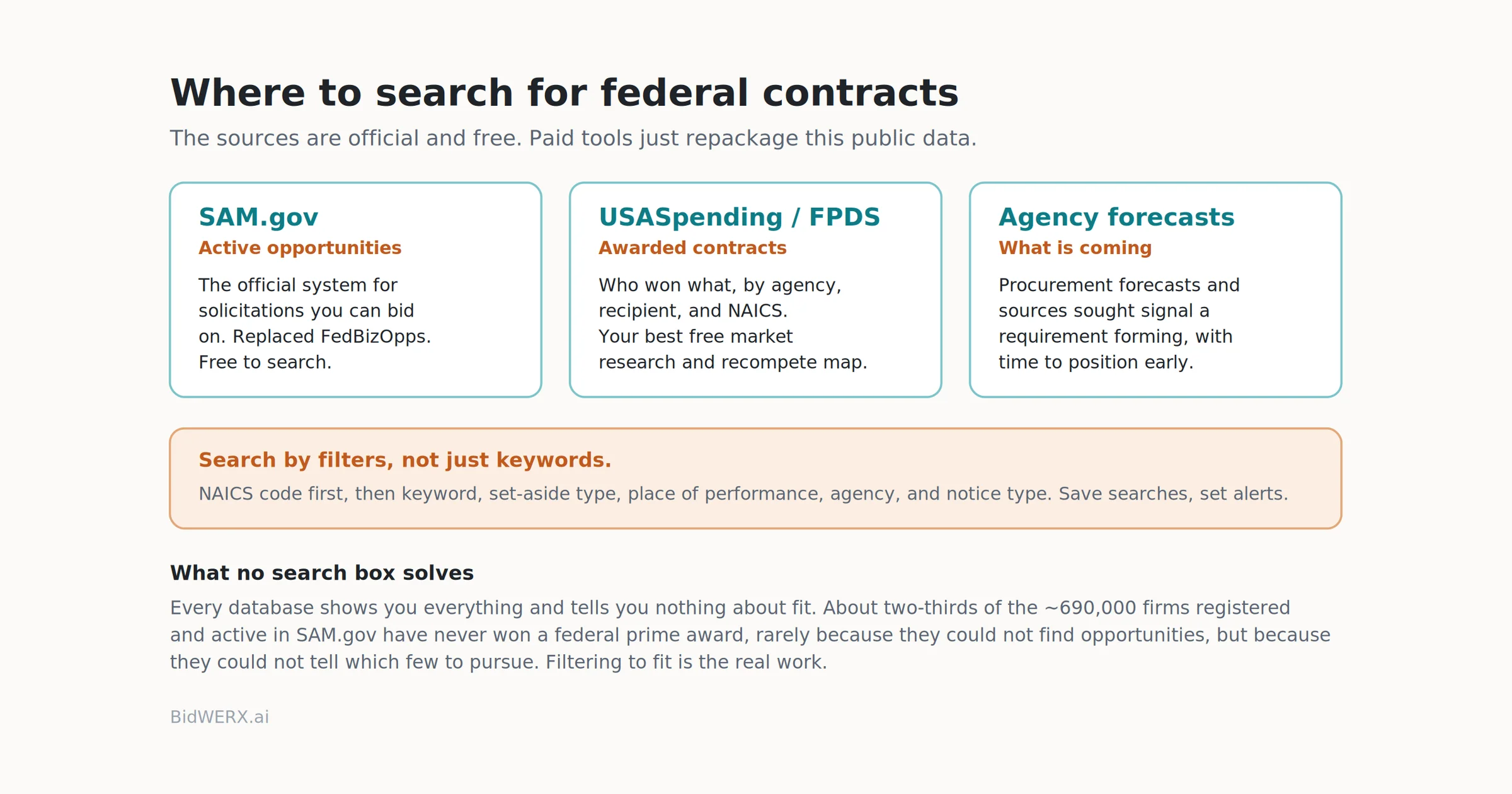
Where does the pipeline come from? Some of it is public. SAM.gov carries active federal opportunities, sources sought notices, and pre-solicitation notices, and Grants.gov carries federal grant opportunities if that is your world. Watching those tells you what is coming. But the best entries on a small team's pipeline usually do not start as a posted opportunity at all. They start as a conversation, a recompete you heard about, a program you already support on someone else's contract. The posted notice, when it comes, confirms what you already knew.
Two practical notes. First, keep the pipeline short. It is better to have eight opportunities you actually understand than forty you skimmed. Second, review it on a schedule, not when you feel like it. A pipeline that only gets looked at when a proposal is due is a pipeline that will always surprise you.
If you want a fuller walkthrough of the mechanics from finding a notice through submission, see How to Bid on a Federal Contract, Step by Step.
The bid/no-bid decision: three questions
This is the decision that shapes everything else, so it deserves the most care. Every hour spent writing a proposal you were never going to win is an hour stolen from one you could have. For a small team with no bench, that trade is brutal. The bid/no-bid gate is how you protect the hours.
I find it useful to run every serious opportunity through three questions, in order. If the answer to any one of them is a clear no, you stop.
Can we win it? Not "can we do the work," which is a different and much easier question. Can we win it, against the field that will actually show up. Look at who holds the incumbent contract if there is one, because incumbents win recompetes at a high rate for reasons that have nothing to do with the paper. Look at whether the requirement was shaped by someone else, which you can often infer from how specific and how tilted the solicitation reads. Look at whether you are known to this customer at all. If the first time the buyer will hear your name is on the cover of your proposal, you are probably not winning.
Should we want it? A winnable contract can still be a bad one. Check the margin. Check whether the work fits the direction you are trying to grow, or whether it pulls you sideways into something you will regret staffing. Check the terms and the risk. A fixed-price contract on scope you do not fully understand can lose you money on a win. Wanting the revenue is not the same as wanting the contract.
Can we deliver it? If you win, can you actually perform, on the schedule, at the price, with the people you can realistically hire or already have. Overpromising to win and then failing to deliver is worse than losing, because it costs you the past performance record you need for the next ten pursuits. Be honest about capacity here, especially staffing, which is where small firms most often get caught.
Notice what these questions do together. The first is about the competition. The second is about your strategy. The third is about your capacity. An opportunity has to clear all three, and most will not. That is the point. A healthy no-bid rate is a sign the gate is working, not a sign you are timid.
For eligibility specifically, some of this you can gate mechanically. If a contract is set aside for a socioeconomic category you do not hold, no amount of capability changes the answer. Set-aside status is a hard eligibility line, not a preference, and it is worth checking first because it can end the analysis in thirty seconds. Inside BidWERX, FitScore treats set-aside as exactly that kind of hard gate against your SAM.gov registration, so an opportunity you are not eligible for does not clutter your read. FitScore is a fit signal, not a prediction of who wins.
I have written a longer piece on structuring this decision, with the questions broken out further, at The Bid/No-Bid Decision: Three Questions to Ask Before You Write a Word.
This is also where BidWERX Go/No-Go earns its place. It does not tell you whether to bid, and it does not put a probability on the outcome. What it does is structure the decision, so the same questions get asked every time and the answers sit in one place instead of in three people's heads. The opportunity data it works from is drawn from SAM.gov and updated automatically each day, so you are deciding against current information rather than a notice someone pasted into an email last week. Go/No-Go is available on the Team Starter tier and up after your trial, and every trial account gets full access for fourteen days, which is enough time to run it against a few real opportunities and see whether the discipline sticks.
Calculating and improving your win rate
Most small firms cannot tell you their win rate. They have a rough feeling, usually more optimistic than the record. The first improvement is simply measuring it, because you cannot manage a number you do not track.
The basic calculation is straightforward. Win rate is the number of awards you won divided by the number of decided bids you submitted, over some period. If you submitted twelve proposals last year and won three, your win rate is 25 percent. Count only decided bids, so exclude ones still pending award, and be consistent about the window you measure.
That single number is useful, but it hides things. Two others are worth tracking alongside it. Capture rate, which is wins divided by dollars pursued rather than count, tells you whether your wins are the big ones or the small ones. And your no-bid rate, the share of identified opportunities you chose not to pursue, tells you how selective the gate really is.
Now the part that surprises people. The fastest way to raise your win rate is usually to bid less. Here is the logic. Your team has a fixed number of good proposal hours in a quarter. If you spread those hours across eight pursuits, each proposal is thin and the two or three you actually had a shot at get shortchanged. If you spend the same hours on four pursuits you genuinely can win, each one is stronger and your rate climbs. You did not get better at writing. You stopped diluting your effort across bids you were going to lose anyway.
This is where that first-party number is worth sitting with. About two-thirds of the nearly 690,000 firms registered and active in SAM.gov have not won a single federal prime award in the last thirteen years (FY2014 to FY2026). Registration is not a pipeline, and activity is not a win. A very large share of the field is submitting, or not even submitting, into a void. The firms that win are not the ones bidding the most. They are the ones bidding the ones they should.
So improving win rate is mostly a discipline problem, not a skill problem. Pursue less. Pick better. Debrief every loss and read the feedback honestly, because the government will often tell you why you lost if you ask. Then feed that back into the bid/no-bid gate so the next round of decisions is sharper. The full method, including how to run useful debriefs, is in How to Calculate and Improve Your Federal Win Rate.
Teaming: how to find and vet partners
There is work a small firm cannot win alone. The contract is too large, or it needs past performance you do not have, or it spans capabilities outside your lane. Teaming is how you reach that work. You join with other companies, one prime and one or more subs, and you bid as a group. Done well, it turns a contract you had no chance at into one you can credibly pursue. Done badly, it costs you money, time, and sometimes your reputation with the customer.
Two structures cover most of it. A prime-subcontractor arrangement, where one company holds the contract and the others work under it, is the common case. A joint venture, where two or more firms form a distinct entity to bid together, is more formal and shows up often with the SBA's programs for small business joint ventures. Which one fits depends on the size of the work, the set-aside, and how much of the effort each firm brings.
Finding partners is the first problem. Small firms tend to team with whoever they already know, which is fine until your network runs out of the capability you need. Broadening the search is where a lot of good teams get made, and it is what the BidWERX Partner Network is built for. It handles discovery and matching, surfacing potential teaming partners whose capabilities, set-asides, and history fit the gap you are trying to fill, so you are not limited to the handful of firms already in your phone. Partner Network is available on the Org Starter tier and up.
Vetting is the harder problem, and the one people skip. A capability deck tells you what a company says it can do. It does not tell you whether they deliver on time, whether they bill cleanly, or whether they will fight you over scope the moment the contract gets hard. Before you put a partner in a proposal, check a few things. Look at their real past performance, not the logos on their website, and if you can, call a customer they served. Confirm the contract vehicles and certifications they claim to hold, because those are checkable facts and people fudge them. Talk through how decisions and disputes will get handled before there is a dispute, so you learn how they negotiate while the stakes are still low. And get the teaming agreement in writing, with work share and roles spelled out, before you submit.
One more thing, because it is easy to forget under deadline. The customer often knows your partners already, for better or worse. A sub with a bad reputation at that agency can sink an otherwise strong bid. Reputation travels in this market, so treat a partner's standing with the customer as part of the vetting, not an afterthought.
The deeper version of all this, including a vetting checklist and the questions to ask a reference, is at How to Find and Vet Teaming Partners for Federal Contracts.
Capture: shaping before the solicitation
Capture is the work between "we want this" and "the RFP is out." It is where a pursuit is won or lost, and it is the part small teams most often underinvest in because it does not feel like progress. There is no document due. Nobody is waiting on you. So it slips, and then the solicitation drops and you are starting cold.
The goal of capture is to make the eventual proposal a formality. You want the customer to know you, to see you as low-risk, and ideally to have your understanding of the problem already reflected in how they write the requirement. None of that is improper. The government wants informed competition, and industry engagement before a solicitation is normal and expected, within the rules. The rules matter, so stay on the right side of them, but do not mistake caution for a reason to hide.
Concretely, capture on a specific opportunity looks like this. You identify the buyers and influencers, the program office and the contracting shop. You get in front of them through the legitimate channels, which include sources sought responses, requests for information, industry days, and one-on-one meetings when they are offered. You use those touchpoints to understand the problem better than your competitors do and to demonstrate that you understand it. You figure out your teaming while there is still time to choose partners rather than settle for whoever is left. And you develop a rough solution and price so that when the solicitation lands, you are refining rather than inventing.
For a small team, the honest constraint is that you can only run real capture on a few opportunities at once. That is fine. It is another argument for a short pipeline. Two or three well-captured pursuits will beat ten cold ones almost every time.
A word on sources sought and RFI responses, since they are the cheapest capture tool available and small firms leave them on the table. When an agency posts a sources sought notice, it is asking the market who can do the work, often to decide whether to set the eventual contract aside for small business. Responding well does two things. It puts your name and capability in front of the buyer months early, and it can influence whether the requirement gets structured in a way that favors firms like yours. Skipping them means you are absent from exactly the conversation that shapes the deal.
A lightweight weekly BD cadence for a small team
All of the above is useless if it only happens when a proposal is due. The firms that do BD well have a rhythm, and the rhythm does not need to be heavy. For a small team, a couple of hours a week, held consistently, beats a frantic push every quarter. Here is a cadence that works without a dedicated BD staff.
Weekly, about ninety minutes. Review the pipeline. Move items between stages honestly and kill the ones that have gone stale. Check what is new on SAM.gov, and Grants.gov if grants are in your mix, against your focus areas. Look at what is coming up for a decision and make sure someone owns the next step on each active pursuit. This is also when you run the bid/no-bid gate on anything that has ripened enough to decide. Keep it short. The discipline is in doing it every week, not in doing it for three hours once a month.
Monthly, about half a day. Step back from the individual opportunities and look at the whole. Is the pipeline balanced, or is everything landing in the same quarter? Are you actually running capture on the pursuits you said you would, or have they quietly gone cold? Do a relationship check: which customers have you not talked to in a while, and which industry events or meetings are worth attending in the next month? This is also a good time to look at your win rate and no-bid rate over the trailing period and ask whether the gate is doing its job.
Quarterly, a longer session. Review what you won and lost, and read the debrief feedback with the whole team. Decide whether your focus areas are still right, or whether the market is telling you to shift. Reset the pipeline against where you actually want to grow.
The trick with cadence is protecting it. It is the first thing that gets dropped when delivery work gets busy, and dropping it is exactly how firms end up back in react mode, scrambling on every RFP. Put the weekly review on the calendar as a real recurring meeting, give it an owner, and hold it even in weeks when nothing seems to be happening. Especially those weeks, because the quiet stretches are when positioning is built.
None of this requires a large team or expensive tooling. It requires a short pipeline you keep current, a bid/no-bid gate you actually enforce, a habit of capture on the few pursuits that matter, and a weekly hour to keep the whole thing honest. Do those four things consistently and you will be ahead of most of the field, which, as the numbers show, is not doing them at all.
About the author
Jon Selvaraj is an operator and co-founder of BidWERX. He spent close to thirty years across federal contracting and Big Four consulting before building BidWERX, an intelligence layer that helps small government contractors decide what to pursue and who to team with. He writes about the parts of GovCon business development that do not fit on a capability slide.
Last updated: October 6, 2026.
Ready to make your bid/no-bid decisions with current data and a structure you run every time? Start a free 14-day trial of BidWERX and put Go/No-Go against a few real opportunities.
How is federal business development different from sales?
Sales in most markets is about finding a buyer and closing them, often quickly. Federal BD runs on a long timeline and is governed by public rules, so most of the deciding work happens before you are allowed to submit a price. It is closer to positioning your company to win a specific requirement, months out, than to closing a deal in a quarter. The relationship and the shaping matter more than the pitch.
When should a small business start business development on an opportunity?
As early as you hear about the need, which is often well before any solicitation posts. Watching sources sought and pre-solicitation notices on SAM.gov gives you a head start, but the earliest signal usually comes from a conversation or a recompete you know is coming. By the time the RFP is public, the shaping is largely done, so starting then means starting behind.
What is a good win rate in GovCon?
There is no single right number, because it depends on how selective you are and what you count. A firm that bids everything will have a low rate, and a firm that bids only what it can win will have a higher one on far fewer submissions. The more useful question is whether your rate is improving as you get more selective. If bidding less is raising your rate, the discipline is working.
Do I need teaming partners to win federal contracts?
Not always. Plenty of small firms win work they can perform alone, especially under set-asides sized for them. You need partners when the work is larger than you can hold, requires past performance you do not have, or spans capabilities outside your lane. When you do team, vet the partner as carefully as you would vet a hire, because a weak partner can cost you the win and the customer relationship.
Can software decide whether I should bid?
No, and you should be wary of anything that claims to. A tool can structure the decision, keep your opportunity data current, and check hard eligibility rules like set-aside status, which is what BidWERX Go/No-Go and FitScore do. What it cannot do is tell you the outcome or make the call for you. The judgment about whether you can win, should want it, and can deliver stays with you.
Where does the opportunity data come from?
For federal contracting, BidWERX works from SAM.gov, and the data is updated automatically each day so you are deciding against current notices rather than stale ones. Grants.gov covers the grant side if that is your world. FitScore and Go/No-Go operate on that SAM.gov data.