By Jon Selvaraj, co-founder of Vista TechWerx and builder of BidWERX. Last updated August 2026.
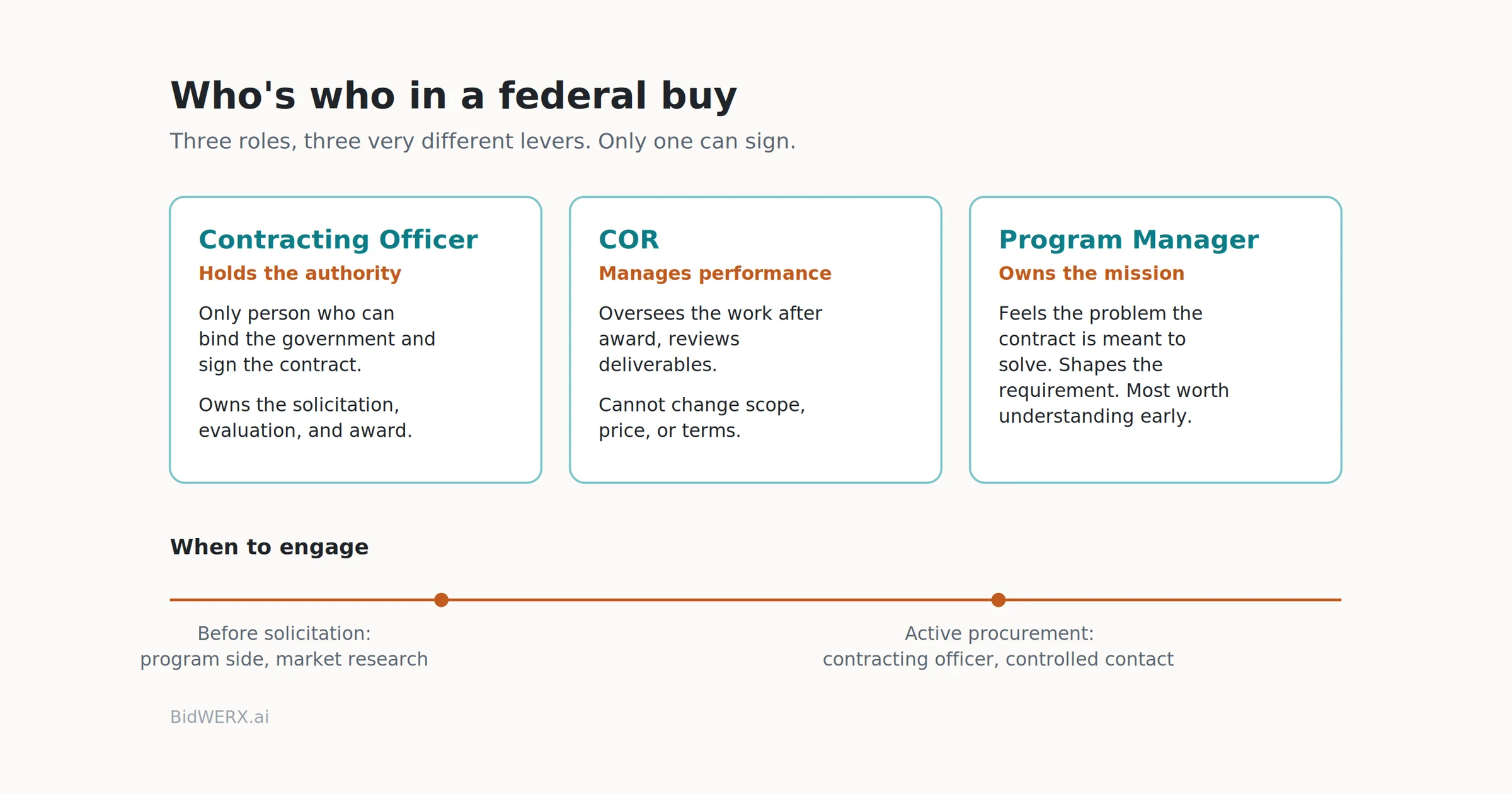
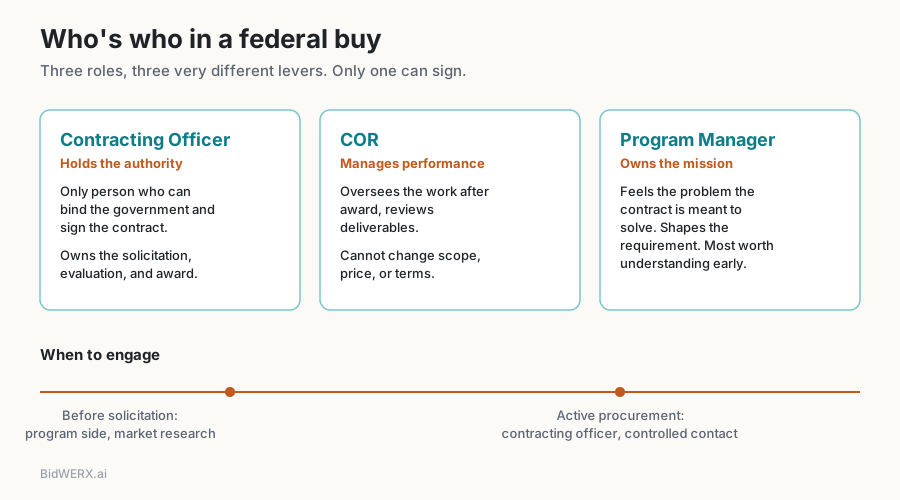
Quick answer: In a federal buy, the contracting officer (CO) is the only person with legal authority to obligate the government and sign the contract. The contracting officer's representative (COR) manages day-to-day technical performance after award but cannot change the contract. The program manager (PM) owns the mission and the requirement. You build a relationship with the program side early, during market research, and you follow the CO's rules once a solicitation is active.
Key takeaways
- Only the contracting officer can bind the government. A promise from anyone else, however senior, is not a commitment you can rely on.
- The COR runs technical oversight after award, but has no authority to change scope, price, or terms. That still runs through the CO.
- The program manager or requirement owner is who feels the mission problem, and the person most worth understanding early.
- Timing matters as much as the org chart. Before a solicitation, relationships are appropriate. During an active procurement, contact rules tighten.
If you are new to federal work, the cast of people around a single contract is confusing, and it is easy to spend your energy talking to the wrong one. A program manager can love your solution and still not be able to buy it. A contracting officer can be ready to award and still be waiting on a requirement someone else owns. Knowing who holds which lever tells you who to build a relationship with, and when.
Why this matters before you write anything
The point of understanding these roles is not trivia. It is where your business development time goes. Federal buys are won or lost long before the solicitation drops, in the period when the government is still shaping what it needs. If you spend that window talking to the wrong person, or treating everyone as if they can make the same decisions, you waste the one part of the process where a small firm can actually move the outcome.
The contracting officer (CO): the only signature that counts
The contracting officer is the person with a warrant, a documented authority to obligate government funds up to a certain dollar threshold. That is the whole point of the role. No one else can commit the government to a contract. Not the program manager, not a general, not a senior executive who tells you in a meeting that they want you on the job. If it is not from the CO, in writing, it is not a commitment.
The CO owns the integrity of the process: the solicitation, the evaluation, the award, and any changes after. During an active procurement, the CO is often your single authorized point of contact, and questions go through them in a controlled way, usually in writing so every offeror gets the same answer. This can feel cold. It is not personal. It is the rule that keeps the competition fair, and respecting it marks you as a firm that knows how to operate.
The contracting officer's representative (COR): day-to-day, but no checkbook
After award, the CO cannot personally watch every contract in their portfolio. The COR is the technical eyes and ears, delegated by the CO to monitor performance, review deliverables, and confirm the work meets the requirement. If you win, the COR is who you talk to most.
Here is the limit that trips people up. The COR manages performance, but the COR cannot change the contract. Not the scope, not the price, not the schedule, not the terms. If a COR tells you to do work beyond the contract, that is not a valid change, and doing it on that say-so can leave you unpaid. Real changes come from the CO, in writing. A good relationship with your COR is essential to delivery. It is not a substitute for the CO's authority.
The program manager (PM): the mission owner
The program manager, or the requirement owner, is the person who actually has the problem the contract is meant to solve. They own the mission, the technical outcome, and usually the budget justification behind the requirement. They are the ones who feel the pain when a capability is missing, and the ones who will live with whatever gets bought.
For a small firm, the PM is often the most valuable person to understand, because they shape the requirement. Early, before a solicitation exists, this is where legitimate market research happens: the government wants to know what industry can do, and you want to understand what they actually need. That is an appropriate, expected conversation. The PM cannot award you anything, but a requirement written by someone who understands your capability is worth more than any proposal trick later.
Who to engage, and when
The pattern is about timing. Early, during market research and before a solicitation, the program side is open for legitimate discovery, and this is where a small firm earns its position. Respond to sources sought and requests for information. Ask about the mission, not the award. Once a solicitation is active, the window shifts: the CO becomes the controlled channel, contact rules tighten, and the relationships you built earlier do their quiet work through a stronger, better-targeted proposal. What is off-limits during an active procurement is trying to route around the CO to lobby the evaluators. That does not help you, and it can disqualify you.
Where this leaves a small firm
Knowing who buys is step one. Knowing which buys are worth your limited time is step two, and it is the harder one. You can map every CO, COR, and PM in your target agency and still lose the year by chasing opportunities that were never a fit for your firm. That is the problem BidWERX Find is built for: it surfaces the opportunities that match your firm, and FitScore gives you a relative read on how well each one fits, so the relationship-building you do goes toward the buys worth pursuing. FitScore is a relative fit indicator to help you prioritize, not a prediction that you will win. If you want to see which opportunities fit your firm, you can start a free BidWERX trial.
Jon Selvaraj is the co-founder of Vista TechWerx and the builder of BidWERX, a readiness and decision tool for small firms pursuing federal work. He writes about the operating discipline behind winning government business.
Related reading: how to register in SAM.gov · how the defense budget cycle (PPBE) decides when you'll win.
Frequently Asked Questions
What is the difference between a contracting officer and a COR?
The contracting officer (CO) has legal authority to sign the contract and obligate government funds. The contracting officer's representative (COR) is delegated by the CO to oversee technical performance after award, but cannot change the contract's scope, price, or terms. Put simply, the CO holds the authority and the COR handles day-to-day oversight.
Who actually makes the decision on a federal contract?
The contracting officer makes the award decision and is the only one who can bind the government. In a best-value procurement, the CO weighs the evaluators' technical ratings against price, but the signature and the legal authority are the CO's. Program managers and evaluators inform the decision; they do not make the award.
Can I talk to the program manager before a solicitation comes out?
Yes, and you should. Before a solicitation is active, market research is a normal, expected part of the process. Responding to sources sought notices and requests for information, and asking about the mission, are all appropriate. Once a solicitation is active, contact typically routes through the contracting officer under stricter rules.
What happens if a COR tells me to do work outside the contract?
Be careful. A COR cannot authorize changes to the contract, so work performed on a COR's instruction alone, beyond the agreed scope, may not be reimbursed. If you are asked to do something outside the contract, get direction from the contracting officer in writing before you do it. Valid changes always come from the CO.