By Jon Selvaraj
Quick answer: Federal evaluators reward what the solicitation asks for, in the order it asks. They score your response against published criteria, not against your idea of a good offer. The work that wins points is responsive, compliant, persuasive on the stated factors, and low risk to the government. Everything else is noise.
Key takeaways
- Evaluators are graders working from a rubric they did not write for you. Your job is to make their job easy, not to impress them.
- Almost everything that decides an award is published in the solicitation, usually in Sections L and M. Read those before you write a word.
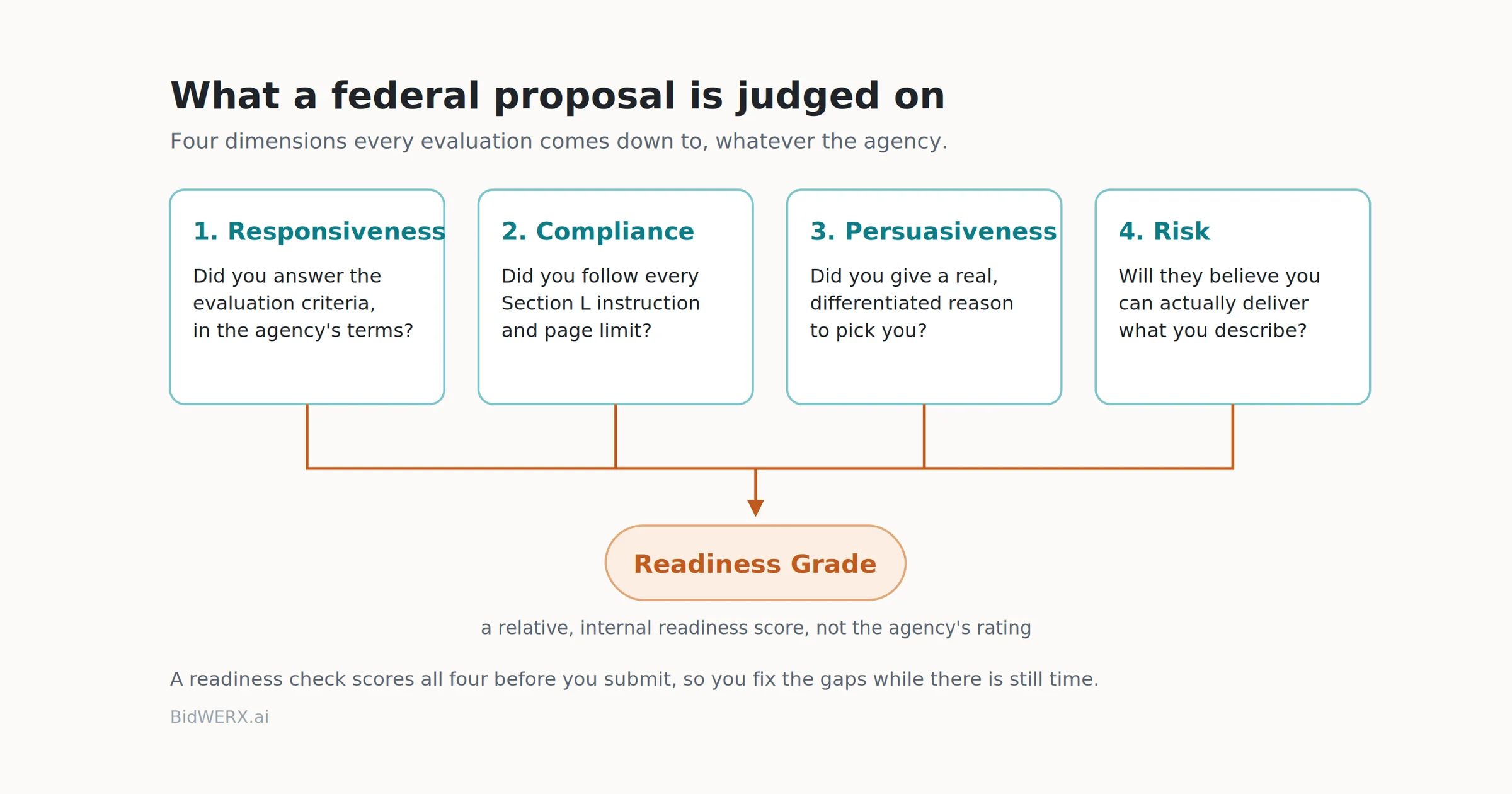
- Four things carry the score: responsiveness, compliance, persuasiveness on the stated factors, and risk to the government.
- Small firms lose more points to non-compliance and vague claims than to weak ideas. The idea is often fine. The response does not prove it.
- Grants, contracts, and SBIR/STTR all reward different things. Reading a grant like a contract, or the reverse, costs you points you will never get back.
Start with the scorecard, not the story
Most losing responses fail for a simple reason. The writer told the story they wanted to tell instead of answering the questions the government asked.
An evaluator is not reading your response the way you read a novel. They are working through a scorecard, section by section, looking for the specific things the solicitation told them to look for. When they cannot find one of those things, or have to hunt for it, you lose a point. When they find something you were not asked for, it does not earn credit. It just slows them down.
So the first move is not writing. It is understanding the scorecard. In a federal solicitation, the scorecard is not a secret. It is written down, usually in the evaluation factors. Your entire response should be built to earn against those factors, in the order and weight the government assigned them.
This is the mental shift that separates firms that win from firms that keep bidding and losing. You are not selling. You are being graded. Write for the grader.
The four dimensions evaluators actually score
Different agencies use different words, but the underlying judgments come down to four questions an evaluator is asking about your response.
Responsiveness: did you answer the question that was asked?
Responsiveness is whether your response actually addresses the requirement in front of the evaluator. Not a related requirement. Not the requirement from the last solicitation you bid. The one on the page.
This sounds obvious. It is the most common failure I see. A firm has strong past work, so it drops in a capability narrative that describes what it does well, rather than what the solicitation asked for. The evaluator reads it, cannot map it to the stated need, and scores it low. The work was good. The answer was to a different question.
Responsiveness also means answering completely. If a requirement has three parts and you address two of them thoroughly, you have not written a strong response. You have written an incomplete one, and the evaluator has to note the gap.
Compliance: did you follow the rules for how to respond?
Compliance is about form and instruction. Page limits, font size, file format, required attachments, section order, submission method, deadlines. These are the rules in the solicitation for how you must respond.
Compliance failures are the cheapest points to lose and the most avoidable. An over-length volume can be truncated or rejected. A missing certification can make you ineligible before anyone reads your technical approach. A late submission is usually just gone. None of that reflects on the quality of your idea. It reflects on whether you read and followed the instructions.
Evaluators treat compliance as a gate for good reason. If you cannot follow the instructions in a solicitation, that is a signal about how you will follow the terms of a contract. Fair or not, that inference gets made.
Persuasiveness: did you make the strong answer easy to believe?
Persuasiveness is where writing quality matters, but not in the way most people think. It is not about polished prose. It is about proof.
An evaluator rewards claims that are substantiated and specific. "We have deep experience in this area" is a claim with nothing behind it. "We ran the same task for the same customer for three years, at this volume, with these measured results" is a claim an evaluator can score. The second one gives them something to point to when they justify a rating.
Persuasive responses also make the evaluator's job fast. They put the answer where the instructions said it would be. They use the government's own terms rather than inventing new ones. They connect each part of the approach to a stated factor, so the evaluator never has to translate. When a reader has to work to find your strength, some of the credit leaks away.
Risk: what could go wrong if the government picks you?
Risk is the quiet factor that decides close competitions. Evaluators are trained to look for reasons an award might fail to deliver. Unstaffed key roles, an approach that skips a hard step, assumptions that depend on things outside your control, a schedule with no slack. Each of these reads as risk.
You reduce risk by naming it and showing how you handle it. A response that pretends nothing could go wrong reads as naive, and naive is risky. A response that identifies the real risks in the work and shows a credible plan to manage them reads as experienced. That difference moves ratings.
These four dimensions are how the BidWERX Evaluate feature reads a draft response. It reads your Response against the agency's published criteria across responsiveness, compliance, persuasiveness, and risk, then produces a Grade. That Grade is a relative internal readiness indicator, a way to see where your draft is thin before an evaluator does. It is not a prediction of the government's rating, and it is not a win probability. It tells you where to spend your remaining time.
How ratings and scoring actually work
Before you can write to the score, you need to know how the score gets calculated. Federal source selection sits on a range that acquisition people call the best-value continuum. Two ends of that range matter most to a small firm.
At one end is tradeoff, often called best-value tradeoff (FAR 15.101-1). Here the government can pay more for a better response. Price matters, but so do the non-price factors, and the solicitation tells you how they stack up. Sometimes technical factors are significantly more important than price. Sometimes they are roughly equal. The relative importance is stated in the evaluation factors, and it changes how you should invest your effort. If technical merit outweighs price, a rock-bottom price with a thin technical volume is a losing combination.
At the other end is LPTA, lowest price technically acceptable (FAR 15.101-2). Here the government sets a bar for acceptability, and among the responses that clear the bar, the lowest price wins. There is no reward for exceeding the requirement. Gold-plating your approach on an LPTA buy is wasted effort, and it can even hurt you if it drives your price up. On LPTA, the winning strategy is to be clearly, provably acceptable on every factor and then to be competitive on price.
The practical point is that the same response can be smart on one buy and foolish on another. You cannot decide how much to invest in technical differentiation until you know whether the evaluation is tradeoff or LPTA. That is in the solicitation. Read it first.
Ratings themselves usually come as adjectives or colors rather than raw numbers. Outstanding, good, acceptable, marginal, unacceptable, or a color scale that means the same thing. Evaluators assign a rating per factor and write a narrative of strengths, weaknesses, and deficiencies to support it. Understanding what those specific words are worth on this solicitation is part of reading the criteria well. BidWERX Analyze is built for exactly that step. It helps you summarize the solicitation, surface the key questions, and document the evaluation criteria so you are writing to the real rubric instead of your memory of it.
Reading Sections L and M, and the SOW or PWS
Most federal solicitations in the negotiated world follow a standard layout called the Uniform Contract Format (FAR 15.204). Two sections in that format decide almost everything about your response.
Section L is instructions to offerors. It tells you how to respond. Volume structure, page limits, what goes in each volume, formatting rules, submission mechanics. Section L is your compliance checklist. If Section L says the technical volume is limited to twenty pages and must address four subfactors in a stated order, that is not a suggestion.
Section M is evaluation factors for award. It tells you how you will be scored. The factors, the subfactors, their relative importance, and whether the buy is tradeoff or LPTA. Section M is your scorecard.
Read these two together, because they are supposed to line up. A factor named in Section M should have a place to be addressed in the Section L structure. When you build your response outline, build it from L and M at the same time, so every scored factor has a home and every home maps to a score.
Then there is the statement of work. On services it is often a Statement of Work (SOW) or a Performance Work Statement (PWS). The SOW tends to tell you what tasks to perform. The PWS tends to tell you what outcomes to achieve and leaves the how to you, often paired with performance standards you will be measured against. Read the SOW or PWS as the definition of the work, and read L and M as the rules for winning the right to do it. Your technical approach has to satisfy the work document while earning points against the evaluation factors. Those are two jobs, and a good response does both without making the evaluator connect the dots.
Build a compliance matrix before you write
A compliance matrix is the single most useful artifact a small proposal team can build, and it is the one most often skipped.
The idea is plain. You go through the solicitation and pull out every requirement, every instruction, and every evaluation factor into a table. For each row you record where it came from (the section and paragraph), what it requires, who on your team owns it, and where in your response it will be answered. Then you do not stop writing until every row has a location and every location satisfies its row.
This does two things at once. It stops compliance failures, because a missing certification or an unaddressed subfactor shows up as an empty cell before submission rather than after. And it forces responsiveness, because you cannot fill the matrix without answering the actual question in each requirement.
The matrix is also how a small team keeps its head straight under deadline pressure. When three people are writing three volumes, the matrix is the shared source of truth for what still has to be covered. I walk through building one, row by row, in How to Build a Compliance Matrix.
Why small firms lose points
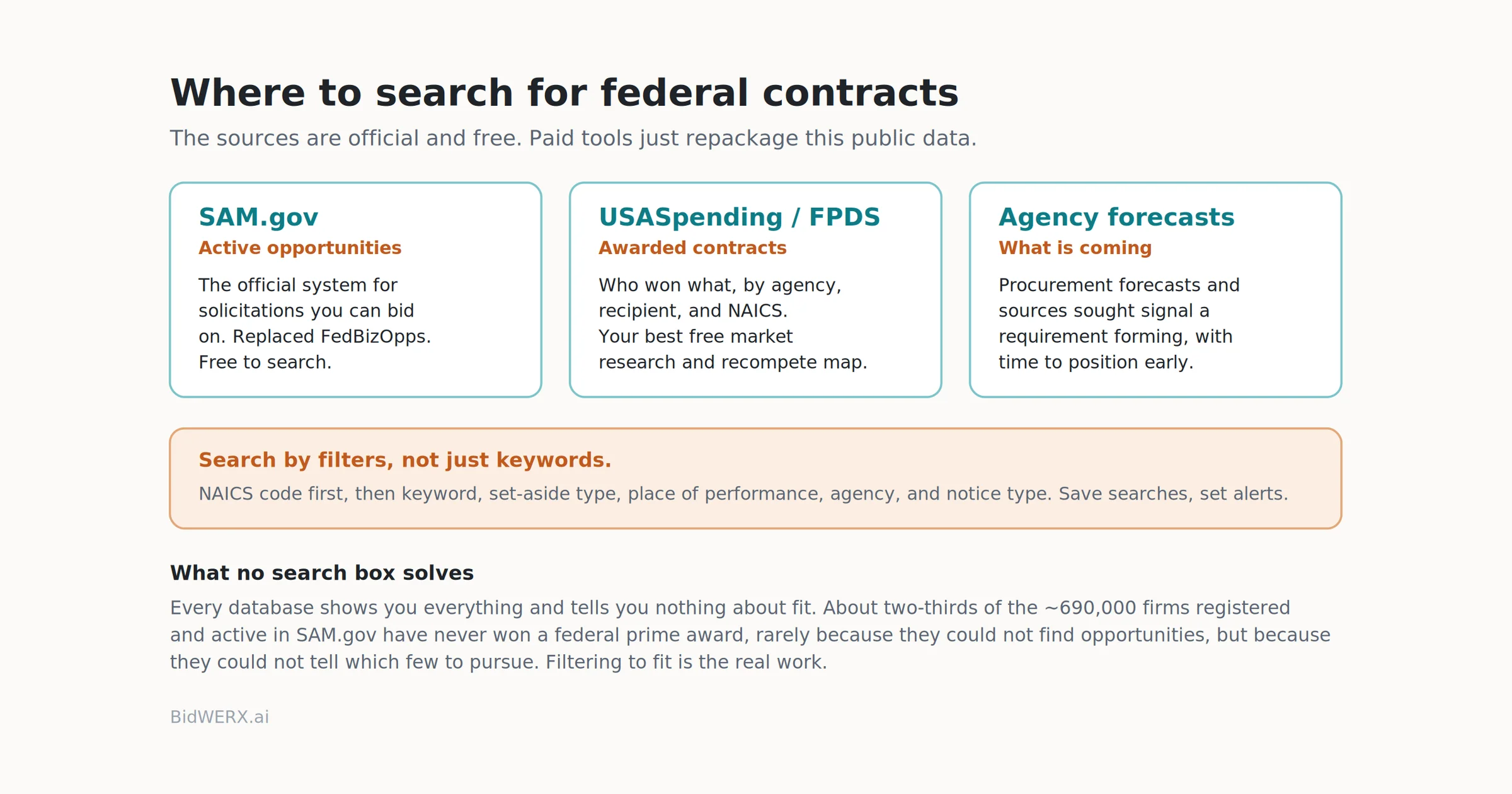
The gap between firms that win federal work and firms that only bid for it is wide. About two-thirds of the nearly 690,000 firms registered and active in SAM.gov have not won a single federal prime award in the last thirteen years (FY2014 to FY2026). Registration is not the hard part. Writing responses that score is.
Here is where I see small firms leave points on the table, most often first.
Answering the requirement they wish they had. A firm reshapes the requirement in its head into something it already does well, then answers that. The evaluator scores the mismatch.
Non-compliance on the boring stuff. Over the page limit, wrong file format, a missing form, a factor addressed out of order so the evaluator cannot find it. These are unforced errors that never touch the merit of the offer.
Claims without proof. "Extensive experience," "proven approach," "highly qualified team." An evaluator cannot score an adjective. Give them a number, a customer, a date, a measured result.
Ignoring the weighting. Pouring effort into a lightly weighted factor while a heavily weighted one gets a thin section. The solicitation told you what mattered. Spend your pages where the points are.
Hiding the answer. The right content is somewhere in the volume, but the evaluator has to dig for it. Buried answers get partial credit at best.
Pretending there is no risk. A flawless plan with no acknowledged risk reads as inexperience. Name the hard parts and show how you manage them.
None of these are about the quality of the underlying idea. That is the frustrating part for good firms. The technical capability is real. The response does not prove it against the scorecard. Running a draft through BidWERX Evaluate before you submit catches several of these, because it grades the draft on the four dimensions and shows you where an evaluator would struggle to give you credit.
How grants differ from contracts
Federal money comes through two very different doors, and they reward different things.
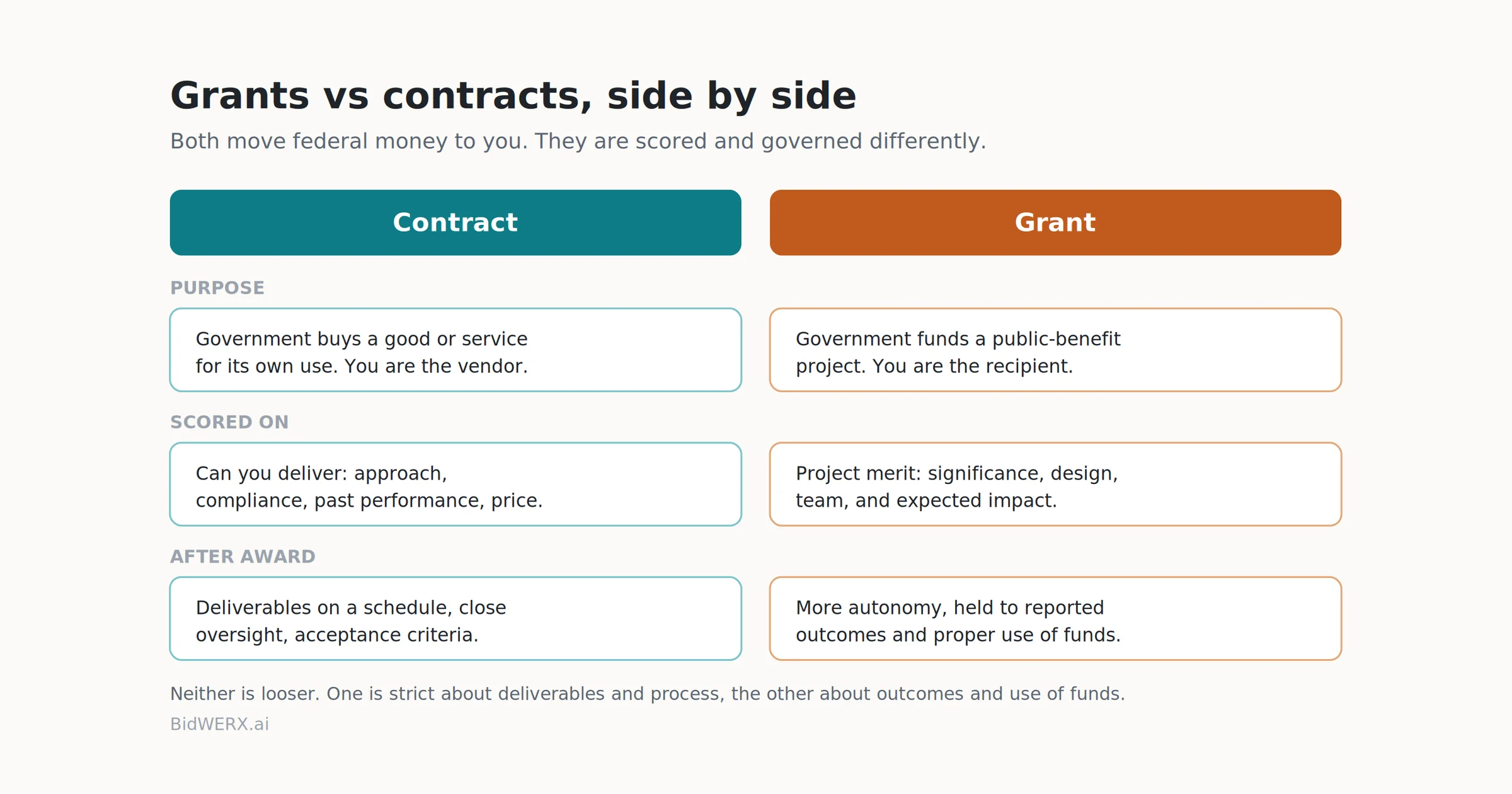
A contract buys a specific good or service for the government's own use, under the FAR, with the government as the customer directing the work. Contract opportunities live on SAM.gov. The evaluation is about whether you can deliver what the government needs, at acceptable risk, at a price it will pay. The language is offers, evaluation factors, and source selection.
A grant (or cooperative agreement) funds work the government wants to see happen in the world, for a public purpose, where you are the one carrying out the project. Grant opportunities live on Grants.gov. The evaluation is about the merit of your project, its impact, your qualifications to run it, and often its broader benefit. The language is applications, review criteria, and merit review, and the reviewers are frequently subject-matter peers rather than contracting officers.
The mistake is writing one as if it were the other. A grant reviewer wants to know why your project matters and whether it will succeed, and a compliance-only, price-driven pitch reads as tone-deaf. A contract evaluator wants to know you can perform the stated work at low risk, and a visionary essay about impact reads as unresponsive. Same firm, same underlying strength, two different documents. I lay out the differences in scoring and expectation, side by side, in Grants vs Contracts: How the Scoring and Expectations Differ.
How SBIR and STTR proposals are evaluated, and how the phases work
SBIR and STTR are worth their own treatment, because the money is real for small firms and the evaluation is different again.
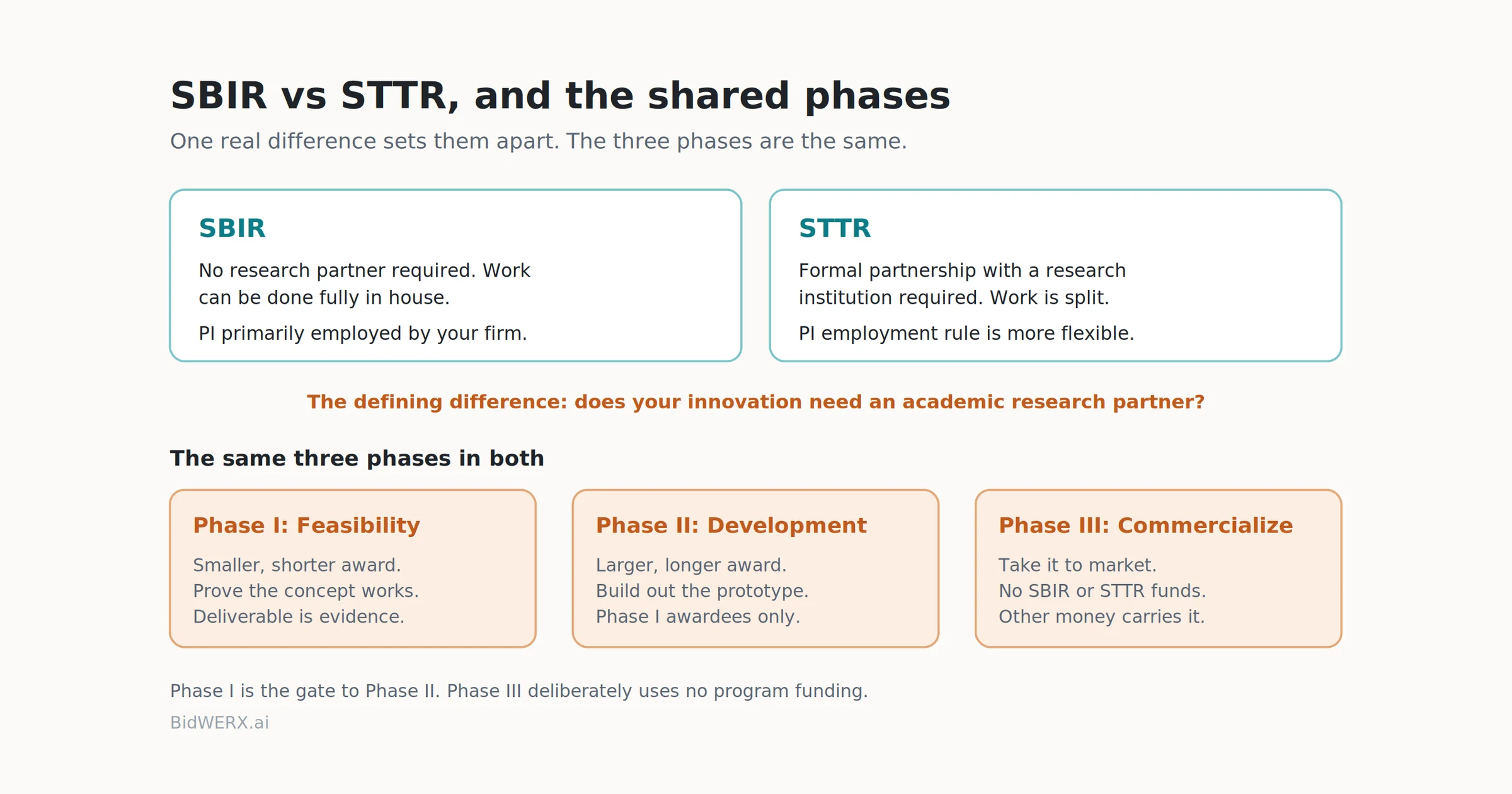
Both programs fund small-business research and development in phases. The two programs are close cousins with one structural difference. Under SBIR, the small business must perform at least two-thirds of the Phase I work itself, and the principal investigator must be primarily employed by the small business. Under STTR, the work is formally split with a research institution, with at least 40 percent performed by the small business and at least 30 percent by the research institution, and the principal investigator can be employed by either the business or the institution. If you have a strong university or lab partner and the science lives partly there, STTR is built for that. If the work sits inside your company, SBIR fits. I compare the two, and the trade-offs, in SBIR vs STTR: Which Fits, and How Phase I, II, and III Work.
The phases work like a funnel.
Phase I is about feasibility. Can the idea work at all? It is a small, short award, usually running six to twelve months, meant to prove the technical merit and the potential. As of April 2026, agencies may issue a Phase I award up to about $323,000 without seeking SBA approval, and many awards sit below that. Reviewers here are scoring the soundness of the technical concept, whether the approach is credible, and whether your team can actually do the work.
Phase II is about development. You take the feasibility you proved and build the prototype or the demonstrated capability. It is larger and longer, commonly around two years, with awards that can reach roughly $2.15 million under the April 2026 guidelines before SBA approval is needed. Phase II proposals are usually only open to firms that succeeded in Phase I, and the evaluation weighs your Phase I results, your development plan, and increasingly your path to commercialization.
Phase III is about commercialization, and it does not use SBIR or STTR funds. The money comes from elsewhere, from an agency's own procurement or R&D budget or from the private sector. Phase III has a feature that surprises people. Because of the work you did in the earlier phases, an agency can award Phase III work to you without further competition, on a sole-source basis, under the program's statute. That is a real advantage, and it is a reason to think about Phase III long before you get there. I explain how that works, and how to set it up early, in SBIR Phase III Explained.
One more distinction trips people up. SBIR and STTR work can arrive as either a grant or a contract, depending on the funding agency, and that changes what the reviewers reward and what your obligations are. It is the grant-versus-contract difference again, inside the SBIR world. I cover it directly in SBIR Grants vs SBIR Contracts.
Across all of this, the reviewer is still asking the four questions. Did you answer what was asked, did you follow the rules, did you prove your claims, and how risky is it to fund you. The vocabulary changes. The judgment does not.
A pre-submission self-check
Before you submit anything, run it against this. None of it requires the government's help, and all of it is the kind of thing an evaluator checks in the first pass.
- Compliance sweep. Is every Section L instruction followed? Page limits, format, order, required forms and certifications, submission method, deadline. Every one.
- Factor coverage. Does every evaluation factor and subfactor from Section M have a clear, findable home in your response? Pull out your compliance matrix and confirm no empty cells.
- Proof pass. Read every claim and ask what an evaluator could point to. If the answer is nothing, add the number, customer, date, or result, or cut the claim.
- Weighting check. Do your strongest, longest sections line up with the most heavily weighted factors? If you spent your best writing on a minor factor, rebalance.
- Risk read. Have you named the real risks in the work and shown how you manage them? A plan with no acknowledged risk needs a second look.
- Cold read. Hand it to someone who has not seen it and ask them to score it from Section M alone. Where they struggle to find an answer, an evaluator will too.
That last one is the highest-value hour you can spend. When you cannot get a fresh reader, BidWERX Evaluate stands in for that cold read. It grades your draft Response against the published criteria across the four dimensions and produces a Grade that tells you where your readiness is thin. Treat the Grade as an internal signal to fix what is weak, not as a forecast of how the government will rate you. It is a mirror, not a crystal ball.
Ready to see where your draft stands?
Reading the criteria and grading yourself against them is work you can do today, on your next response. When you want a faster, structured read on where a draft is thin before an evaluator sees it, BidWERX Analyze helps you understand what the solicitation is really asking, and BidWERX Evaluate grades your draft Response across the four dimensions and gives you a readiness Grade.
About the author
Jon Selvaraj is an operator and co-founder of BidWERX, with about thirty years of work across federal contracting and Big Four consulting. He now builds BidWERX, an intelligence layer that helps small firms read solicitations and self-assess their responses before they submit.
Last updated: September 13, 2026.
How do I find out how my proposal will be scored?
Read the evaluation factors in the solicitation, usually Section M in a standard contract, or the review criteria in a grant announcement. The government tells you the factors, their relative importance, and whether the buy is tradeoff or lowest price technically acceptable. That is your scorecard. Build the whole response to earn against it.
What is the difference between best-value tradeoff and LPTA?
In a best-value tradeoff, the government can pay more for a stronger response, and non-price factors carry real weight. In LPTA, lowest price technically acceptable, the government picks the cheapest response that clears the acceptability bar, and exceeding the requirement earns nothing. The solicitation states which one applies, and it should change how much you invest in technical differentiation.
What makes small firms lose points most often?
Not weak ideas. The usual culprits are non-compliance on formatting and instructions, answering a slightly different requirement than the one asked, and claims with no proof behind them. Evaluators cannot score an adjective, and they cannot give credit for an answer they cannot find. Follow the instructions exactly and substantiate every claim.
How are SBIR and STTR proposals evaluated differently from regular contracts?
Both fund research and development in phases. Phase I proves feasibility, Phase II builds it out, and Phase III commercializes with non-SBIR money and can be awarded sole-source. Reviewers weigh technical merit, your team's ability to do the work, and, increasingly by Phase II, a credible path to commercialization. STTR also requires a formal split of work with a research institution, which SBIR does not.
Do I need to write a grant differently from a contract?
Yes. A contract evaluator wants proof you can deliver the stated work at low risk and acceptable price, so responsiveness and compliance dominate. A grant reviewer wants to know why your project matters and whether it will succeed, so merit and impact carry more weight. Same capability, two different documents. Do not send a contract-style pitch to a grant panel.
Can I check my own draft before I submit?
You can, and you should. Run the pre-submission self-check in this article, and get a cold reader to score your draft from the evaluation factors alone. BidWERX Evaluate does a version of that cold read automatically, grading your draft Response on responsiveness, compliance, persuasiveness, and risk. Use the result to find and fix weak spots, and remember it is an internal readiness indicator, not a prediction of the award.