By Jon Selvaraj, co-founder of Vista TechWerx and builder of BidWERX. Last updated August 2026.
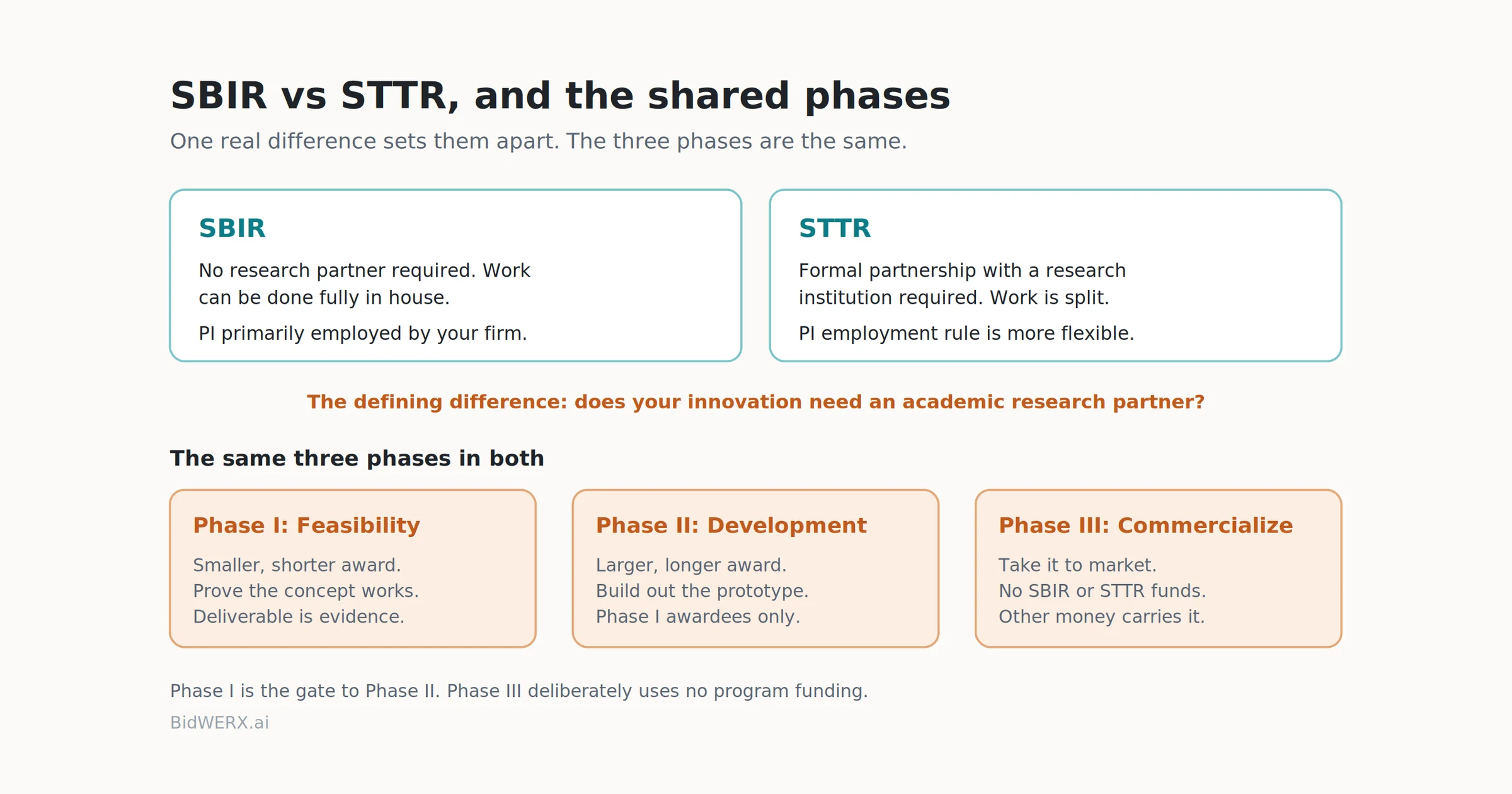
Quick answer: SBIR and STTR are both federal programs that fund small-business research and development. The one real difference is partnering: STTR requires you to formally partner with a research institution (like a university), and SBIR does not. STTR also has looser rules on where the principal investigator can be employed. Both run through Phase I (feasibility), Phase II (development), and Phase III (commercialization, no SBIR/STTR funds).
Key takeaways
- The single defining difference is the research-partner requirement. STTR requires a partnership with a research institution; SBIR does not.
- The principal investigator rules differ too. Under SBIR the PI must be primarily employed by your company; STTR is more flexible, which is what enables the partnership.
- The phases are the same in both: Phase I proves feasibility, Phase II builds it out, Phase III commercializes without SBIR or STTR money.
- STTR is not "SBIR with a university bolted on." If your core innovation depends on academic research, STTR fits. If it lives inside your company, SBIR usually fits better.
SBIR and STTR get lumped together constantly, and for good reason: they share phases, funding logic, and much of the same paperwork. But choosing the wrong one, or misreading how the phases work, wastes a real shot at non-dilutive funding. Here is the difference that actually matters, and how the phases play out.
The one difference that defines the choice
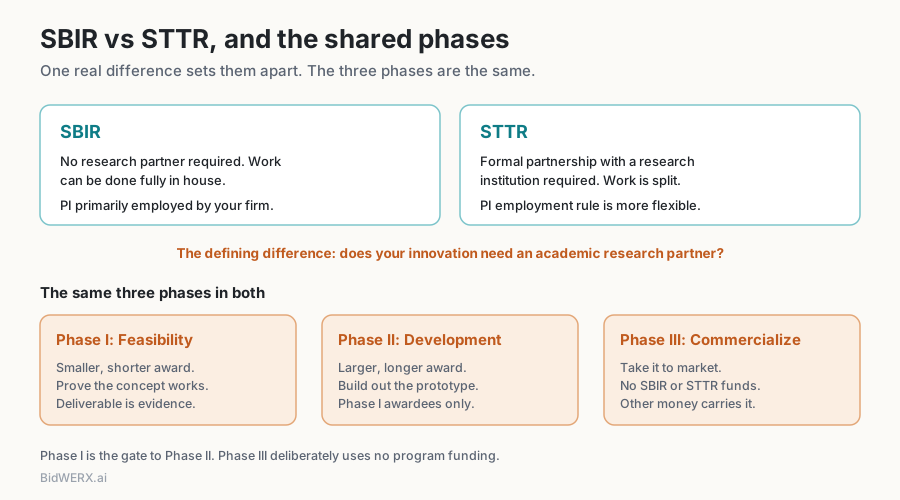
Almost everything about SBIR and STTR is shared. The defining difference is the research partner. STTR (Small Business Technology Transfer) requires your company to formally partner with a research institution, typically a university or a federally funded research center, and to split the work so that a meaningful share is done by each side. SBIR (Small Business Innovation Research) has no such requirement. You can do all the work in house.
Everything else about the choice flows from this. If your innovation genuinely depends on research capability that lives in a university lab, STTR is built for exactly that hand-off from academic research to a commercial product. If your innovation lives inside your own company and you do not need an academic partner, SBIR is usually the cleaner fit, because you avoid the overhead of structuring and managing a formal partnership.
The principal investigator rule
The second difference follows from the first. The principal investigator (PI) is the person who leads the technical work. Under SBIR, the PI generally must be primarily employed by your small business at the time of award and for the duration of the project. Under STTR, that primary-employment requirement is relaxed, which is what allows a university researcher to serve as, or work closely with, the PI. If your best technical lead sits at a university rather than on your payroll, that flexibility is a reason STTR may fit. If your PI is your own employee, SBIR's rule is no obstacle.
The phases, in plain English
Both programs run the same three-phase structure.
Phase I is feasibility. A smaller award over a short period to prove the concept has technical merit and is worth pursuing. The deliverable is evidence, not a finished product. The goal is to answer "does this actually work" convincingly enough to justify Phase II.
Phase II is development. A larger award over a longer period to build out the prototype or technology, based on the Phase I results. This is where the real R&D happens. Only Phase I awardees are generally eligible to compete for Phase II on the same topic, so Phase I is the gate.
Phase III is commercialization. This is the part newcomers miss: Phase III uses no SBIR or STTR funds. It is where you take the technology to market, whether through a follow-on government contract funded by other money, or commercial sales. The program is designed to walk you to the edge of a market and expects you to cross it on other funding.
Which one fits your setup
Reduce it to a few honest questions. Does your core innovation require research capability you do not have in house, of the kind a university provides? If yes, STTR fits the structure. Is your PI your own employee, or would your best technical lead be an academic? SBIR wants an in-house PI; STTR allows the academic. Do you want the overhead of managing a formal research partnership, or would you rather move faster alone? Partnerships add coordination cost, and that cost is only worth paying when the partner brings capability you truly need.
Common misreads
A few traps catch new applicants. Treating STTR as "SBIR plus a university" and adding a token academic partner you do not need, which adds overhead for no benefit. Assuming Phase III comes with funding, when it deliberately does not. And underestimating the commercialization expectation: both programs increasingly weight whether you have a credible path to a real customer, not just good science. Reading a specific solicitation carefully, against your actual setup, beats assuming the two programs are interchangeable.
Reading a specific solicitation's fit
The choice between SBIR and STTR is structural, but the harder question is whether a specific solicitation fits your company at all: the topic, the eligibility, the commercialization expectation, and the competitive field. That is where a readiness check and a fit read help. BidWERX Evaluate structures a readiness check on the response you would submit, against the criteria the solicitation sets. For contract-based SBIR and STTR opportunities on SAM.gov, FitScore adds a relative read on how well the opportunity fits your firm. FitScore is a relative fit indicator to help you prioritize, not a prediction that you will be awarded. If you want to weigh a specific SBIR or STTR pursuit against your firm, you can start a free BidWERX trial.
Jon Selvaraj is the co-founder of Vista TechWerx and the builder of BidWERX, a readiness and decision tool for small firms pursuing federal work. He writes about the operating discipline behind winning government business.
Related reading: grants vs contracts: how the scoring and expectations differ · what federal evaluators actually reward.
Frequently Asked Questions
What is the main difference between SBIR and STTR?
The main difference is the research partner. STTR requires your small business to formally partner with a research institution, such as a university, and to divide the work between you. SBIR has no partnering requirement, so you can do all the work in house. The principal investigator employment rules also differ, with STTR being more flexible.
Do I have to partner with a university for SBIR?
No. SBIR has no research-partner requirement, so you can perform all the work within your own company. The mandatory partnership with a research institution applies to STTR, not SBIR. If your innovation does not need academic research capability, SBIR avoids the overhead of structuring a formal partnership.
What are the three SBIR/STTR phases?
Phase I proves feasibility with a smaller, shorter award. Phase II develops the technology further with a larger, longer award, and is generally open only to Phase I awardees on the same topic. Phase III is commercialization, taking the technology to market, and it uses no SBIR or STTR funds. Both programs share this three-phase structure.
Does Phase III come with funding?
No, and this surprises many applicants. Phase III is the commercialization stage and deliberately uses no SBIR or STTR dollars. You reach the market through other means, such as a follow-on contract funded by other money or commercial sales. The programs are designed to fund the research and prototype, then expect you to commercialize on other funding.