By Jon Selvaraj, co-founder of Vista TechWerx and builder of BidWERX. Last updated August 2026.
Quick answer: To find teaming partners, start with the specific gap a solicitation exposes, then search past performance records, industry events, agency awardee lists, and your own network for firms that fill it. Vet each on three things: capability (can they do the work), credibility (do they have the record and standing), and commitment (will they actually show up). Document the arrangement in a teaming agreement before you bid, not after.
Key takeaways
- Team for a reason, not for comfort. The right partner fills a specific gap in capability, past performance, or set-aside eligibility.
- Vet on three C's: capability, credibility, and commitment. The third is the one firms skip and the one that sinks bids.
- Decide the prime-versus-sub structure early, because it changes who carries the relationship, the risk, and the revenue.
- Put it in writing before you submit. A handshake teaming arrangement is where past-performance credit and workshare disputes come from.
Teaming is how a small firm competes for work it could not win alone, by combining capabilities, past performance, and eligibility. It is also how a small firm loses a proposal it should have won, when a partner overpromised, underdelivered, or vanished after the bid. The difference is entirely in how you choose and vet the partner. Here is the practical version.
Why team at all
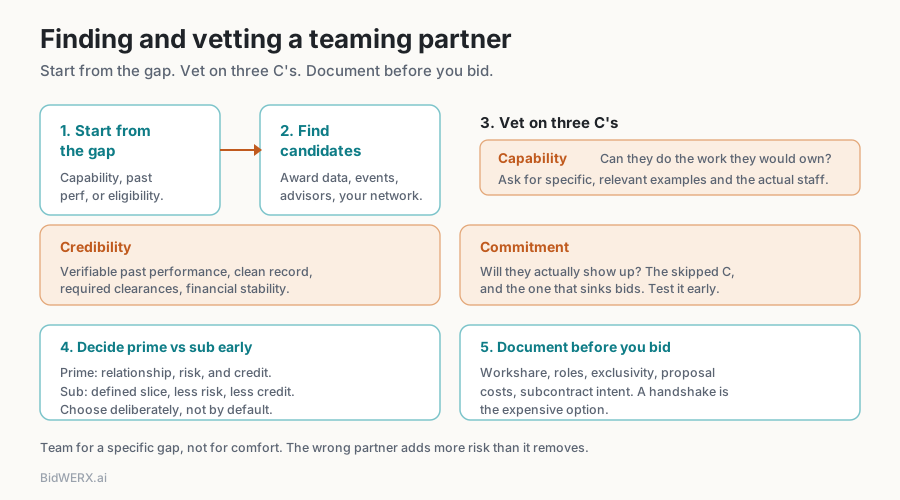
Team when going alone leaves a gap the evaluation will punish. There are three common reasons. The first is capability: the scope requires skills, facilities, or clearances you do not have. The second is past performance: you can do the work but lack the documented record on similar scope that the evaluation demands, and a partner brings that record. The third is set-aside and eligibility math: the structure of the acquisition, size standards, socioeconomic set-asides, or workshare rules, makes a particular teaming arrangement the only way to be both eligible and competitive. If none of these applies, you may not need a partner, and adding one dilutes your margin and your control for no reason.
Where to find partners
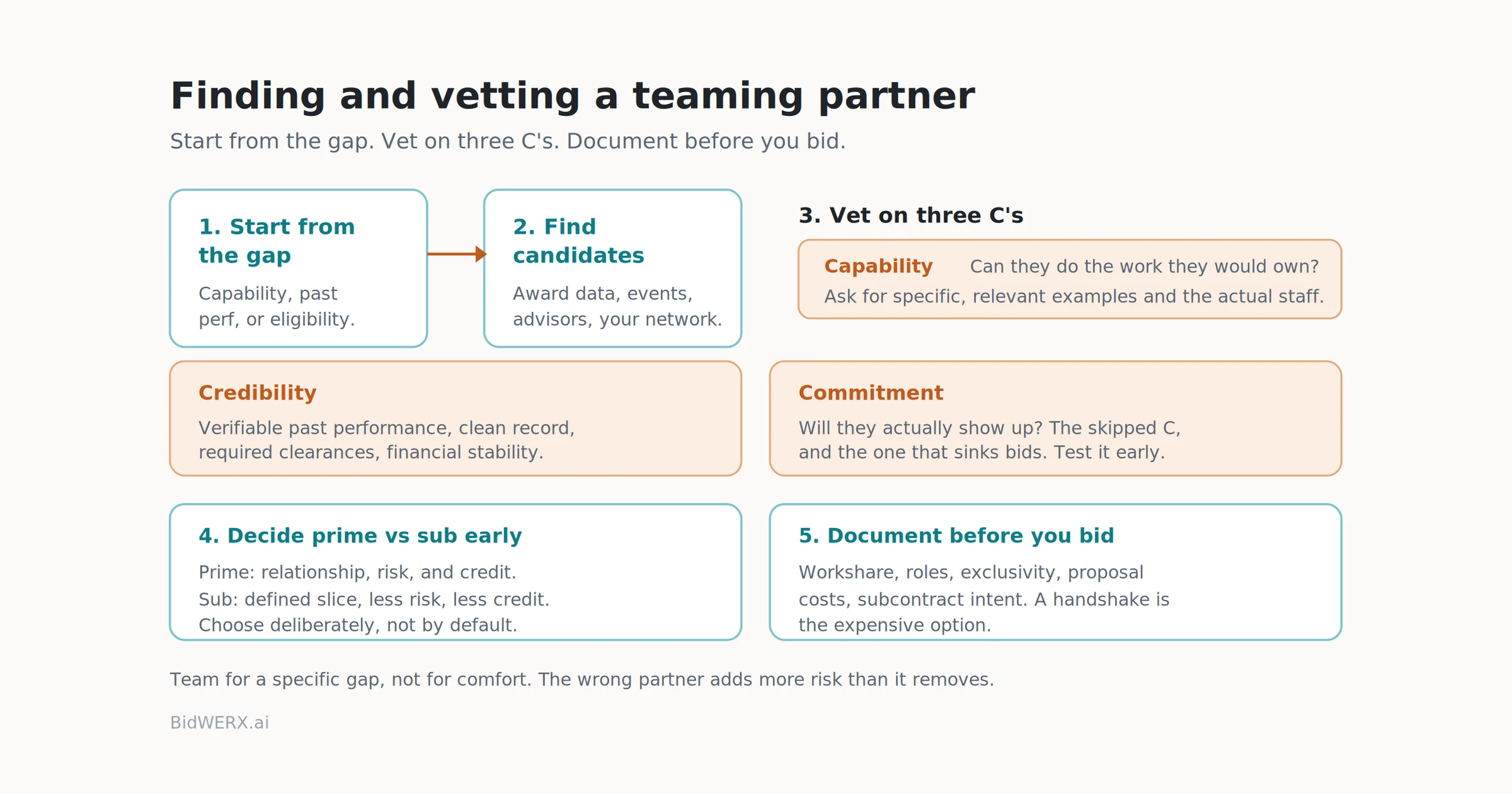
Start from the gap, because it tells you exactly what to look for. Then work the sources. Public award data shows you which firms have won similar work and holds the past performance you might be missing. Agency industry days and matchmaking events exist specifically to connect primes and subs. Small-business offices and APEX Accelerators (formerly PTACs) maintain networks and can make introductions. And your own past collaborators, people you have delivered with, are the highest-signal source of all, because you already know how they work. The goal at this stage is a short list of firms that plausibly fill the gap, not a signed partner.
The vetting checklist: three C's
Vetting is where teaming succeeds or fails, and it comes down to three questions.
Capability. Can they actually do the work they would own, at the quality the evaluation implies? Look past the capability statement. Ask for specific, relevant examples, the people who would actually staff it, and evidence they have done this scope, not something adjacent to it.
Credibility. Do they have the standing the bid needs: relevant, verifiable past performance, a clean record, the certifications or clearances required, and financial stability to carry their share? A partner whose past performance you are counting on has to be able to document it, because the evaluator will want to see it.
Commitment. This is the one firms skip, and it is the one that sinks bids. Will this partner actually show up, put real effort into the proposal, and deliver after award, or are you one of five teams they are hedging across? Test it early. A partner who is slow to return a call during the capture phase, when they are trying to win you, will not get faster after award. Commitment shows up in responsiveness, in willingness to commit named key personnel, and in whether they will sign an exclusive teaming agreement for this pursuit.
Prime versus sub: decide early
Settle the structure before you get deep into the proposal, because it changes everything downstream. As the prime, you hold the relationship with the government, carry the performance risk, and control the bid, but you also own the coordination burden and the accountability. As a sub, you take a defined slice with less risk and less control, and less of the past-performance credit that helps you win the next one as a prime. Neither is better in the abstract. What matters is choosing deliberately based on the gap you are filling and the record you are trying to build, rather than defaulting into a role.
Documenting the arrangement
Put it in writing before you submit. A teaming agreement should capture the workshare split, each party's roles, exclusivity for this pursuit, how proposal costs are handled, and the intent to negotiate a subcontract if you win. This is not bureaucracy. It is what prevents the two most common teaming disputes: a partner who claims more workshare than you agreed to after the award, and a partner who quietly bids the same opportunity with a competitor while also teaming with you. A handshake feels faster. It is the expensive option.
Matching partners to opportunities
The hard part is not vetting one partner. It is knowing which partner fits which opportunity, across a pipeline, before your competitors lock them up. That is what BidWERX Partner Network is built to help with: matching partners to the specific opportunities where the fit is real, so teaming is a deliberate move tied to a pursuit rather than a scramble after the solicitation drops. It helps you find and match; it does not guarantee a win, and the vetting discipline above is still yours to run. If you want to match partners to the opportunities that fit your firm, you can start a free BidWERX trial.
Jon Selvaraj is the co-founder of Vista TechWerx and the builder of BidWERX, a readiness and decision tool for small firms pursuing federal work. He writes about the operating discipline behind winning government business.
Related reading: how to calculate and improve your federal win rate · the bid/no-bid decision: three questions before you write a word.
Frequently Asked Questions
How do I find teaming partners for government contracts?
Start from the specific gap a solicitation exposes, then work several sources: public award data to find firms with the past performance you need, agency industry days and matchmaking events, small-business office and advisor networks, and your own past collaborators. The people you have already delivered with are the highest-signal source, because you know how they actually work.
How do I vet a potential subcontractor or teaming partner?
Vet on three things. Capability: can they do the work they would own, with specific relevant examples and the actual staff. Credibility: do they have verifiable past performance, a clean record, and required certifications. Commitment: will they truly show up for the proposal and after award. Commitment is the most skipped and the most important, so test responsiveness early.
Should I be the prime or the subcontractor?
It depends on the gap you are filling and the record you are building. As prime, you hold the government relationship and the past-performance credit but carry the risk and coordination burden. As sub, you take a defined slice with less risk and less credit. Decide deliberately and early, because the structure changes who owns the relationship, the risk, and the revenue.
What should a teaming agreement include?
A teaming agreement should capture the workshare split, each party's roles and responsibilities, exclusivity for the specific pursuit, how proposal costs are handled, and the intent to negotiate a subcontract if you win. Signing it before you submit prevents the two most common disputes: workshare claims after award and a partner who also bids with a competitor.