By Jon Selvaraj, co-founder of Vista TechWerx and builder of BidWERX. Last updated September 2026.
Quick answer: SBIR Phase III is the commercialization stage of the SBIR program: the point where your Phase I and II research becomes products, services, or follow-on government work. By design it uses no SBIR set-aside funds. It runs on agency mission money, follow-on contracts, or commercial revenue. Its defining feature is a sole-source path: an agency can award Phase III work directly to your firm, without a new competition, when the work derives from, extends, or completes your prior SBIR effort.
Key takeaways
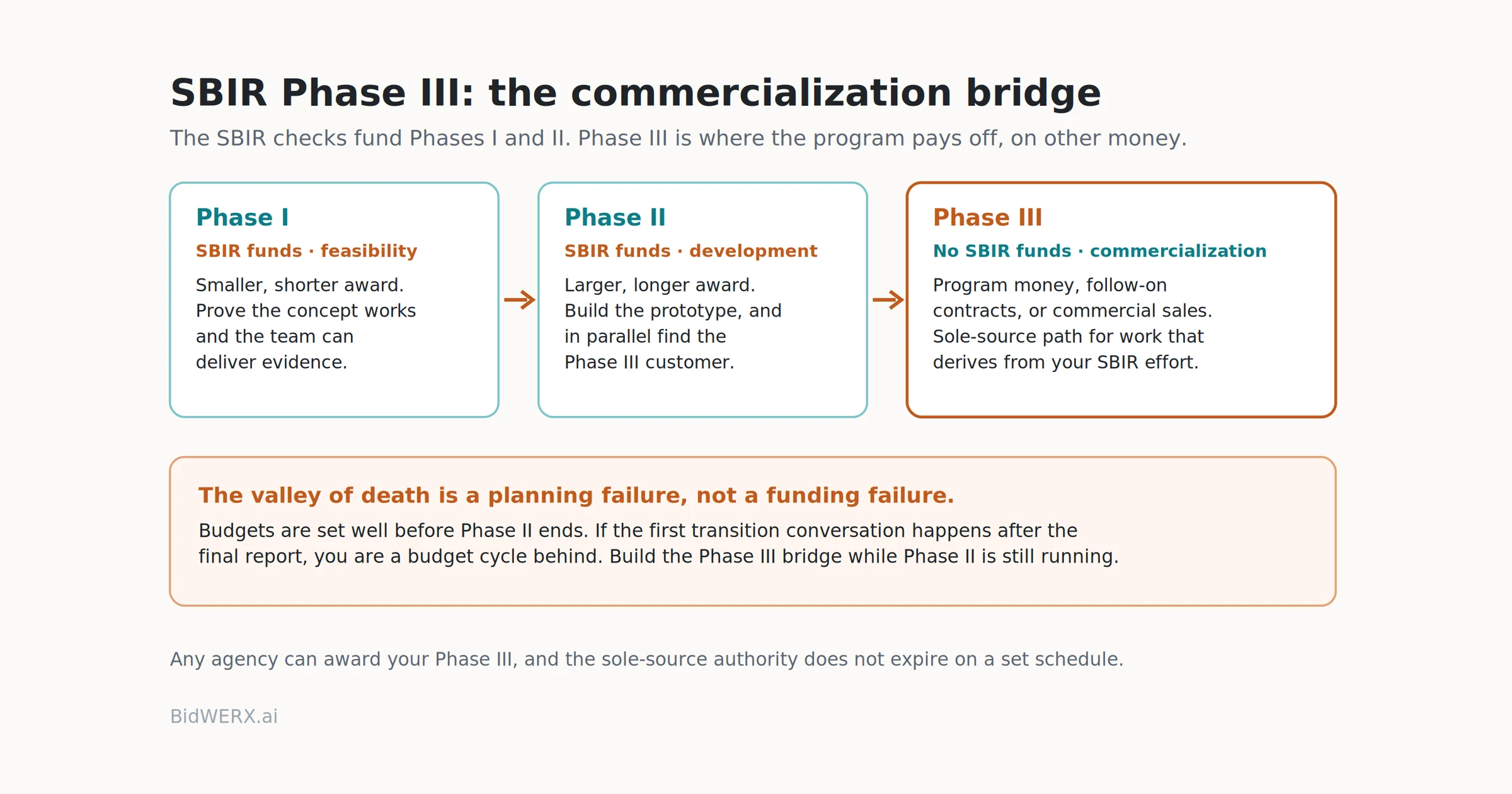
- Phase III is not another SBIR award. It is everything that happens after the SBIR money ends, funded by program dollars, follow-on contracts, or commercial sales.
- The sole-source path is the prize. Work that derives from your Phase I or II can be awarded to you directly, without a new competition, and that authority does not expire on a set schedule.
- Any agency can award your Phase III, not just the one that funded your Phase I and II. Your SBIR history travels with the technology.
- Most SBIR firms stall in the gap between Phase II and Phase III, the so-called valley of death, and the firms that cross it start building the bridge during Phase II, not after.
Phase I and Phase II get most of the attention because that is where the SBIR checks come from. But the program's entire purpose points at Phase III: getting small-firm innovation into government programs and commercial markets. It is the least understood phase and the most valuable one, and misunderstanding it is a big part of why promising technologies stall after Phase II. Here is how it actually works, in plain terms.
What Phase III actually is
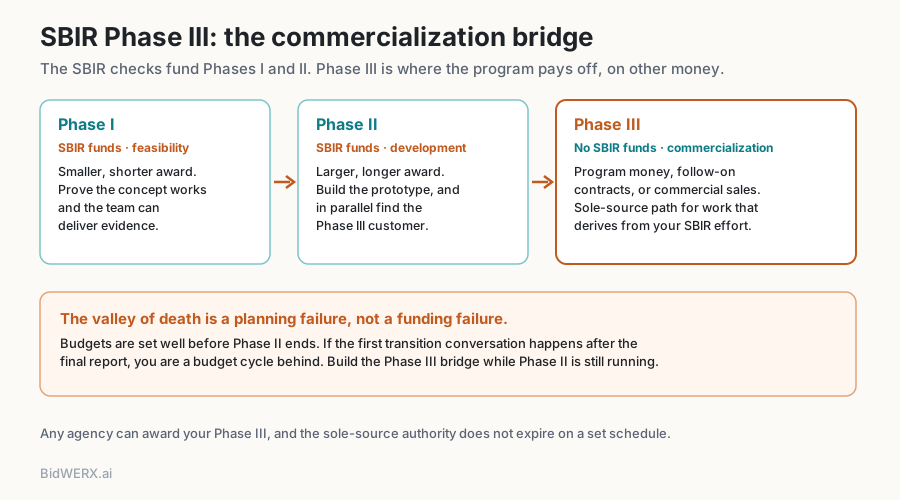
Phase III is the commercialization stage, and the first thing to understand is what it is not: it is not a third SBIR check. The program deliberately uses no SBIR set-aside funds in Phase III. Instead, Phase III is any work that derives from, extends, or completes your Phase I and II effort and is funded by other money, whether that is an agency's own program funds, a follow-on federal contract, or commercial sales.
That definition is broader than people expect. A production contract for the system you prototyped is Phase III. Continued development funded by a program office is Phase III. Selling the commercial version of the technology is Phase III. The common thread is the lineage: the work traces back to your SBIR research, and that lineage is what carries the program's benefits forward.
Where the money comes from
Because Phase III spends no SBIR funds, the money has to come from somewhere with a mission reason to pay. On the government side that usually means a program office that wants the capability, paying from its own budget through a contract. On the commercial side it means customers. In practice, strong Phase III outcomes often combine both: government follow-on work that sustains the firm while the commercial version matures.
This is why the funding question and the customer question are the same question in Phase III. During Phase I and II, the SBIR program is your customer of record. In Phase III, someone has to want the technology enough to fund it from a budget that was never set aside for small business research. Finding and cultivating that someone is the real work of the phase.
The sole-source path
Here is the feature that makes Phase III worth planning for. Agencies can award Phase III work to the SBIR firm directly, on a sole-source basis, without running a new competition, because the work derives from research the government already competed and funded at Phase I. For a small firm, that is a rare thing in federal contracting: a legitimate, program-sanctioned route to a contract that does not require winning an open competition against established incumbents.
Three details make this stronger than most firms realize. The authority is not limited to the agency that funded your Phase I and II, so a different agency that wants the technology can award your Phase III. It is not capped at a particular dollar size or number of awards. And it does not expire on a set schedule after your Phase II ends. What it does require is the lineage: you need to be able to show that the Phase III work derives from, extends, or completes your prior SBIR effort, which is a reason to keep your project records and technical descriptions clean from the start.
Your data rights matter here too. SBIR awards come with protections on the technical data and software you develop, and those protections continue into Phase III. They are part of what makes your firm, rather than a larger integrator, the natural home for the follow-on work. Treat the details as something to read carefully in your specific agreements, because this article is information, not legal advice.
The valley of death, honestly
Between the end of Phase II funding and the start of real Phase III revenue there is a gap, and enough firms die in it that it has a name. The technology works, the report is delivered, and then nothing happens: no program adopts it, no follow-on arrives, and the firm burns savings waiting for a customer that was never actually lined up.
The uncomfortable truth about the valley of death is that it is mostly a planning failure, not a funding failure. A program office needs time to see the technology, believe in it, and budget for it, and budgets are set well in advance. If the first conversation about transition happens after Phase II ends, you are already a budget cycle or more behind. The firms that cross the valley treat Phase II as a two-front effort: deliver the research, and in parallel find the champion, the program, and the budget line that will carry the technology after the SBIR money stops.
Building toward Phase III from day one
Practically, that means a few habits. Write your commercialization plan as a real plan rather than a proposal formality, with named candidate programs and customers. Use the Phase II period to get the technology in front of the people who would fund Phase III, and listen hard to what would make it adoptable: integration, certifications, form factor, support. Keep the paper trail that establishes lineage from your SBIR work, so a sole-source award is easy for a contracting office to justify. And scope your follow-on proposals in the government's terms, against a real requirement, because Phase III work is won like any other federal work: by being specific, credible, and responsive to what the buyer actually needs.
Choosing the pursuits that lead somewhere
All of this feeds back into opportunity selection. An SBIR topic is not just a research grant or contract, it is the opening move of a multi-year path, and the topics worth pursuing are the ones where you can see a plausible Phase III customer from the start. BidWERX Evaluate structures a readiness check on the response you would submit, against the criteria the solicitation sets. For contract-based SBIR and STTR opportunities on SAM.gov, FitScore adds a relative read on how well the opportunity fits your firm. Evaluate assesses readiness rather than writing the proposal, and FitScore is a relative fit indicator to help you prioritize, not a prediction that you will be awarded. If you want to weigh your next SBIR pursuit with the endgame in view, you can start a free BidWERX trial.
Jon Selvaraj is the co-founder of Vista TechWerx and the builder of BidWERX, a readiness and decision tool for small firms pursuing federal work. He writes about the operating discipline behind winning government business.
Related reading: SBIR grants vs SBIR contracts · SBIR vs STTR: which fits, and how the phases work.
Frequently Asked Questions
What is SBIR Phase III?
Phase III is the commercialization stage of the SBIR program: work that derives from, extends, or completes your Phase I and II research, funded by non-SBIR money such as agency program funds, follow-on contracts, or commercial sales. It is where the technology moves into government programs or the market, and it can be awarded sole-source.
Does Phase III use SBIR funding?
No, by design. The SBIR program funds Phase I (feasibility) and Phase II (development), and Phase III deliberately uses no SBIR set-aside funds. Phase III work is paid for by an agency's own mission or program budget, by follow-on federal contracts, or by commercial revenue, which is why lining up that funding source is the central Phase III task.
What is SBIR sole-source authority?
Agencies can award Phase III work directly to the firm that performed the SBIR research, without a new competition, because the work derives from research the government already competed at Phase I. The authority is not limited to the original funding agency and is not capped at a set dollar size, but it does require clear lineage back to your SBIR effort.
Can a different agency award my Phase III work?
Yes. Phase III eligibility follows the technology and the firm, not the agency that funded the original research. An agency that wants a capability you developed under another agency's SBIR award can fund and award your Phase III work, including on a sole-source basis, as long as the work derives from, extends, or completes the prior SBIR effort.