Key takeaways
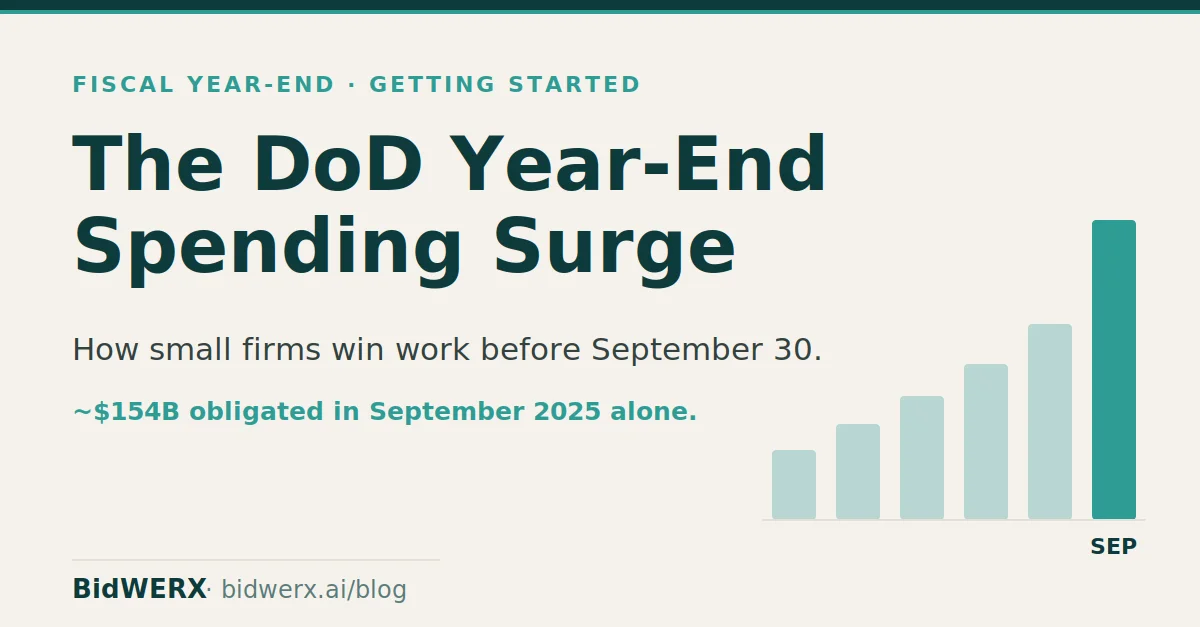
- September is the biggest buying month of the government's year. Agencies obligated 37.5% of all FY2025 dollars in the fourth quarter, and roughly 18.9% in September alone.
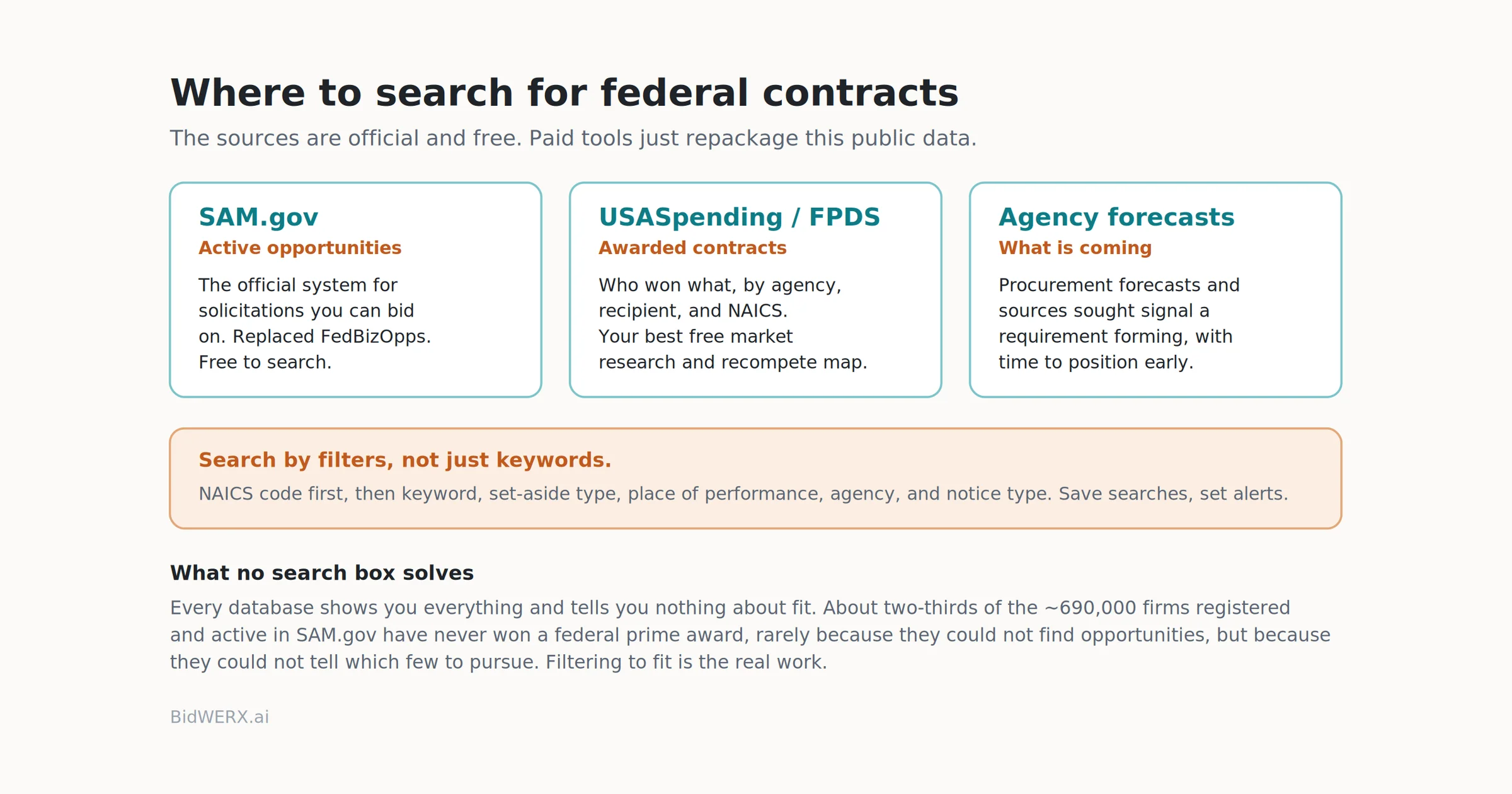
- The surge is real, but it is not a lottery. About two-thirds of the nearly 690,000 firms registered and active in SAM.gov have not won a single federal prime award in the last thirteen years (FY2014 to FY2026). Being registered is the floor, not the finish line.
- Year-end money moves through channels built for speed: existing contract vehicles, simplified acquisition (now up to $350,000), and micro-purchases (now up to $15,000).
- This year has a twist. Congress passed a continuing resolution on September 3, 2026, funding the government through December 11. The usual October-to-December slowdown for new work will probably be sharper.
- If you are not positioned in time, the work you do this month is really about being ready next September.
Why September looks different from the rest of the year
The federal fiscal year runs October 1 to September 30. FY2026 ends on September 30, 2026, and FY2027 starts the next day. That single date drives a lot of behavior across the DoD (operating name: Department of War) and every civilian agency.
Most of the money agencies get is one-year money. If it is not obligated by the end of the fiscal year, it expires. Program offices do not want to hand money back, and they do not want a smaller budget next year for having underspent this one. So the last weeks of September turn into a scramble to put remaining dollars on contract.
The numbers are not subtle. In FY2025, agencies obligated 37.5% of the full year's dollars in the fourth quarter, about $304 billion out of $813 billion. September on its own accounted for roughly $154 billion, close to 19% of the year. Some departments concentrate more than half of their annual spending in that final quarter. The pattern has been growing, not shrinking.
For a small firm, this means the volume of opportunities and awards in your space can spike in a two-week window. It also means the buyers are moving fast and want low-risk, easy-to-award work.
Why this year's surge carries extra weight
There is a wrinkle in 2026 worth understanding before you plan your September.
Congress did not pass full-year appropriations for FY2027 on time. Instead, a continuing resolution was signed into law on September 3, 2026, funding the government through December 11 and pushing the real FY2027 decisions past the November midterms.
A continuing resolution keeps the lights on, but it limits new starts. Agencies generally cannot begin new programs at full scale, or shift money to new priorities, until full-year appropriations arrive. Two things follow from that. First, the FY2026 money that has to be obligated by September 30 becomes more valuable to spend now, because the path to new money in early FY2027 is narrow. Second, the first quarter of FY2027, roughly October through December, is likely to be slow for new work.
The practical read: the last two weeks of September matter more than usual this year, and you should expect a quiet stretch right after. If you plan your pipeline around a busy October, you may be disappointed.
Where year-end money actually goes
Speed is the constraint in September. A contracting officer with money to obligate and days to do it will reach for whatever is fastest and lowest-risk. That shapes where the money lands.
Existing contract vehicles come first. If there is already an indefinite-delivery contract, a schedule, or a task-order vehicle in place, money flows there because the hard work of competing and awarding is already done. A new task order against an existing vehicle can move quickly.
Below the competitive thresholds, procedures get simpler. The simplified acquisition threshold rose to $350,000, effective October 1, 2025, up from $250,000. Buys under that ceiling use faster, less formal procedures. The micro-purchase threshold rose to $15,000, up from $10,000, and those can go on a government purchase card with very little process. Both of those raised ceilings mean more year-end buys can move the fast way.
Small-business set-asides are a large part of the picture too. A contracting officer trying to meet small-business goals before the year closes has a real incentive to steer year-end work toward eligible firms.
Here is the honest part. Brand-new, large, fully competed awards rarely land in the final weeks for a firm starting cold. If you are not already on a vehicle, already known to a buyer, or already registered and eligible, the realistic year-end win is smaller and faster: a simplified buy, a task order, a subcontract to a prime that is spending down its own money, or a small set-aside that fits you exactly.
What a small firm can realistically win right now
It helps to be clear-eyed about the base rate. About two-thirds of the nearly 690,000 firms registered and active in SAM.gov have not won a single federal prime award in the last thirteen years (FY2014 to FY2026). Registration is the floor, not the finish line. The math behind federal win rates is worth sitting with before you assume September is a shortcut.
So what is actually winnable in the next two weeks?
- A task order on a vehicle you already hold, or one your teaming partner holds.
- A simplified acquisition buy under $350,000 where you can turn a compliant quote around fast.
- A micro-purchase for a product or service you can deliver immediately.
- A small set-aside that matches your NAICS code and your certifications exactly.
- A subcontract role with a prime that has money to move and needs your capability.
Notice the theme. In the final weeks, focus beats volume. Chasing every notice that scrolls by is how you end September with a stack of half-finished quotes and nothing submitted.
How to position before September 30
If you want a shot at year-end work, a short checklist covers most of it.
Get your registration current. Your SAM.gov entity should be active, with your UEI, CAGE code, and your representations and certifications up to date. If any of that has lapsed, fix it first, because an expired registration takes you out of the running before anything else matters. Our walkthrough on registering in SAM.gov covers the steps.
Know your codes and your eligibility. Be certain which NAICS codes describe what you do and which set-asides you actually qualify for. Set-aside eligibility is a hard yes or no. If a buy is reserved for a category you are not in, it does not matter how good you are.
Watch the right opportunities every day. Year-end is high velocity, and new notices pile up fast in the last two weeks. This is where BidWERX Find helps: it surfaces open SAM.gov opportunities, and its feeds are updated automatically each day, so you are not refreshing a search by hand while the window closes. Find is available to Org Admin and Capture Manager roles.
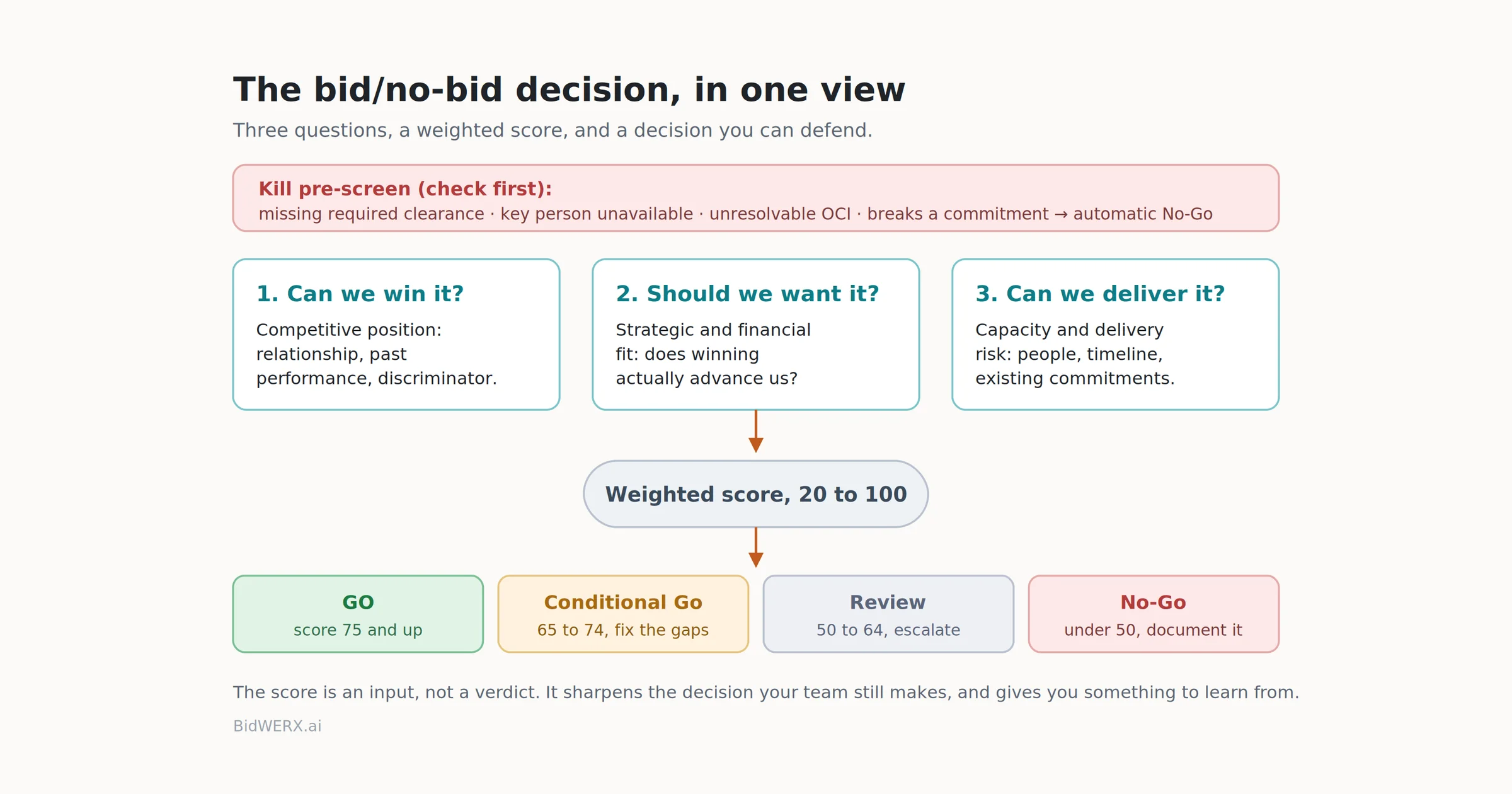
Read fit before you commit. The trap in September is spending your last week on an opportunity that was never yours to win. FitScore reads a specific SAM.gov opportunity against what your firm actually does. It is not predicting whether you will win. It tells you how well the work matches your firm, and it treats set-aside as a hard gate: if the opportunity is reserved for a category you do not qualify for, the score zeroes out, which is your signal to move on. Used that way, it keeps your final two weeks pointed at the buys that could realistically go to you. FitScore is available on Individual plans and up.
For the longer view behind all this, the PPBE budget cycle explains how money gets planned years ahead of the September rush, and how to find federal contracts goes deeper on the search itself. It also helps to know who is actually doing the buying, since the contracting officer, the COR, and the program manager play different roles in a year-end award.
(Internal link pending: this cluster will link up to the Getting Started pillar anchor, "How to Start Government Contracting," once that page is live.)
If you are not ready for this September
Most firms reading this in mid-September will not win a year-end award this year, and that is fine. The move is to treat this month as the deadline that gets you ready for the next one.
The continuing resolution actually helps here. With new work likely slow from October through December, that stretch is a good time to do the unglamorous setup: get your SAM.gov registration clean, settle your NAICS codes, sort out any certifications you qualify for, write down real past performance, and line up the teaming partners you would want to be on a bid with. Do that now, and next September you are findable and focused instead of starting cold.
The surge rewards firms that were ready before it started. There is still time to be one of them next year.
Ready before the next surge? Start a free BidWERX trial and get your SAM.gov opportunities in one place, scored against what your firm actually does. All trial users get full access for 14 days.
Frequently asked questions
Does the government really spend more at the end of the fiscal year?
Yes. In FY2025, agencies obligated 37.5% of the full year's dollars in the fourth quarter, and roughly 18.9% in September alone. Because most appropriations expire on September 30, program offices push to obligate remaining money before it is lost. The concentration has been growing over the last several years.
Can a small business win a contract in September if it is not already set up?
Rarely for a large, newly competed award. Those take longer than the final weeks allow. What is realistic is a smaller, faster win: a task order on a vehicle you already hold, a simplified acquisition buy, a micro-purchase, a small set-aside that fits you, or a subcontract with a prime that is spending down. All of those still require your SAM.gov registration to be active first.
What is the fastest way to be eligible for year-end awards?
Make sure your SAM.gov registration is active with a current UEI, CAGE code, and completed representations and certifications, then confirm your NAICS codes and any set-aside eligibility. That combination is the minimum to be considered. It does not win you anything on its own, but without it you are not in the running.
Does a continuing resolution change year-end spending?
Yes. The FY2027 continuing resolution signed on September 3, 2026, funds the government through December 11 and limits new starts until full-year appropriations pass. That makes expiring FY2026 money more urgent to obligate now, and it usually means a slower October through December for new work.
What happens to contracting in October?
Under a continuing resolution, agencies generally cannot begin new programs at full scale, so the start of the fiscal year tends to be quiet for new awards. Existing work continues. It is a good window to fix your registration and positioning rather than to expect a wave of new opportunities.