By Jon Selvaraj, co-founder of Vista TechWerx and builder of BidWERX. Last updated August 2026.
Quick answer: PPBE stands for Planning, Programming, Budgeting, and Execution, the multi-year process the Department of Defense (DoD, operating name: Department of War) uses to decide what to fund. The money attached to any solicitation was planned and defended one to two years before the RFP appears. Understanding where a program sits in that cycle tells you when to position, so you are known to the customer long before the opportunity is public.
Key takeaways
- The RFP is the end of the money story, not the start. Funding was planned and defended one to two years earlier.
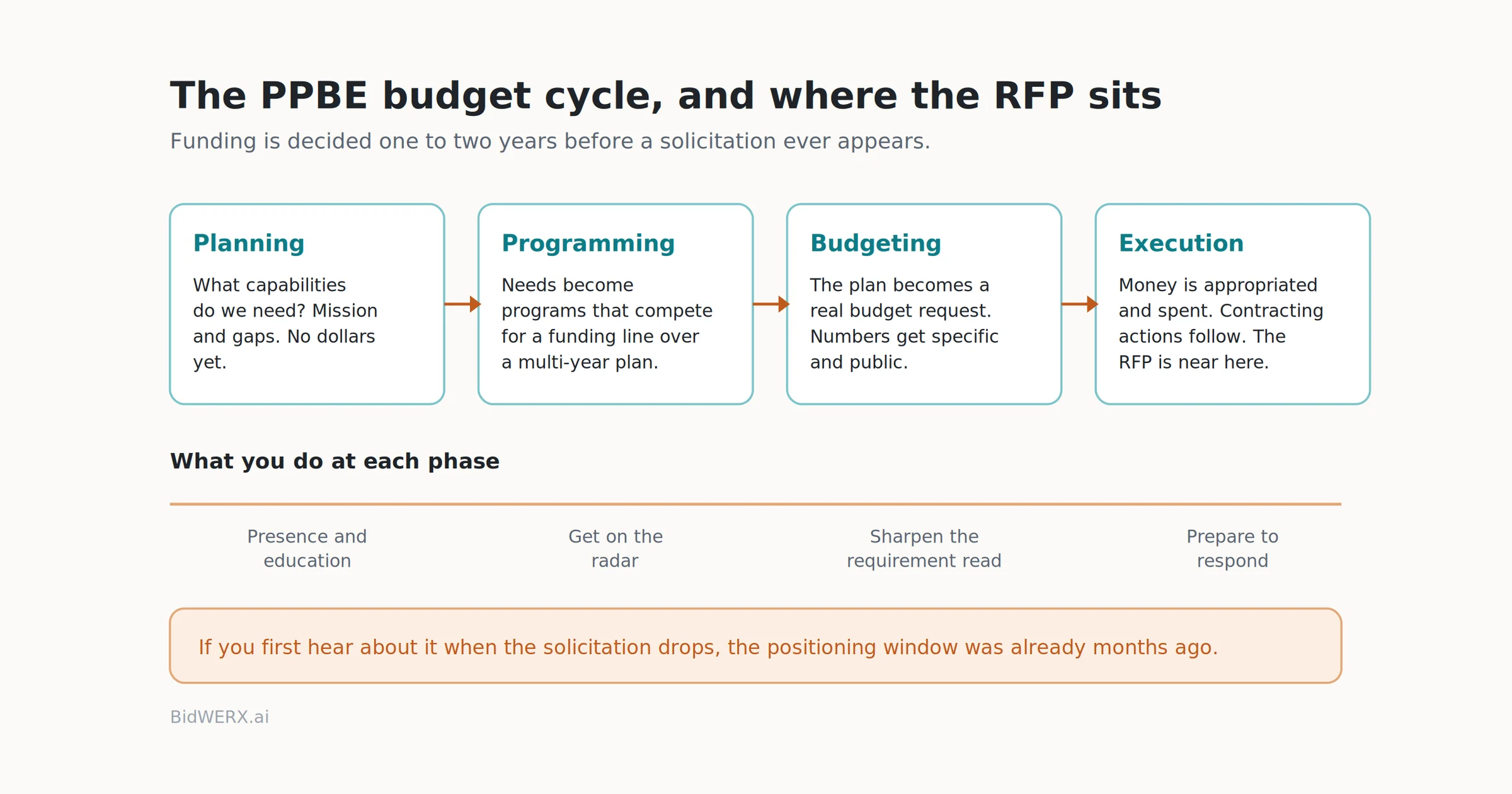
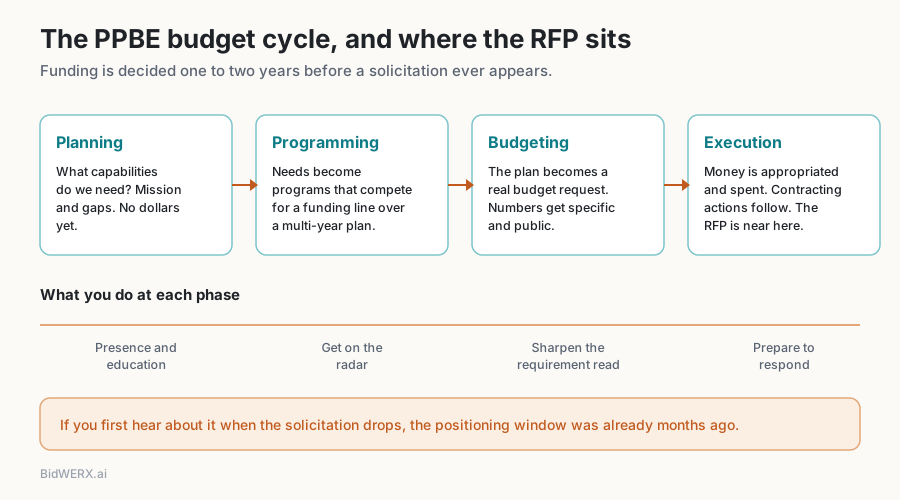
- PPBE has four phases: planning (what do we need), programming (what will we fund), budgeting (turn it into a request), and execution (spend it).
- If you first hear about an opportunity when the solicitation drops, you are already late. The positioning window was months ago.
- Budget documents and forecasts are public signals. They tell you where money is heading before a contract is ever written.
Most small firms treat the RFP as the starting gun. The government treats it as nearly the finish line of a process that has been running for a couple of years. That gap in perception is why firms feel blindsided by solicitations that the eventual winner saw coming for eighteen months. Understanding the budget cycle does not require an insider. It requires knowing where to look and what the phases mean.
Why the money is decided before the RFP
A contract needs funding, and funding does not appear the moment someone writes a requirement. It has to be planned, defended against competing priorities, approved, and appropriated. For the DoD, that process is PPBE, and it runs on a multi-year rhythm. By the time you see a solicitation, the dollars behind it were argued for one to two budget cycles earlier. The decision about whether this capability would be funded at all was made long before you had a chance to respond. This is the single most useful thing to internalize as a newcomer: the RFP is late in the story, not early.
The four phases in plain English
Planning. The government looks at its mission, the threats and gaps it faces, and decides what capabilities it needs. This is strategy, not dollars yet. If your capability maps to a stated need here, you are aligned at the earliest possible point.
Programming. Needs get turned into programs, and programs compete for a limited pot over a multi-year plan. This is where a capability either gets a funding line or gets deferred. Trade-offs happen here, and priorities that survive are the ones that will eventually become contracts.
Budgeting. The programmed plan becomes an actual budget request, reviewed and packaged into what the administration sends forward. The numbers get specific. This is where you can start to read real dollar figures against specific program elements.
Execution. The money is appropriated and now has to be spent, on time and on purpose. This is the phase closest to a solicitation. When a program office is in execution with funds in hand, contracting actions follow.
How to read the signals
You do not need to be in the room. A lot of this is public. Budget request documents lay out program elements and the dollars attached to them. Agency and program forecasts signal upcoming procurements. Industry days and sources sought notices tell you a requirement is maturing toward a solicitation. The skill is connecting a program you care about to where it sits in the cycle, so you know whether to be building a relationship now or preparing a proposal soon.
Timing your positioning to the cycle
Here is the practical translation. If a program is in planning or programming, your job is presence and education: help the customer understand what industry can do, respond to sources sought, get your capability on the radar. If it is in budgeting, you sharpen your understanding of the specific requirement and the likely competitive field. If it is in execution, you prepare to respond, because the solicitation is near. Matching your effort to the phase is what separates firms that always seem to be first to a relationship from firms that are always reacting to a posted RFP.
What this means for a small firm's pursuit calendar
A small firm cannot position for everything, and the budget cycle is long, so the discipline is choosing which programs to track early and staying with them across the phases. That is a tracking problem as much as a strategy problem. BidWERX Find is built to help you watch the opportunities and programs that fit your firm, so you catch the early signals instead of discovering a solicitation the week it closes. It helps you position earlier against the right pursuits. It does not promise a win, and no tool changes the fact that the money was decided upstream. If you want to track the opportunities that fit your firm from earlier in the cycle, you can start a free BidWERX trial.
Jon Selvaraj is the co-founder of Vista TechWerx and the builder of BidWERX, a readiness and decision tool for small firms pursuing federal work. He writes about the operating discipline behind winning government business.
Related reading: how to register in SAM.gov · who's who in a federal buy (CO, COR, and PM).
Frequently Asked Questions
What does PPBE stand for?
PPBE stands for Planning, Programming, Budgeting, and Execution. It is the process the DoD uses to decide what to fund and then to spend that funding. Each phase moves a capability from a stated need toward appropriated dollars, and the full cycle spans multiple years, which is why funding is set long before a solicitation appears.
Why does the budget cycle matter to a contractor?
Because the money behind any contract was planned and defended one to two years before the RFP. If you only engage when the solicitation posts, you have missed the window when the requirement was shaped and relationships were built. Understanding the cycle lets you position early, when a small firm can still influence how a need is understood.
How can I tell where a program is in the PPBE cycle?
Public signals help. Budget request documents show program elements and their funding. Agency procurement forecasts flag upcoming buys. Sources sought notices and industry days indicate a requirement is maturing. Connecting a specific program to these signals tells you whether to focus on relationship-building now or proposal preparation soon.
Is PPBE only for defense contracts?
PPBE is the DoD's process, so it applies most directly to defense work. Civilian agencies follow their own budget processes, but the underlying principle is the same everywhere: funding is planned, justified, and appropriated well before a contract is solicited. Whatever the agency, the RFP sits near the end of a long budget story, not the beginning.