By Jon Selvaraj, co-founder of Vista TechWerx and builder of BidWERX. Last updated September 2026.
Quick answer: To look up federal contracts that have already been awarded, use USASpending.gov, the free official record of federal spending. Search by recipient, awarding agency, NAICS code, or timeframe, and you can see who won, how much was obligated, and the period of performance. SAM.gov now also hosts the government's contract award data search, which replaced the old FPDS system in February 2026. Together they are some of the best free market research in government contracting.
Key takeaways
- Awarded-contract data is public and free. USASpending.gov is the official spending record, and SAM.gov now hosts the contract award search that replaced FPDS. Nobody needs to pay to see who won what.
- Award history answers the questions that matter before you pursue anything: which agencies buy what you sell, how much they spend, and who they buy it from.
- Every award has a period of performance with an end date, and end dates are a recompete calendar. Reading them is how you start positioning months or years before a solicitation exists.
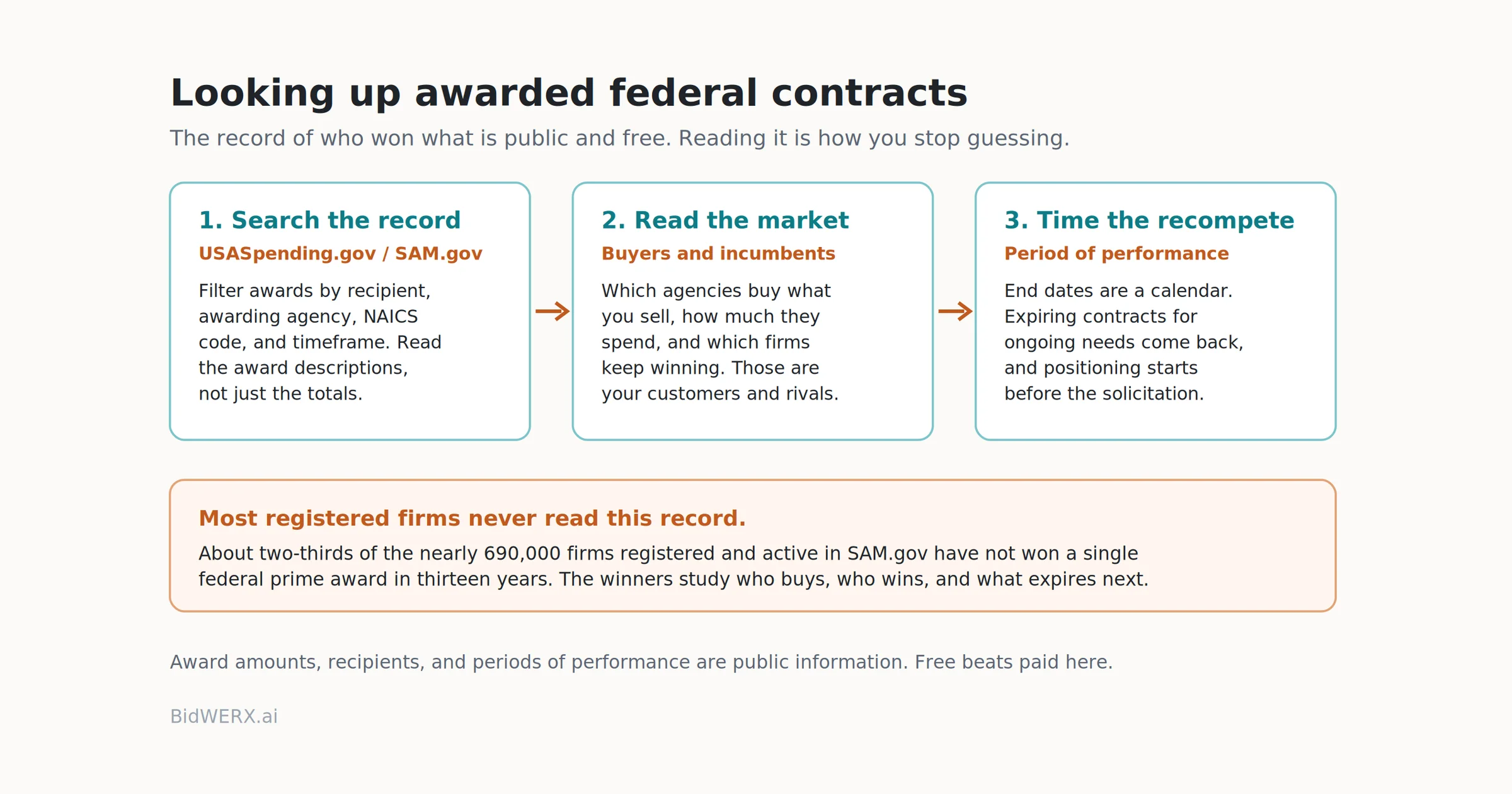
- Most registered firms never use any of this. In our analysis of the nearly 690,000 firms registered and active in SAM.gov, about two-thirds have not won a single federal prime award in the last thirteen years (FY2014 to FY2026). Studying the firms that do win is how you stop guessing.
Active solicitations get all the attention, but the richer information is usually behind you, in the contracts the government has already awarded. Award data tells you what an agency actually buys rather than what it says it might buy, and it names the competitors you would face. All of it is public. Here is where it lives, how to search it, and how to turn it into a pursuit list instead of trivia.
Where awarded contracts live: USASpending.gov and SAM.gov
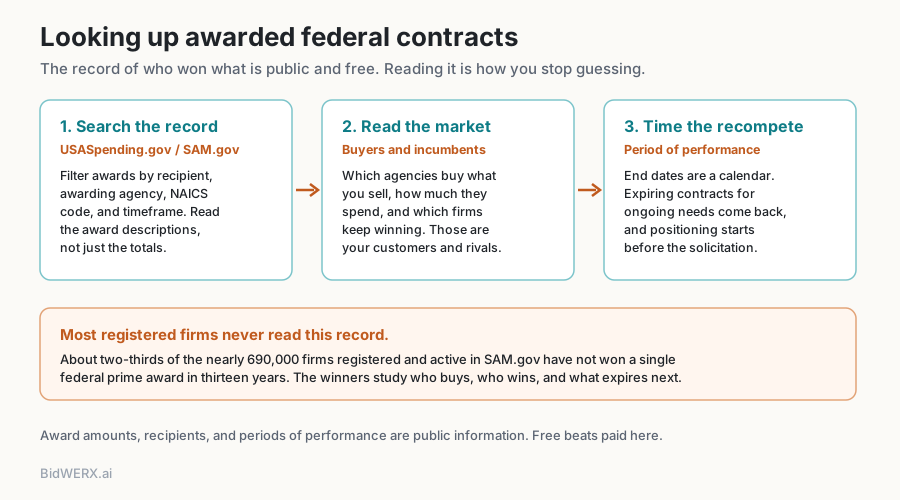
USASpending.gov is the government's official, public record of federal spending, and it is free. Its award search covers contracts along with grants and other assistance, and each award record shows the recipient, the awarding agency and sub-agency, the obligated amounts, the NAICS and product or service codes, and the period of performance. You can browse a single award in detail or pull filtered lists across years of spending.
For years the contract-level detail behind that spending lived in FPDS, the Federal Procurement Data System. That changed in February 2026: FPDS was decommissioned and its public search moved into SAM.gov, where contract award data now sits alongside the entity registry and active opportunities. Old FPDS.gov links redirect there. Viewing award search results requires a free SAM.gov account, and for most firms USASpending remains the friendlier front door to the same underlying facts. Either way, the point stands: the record of who won what is not a secret, and any service selling "exclusive" award data is packaging what these systems publish for free.
How to search it
Start with the award search on USASpending.gov and apply filters the way you would on any opportunity search, just pointed backward in time.
Search by recipient when you want to understand a competitor: every federal prime award a firm has won, with amounts and agencies attached. Search by awarding agency when you want to understand a customer: what a given agency spent, on what, with whom. Search by NAICS code when you want to understand a market: every award in your line of work, across all agencies, over whatever window you choose. Add a timeframe so the picture reflects current buying rather than ancient history, and export the results if you want to work the list properly.
One habit worth building: look at the award description fields, not just the totals. The descriptions tell you what the work actually was, and that is what lets you judge whether an award is truly comparable to what your firm does.
Reading the results: who buys what you sell
The first strategic question award data answers is which agencies buy your kind of work. Firms new to federal contracting tend to assume their customer is "the government." It is not. It is a handful of specific buying offices with budgets, habits, and incumbent relationships, and award history names them. If three agencies account for most of the spending in your NAICS codes, those three are your market, and everything from your capability statement to your pursuit calendar should reflect that.
The second question it answers is who you would be up against. Pull the awards in your niche and the same recipient names will start repeating. Those are the incumbents. Knowing them changes how you pursue: an award held for years by a firm with deep past performance is a different competitive situation than a first-time award, and you want to know which one you are walking into before you spend a dollar on a proposal.
The recompete calendar
Every contract award carries a period of performance, and the end date is one of the most useful pieces of information in the entire record. Contracts for ongoing needs are typically competed again as they expire, and the recompete is often a real opening: the requirement is proven, the budget exists, and the agency is obligated to run a competition.
So read end dates as a calendar. If an incumbent's contract in your niche ends in eighteen months, that is a pursuit you can begin positioning for now, long before a solicitation appears. Watch for the early signals on the active side, such as sources sought notices and presolicitations, and pair them with agency procurement forecasts where they are published. The firms that seem to be early on every opportunity are usually not lucky. They read the award data and started before the starting gun.
Sizing up incumbents honestly
Incumbent research cuts both ways, and the honest use of it includes talking yourself out of pursuits. If the award history shows an entrenched incumbent, strong agency ties, and a scope that plays to their strengths, that is real information about your odds of a productive pursuit, and a disciplined no frees your capacity for a better target. If the history shows a vulnerable incumbency, or an agency that spreads awards across multiple firms, or task orders small enough for a newcomer to win credibly, that is information too. Either way you are deciding on evidence instead of hope, which is the entire point of doing the research.
Why most firms never do this
Here is the uncomfortable context. In our analysis of the nearly 690,000 firms registered and active in SAM.gov, about two-thirds have not won a single federal prime award in the last thirteen years (FY2014 to FY2026). Very little of that gap is about proposal writing. Firms register, search active opportunities, bid at whatever looks plausible, and lose to competitors they never studied, at agencies they never researched. The award record that would have told them all of it sat public and unread. Looking up awarded contracts is the cheapest correction available: it costs time, not money, and it converts your pursuit decisions from guesses into targeting.
From research to a pursuit list
The gap between reading award data and acting on it is where the work usually stalls. You can know your market and still face the daily firehose of new notices with no efficient way to match them against what you learned. That is the job BidWERX Find is built for: it surfaces the opportunities that match your firm, and FitScore gives you a relative read on how well each one fits, so the research you did shapes what you actually pursue. FitScore is a relative fit indicator to help you prioritize, not a prediction that you will win. If you want your pursuit list to reflect your market instead of your inbox, you can start a free BidWERX trial.
Jon Selvaraj is the co-founder of Vista TechWerx and the builder of BidWERX, a readiness and decision tool for small firms pursuing federal work. He writes about the operating discipline behind winning government business.
Related reading: how to find and search federal contract opportunities · how to calculate and improve your federal win rate.
Frequently Asked Questions
Where can I look up federal contracts that have been awarded?
USASpending.gov is the free, official record of federal spending, searchable by recipient, awarding agency, NAICS code, and timeframe. Each award shows who won, the obligated amount, and the period of performance. SAM.gov hosts the contract award data search that replaced the older FPDS system in February 2026.
What happened to FPDS?
FPDS, the Federal Procurement Data System, was decommissioned in February 2026 and its public functions moved into SAM.gov, which now hosts the government's contract award data search. Old FPDS.gov links redirect to SAM.gov. USASpending.gov is unaffected and remains the official public record of federal spending, and for most research it is still the easier place to search. Both are free and draw on the same underlying award records.
Can I see how much a federal contract was awarded for?
Yes. Obligated dollar amounts on federal contract awards are public information, and USASpending.gov displays them on each award record along with the recipient, the awarding agency, and the period of performance. Amounts can change over a contract's life as modifications are recorded, so check the full award history rather than a single entry.
How do I find out when a federal contract will be recompeted?
Start with the period of performance end date on the current award in USASpending.gov, since expiring contracts for ongoing needs are typically competed again. Then watch the active side for early signals such as sources sought and presolicitation notices, and check agency procurement forecasts where published. Together those give you a working recompete timeline.