By Jon Selvaraj, co-founder of Vista TechWerx and builder of BidWERX. Last updated August 2026.
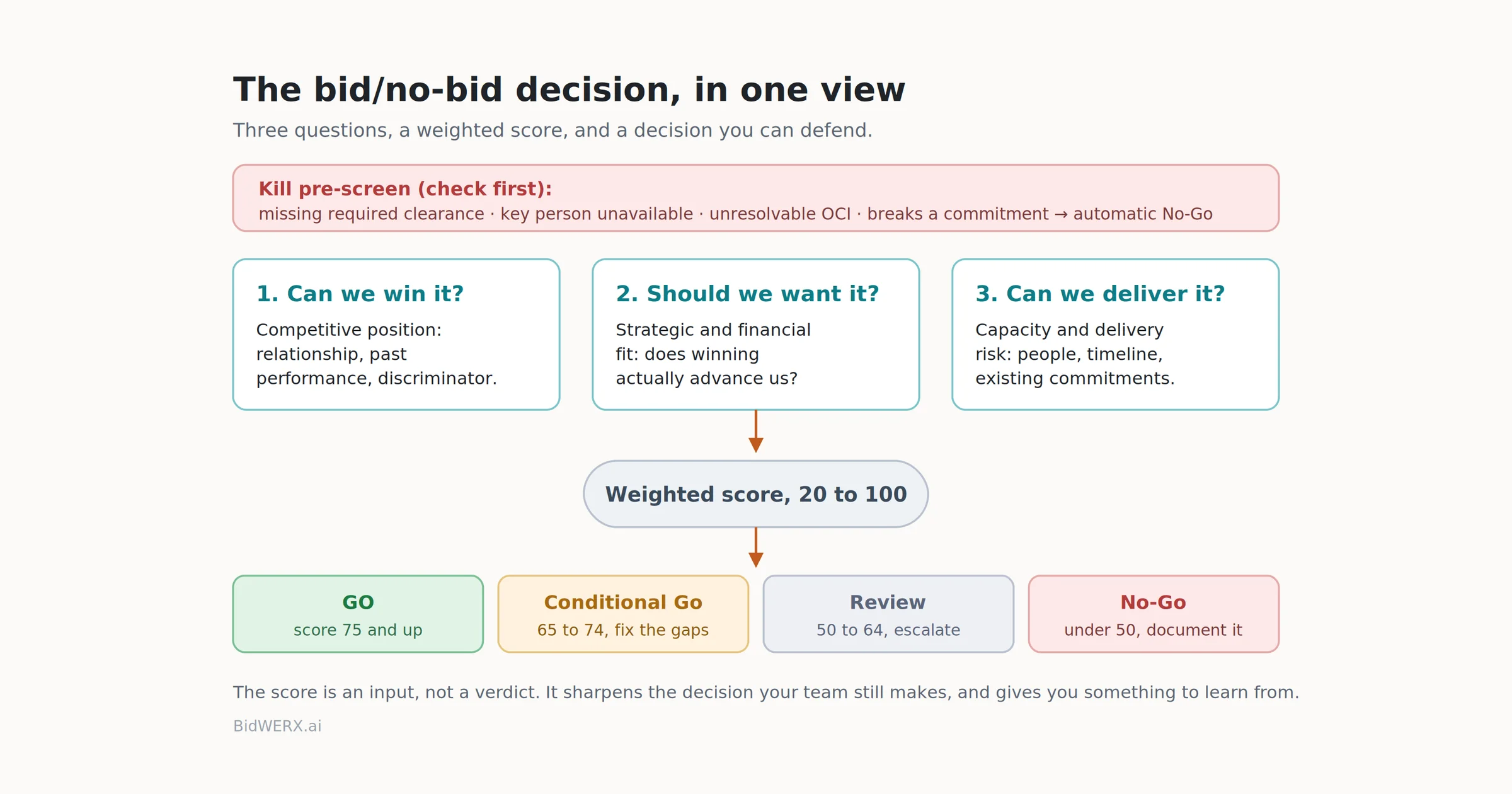
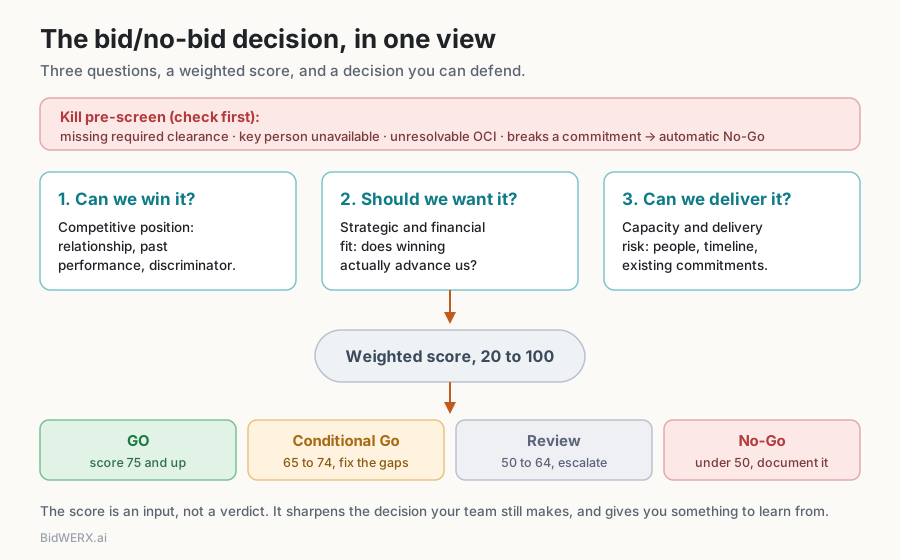
Quick answer: A bid/no-bid decision comes down to three questions: can we win it (competitive position), should we want it (strategic and financial fit), and can we deliver it (capacity and delivery risk). Answer all three honestly before you commit proposal budget, and check the kill items first, because any one of them ends the decision on its own.
Key takeaways
- Your win rate is wins divided by pursuits, so the fastest way to raise it is to pursue fewer, better-chosen opportunities, not to write better losing proposals.
- Check the kill items first: a missing required clearance, an unavailable key person, an unresolvable conflict of interest, or a broken commitment is an automatic no.
- "Can we win it" carries the most weight, because a strong strategic fit you cannot win is still a loss.
- The three questions become far more useful when you score them consistently, so you can compare pursuits and learn from the outcomes.
Most small firms decide whether to bid the same way: a quick gut read, a half-finished hallway conversation, and a default toward yes because saying no feels like leaving money on the table. The result is predictable. Too many proposals on low-probability pursuits, capture hours spent on work that was never winnable, and no way to learn from the losses because there was never a written rationale to look back at.
Here is the reframe that changes the math. Your win rate is wins divided by pursuits, which means the fastest way to raise it is not to write better proposals. It is to pursue fewer, better-chosen ones. In our own analysis of the nearly 690,000 firms registered and active in SAM.gov, about two-thirds, roughly 450,000, have not won a single federal prime award in the last thirteen years (FY2014 to FY2026). Persistence on the wrong pursuits is a big part of why. The bid/no-bid decision is where you break that pattern, and it is worth more than any single proposal edit.
First, the cost of the wrong yes
A no-bid costs you nothing but the time to decide. A wrong yes costs real money: the capture hours, the proposal team, the subject-matter experts pulled off billable work, and the opportunity cost of the pursuit you did not chase because you were busy losing this one. Naming that cost is the point. The question is never "can we write something?" It is "is this the best use of a pursuit we could only run a limited number of." Once the cost is on the table, the three questions do their job.
Question 1: Can we win it?
This is the hardest question to answer honestly, and it carries the most weight, because a strong strategic fit you cannot win is still a loss. Competitive position is the real subject here. Do you have a relationship with the program office that predates the solicitation? Do you have past performance that maps directly to this scope, not adjacent to it? Is there an incumbent, and if so, are they vulnerable or entrenched? Do you have a genuine discriminator, something you have done that makes you the clear choice, or would you be one compliant bidder among many?
If your honest answer is that you would be competing on price alone against firms with deeper relationships and closer past performance, that is a signal, not a challenge to overcome with a better cover letter.
Question 2: Should we want it?
A winnable pursuit is not automatically a good one. This question is about strategic and financial fit. Does the work advance where you are trying to go, or is it a detour that fills a quarter but builds nothing? Are the margins real once you account for the true cost of performance? Does it strengthen your past-performance record in a direction that opens the next three opportunities, or is it a one-off? Small firms lose years to contracts they won and then wished they had not, because the work was profitable on paper and corrosive in practice.
Question 3: Can we deliver it?
The last question is the one optimism skips. If you win, can you actually execute, on the timeline, at the quality the evaluation implied, without breaking your existing commitments? Capacity is part of it: do you have the people, or a credible plan to get them? Delivery risk is the rest: named key personnel, tools you already run, and honest room in your schedule. Winning work you cannot deliver is worse than losing it. It shows up in your past-performance record, which is the very thing you are trying to build.
The items that end the decision immediately
Some conditions are not scored, they are absolute. If any of these is true, the answer is no, regardless of how attractive the opportunity looks. You are missing a required clearance you cannot obtain in time. A named key person the solicitation requires is not actually available. There is an organizational conflict of interest you cannot resolve. Or pursuing this would break a commitment you have already made. Treat these as a pre-screen. Check them first, before you spend an hour on anything else, because a "yes" on the three questions cannot override a hard "no" here.
Turning three questions into a repeatable decision
The three-question structure is the useful part, but a gut answer to each still drifts from person to person and week to week. The improvement is to score each question against plain anchors, weight them, and roll them into one number you can compare across pursuits and look back on after the outcome is known.
That is the model BidWERX's Go/No-Go is built on. Nine criteria across the three questions, each rated one to five against plain-English anchors, weighted (competitive position carries the most, because winnability does), and normalized into a single score with a clear band: a strong score authorizes proposal resources, a middling one flags specific gaps to fix or escalate, and a low one is a documented no. The weighting is calibrated against established capture practice (Shipley, APMP) and the empirical bid/no-bid research, including Egemen and Mohamed's 2007 study of 80 contractors. It is deliberately simple, and it runs in under ten minutes once you have the intelligence in hand.
Two honest caveats, because the framework is only as good as your discipline with it. First, the score is an input, not a verdict. It is an internal, relative decision aid, not a government metric. It sharpens the conversation your team still has to have. It does not replace judgment, and it does not predict the award. Second, it only works if you rate honestly. If you find yourself nudging a criterion up to push the number past the threshold, the score is telling you something. Listen to it.
If you want to run your next opportunity through a structured Go/No-Go instead of a hallway conversation, you can start a free BidWERX trial and score one live pursuit end to end. The three questions are the framework either way. The score just makes the call consistent, and gives you something to learn from when the result comes in.
Jon Selvaraj is the co-founder of Vista TechWerx and the builder of BidWERX, a readiness and decision tool for small firms pursuing federal work. He writes about the operating discipline behind winning government business.
Related reading: how to calculate and improve your federal win rate · what federal evaluators actually reward.
Frequently Asked Questions
What is a bid/no-bid decision?
A bid/no-bid decision is the deliberate call a firm makes about whether to pursue a specific opportunity before it commits proposal resources. Done well, it is not a gut reaction. It weighs whether you can win, whether the work is worth wanting, and whether you can deliver, and it produces a rationale you can look back on after the result.
What factors go into a bid/no-bid decision?
The factors sort into three questions. Can we win it covers competitive position: relationships, relevant past performance, incumbency, and a genuine discriminator. Should we want it covers strategic and financial fit. Can we deliver it covers capacity and delivery risk. A handful of absolute kill items, like a missing required clearance or an unresolvable conflict of interest, override everything else.
What is a Go/No-Go decision in government contracting?
Go/No-Go is another name for the bid/no-bid decision, used widely in capture and proposal management. A structured Go/No-Go scores an opportunity against weighted criteria and returns a recommendation, but the score is an input to a human decision, not an automatic verdict. It exists to make the call consistent and defensible across a team.
How do you decide whether to bid on a government contract?
Start with the kill items: if any is true, it is a no. Then answer the three questions honestly, ideally scored against plain anchors rather than by feel. Weight winnability most heavily, since a fit you cannot win is still a loss. If the pursuit clears all three and the cost is justified, bid. If it does not, document why and move on, so the next decision is faster.