By Jon Selvaraj, co-founder of Vista TechWerx and builder of BidWERX. Last updated August 2026.
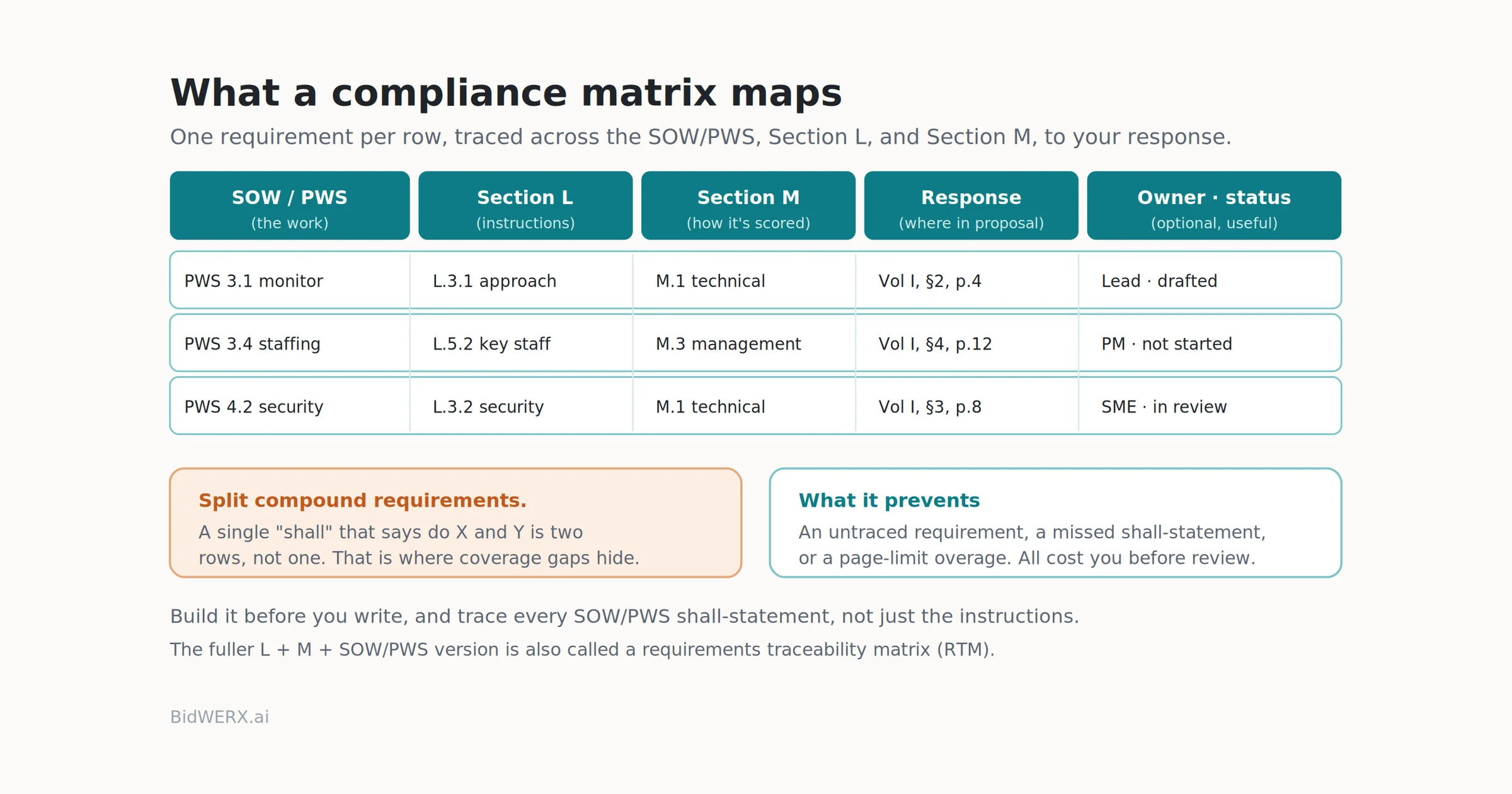
Quick answer: A compliance matrix is a table that crosswalks every requirement in a solicitation, the work in the SOW or PWS, the instructions in Section L, and the evaluation criteria in Section M, to the exact place in your proposal where you address it. Build it before you write, with one row per requirement, and use it to assign sections, track coverage, and confirm nothing is missing. It prevents the failures that sink strong proposals: an untraced requirement, a missed shall-statement, and a page-limit violation.
Key takeaways
- A compliance matrix is built before you write, not after. Its job is to shape the outline, not to check a finished draft.
- One row per requirement. Break compound requirements into separate rows, because a shall-statement that says "do X and Y" is two things to satisfy, not one.
- A basic matrix crosswalks Section L to Section M to your response. A stronger one also traces the SOW or PWS requirements (often flowing from Section C), so every shall-statement, not just every instruction, is covered.
- The failures it prevents, an untraced requirement and a page-limit overage, are not judgment calls. They cost you before your content is even read.
A compliance matrix is the least glamorous tool in proposal work and one of the most protective. It is a simple table, and firms that skip it lose points they never needed to lose, on requirements they could have easily met, because nobody tracked whether every instruction was actually answered. Here is how to build one and use it, in plain steps.
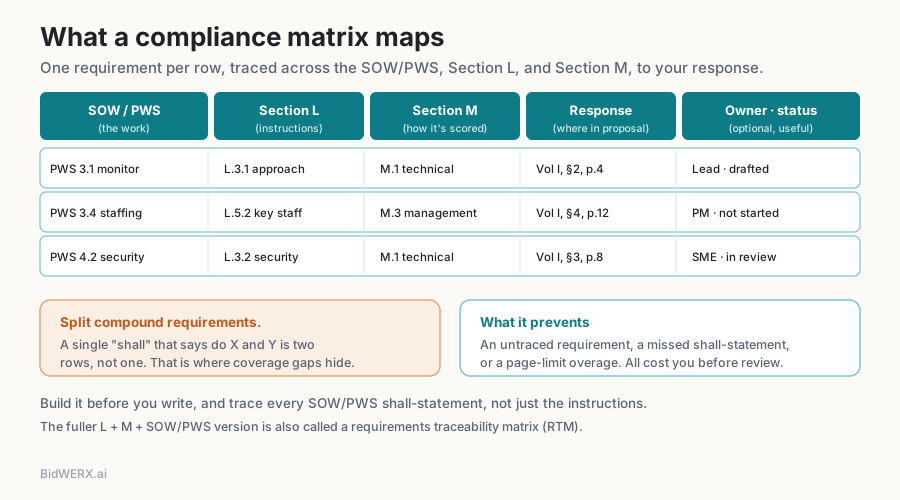
What a compliance matrix actually is
Strip away the jargon and it is a checklist with structure. Each row is one requirement the government stated. The columns tie that requirement across its sources, the work statement, the instructions, and the evaluation criteria, to where in your response you handle it. That is the whole idea. The value is not the table itself; it is that building the table forces you to read the solicitation the way an evaluator will, requirement by requirement, before you have written a word you might have to throw away.
Section L, Section M, and the work statement
Three parts of a federal solicitation drive a full matrix. The SOW or PWS, often flowing from Section C, is the work itself: the tasks and shall-statements you must actually perform and deliver. Section L is the instructions: how to prepare and organize your proposal, what volumes to submit, what format to follow, and what page limits apply. Section M is the evaluation criteria: how the government will score what you submit. They are not the same, and satisfying one does not satisfy the others. A response that follows every Section L instruction but never traces a PWS task, or ignores what Section M rewards, still leaves both requirements and points on the table. The matrix exists to hold all three in view at once, so every task you must perform is also instructed, scored, and answered in one traceable line.
A quick note on scope. The stripped-down version of this tool, mapping only Section L to Section M, is what many people first learn as a compliance matrix. The fuller version that also traces the SOW or PWS is sometimes called a requirements traceability matrix. The label matters less than the habit: trace every requirement, from wherever it originates, to a real place in your response.
Building it, row by row
Start with a blank table and work through the solicitation. For each requirement, create a row. Pull the requirement from its source: a task or shall-statement from the SOW or PWS, the matching Section L instruction that tells you how to present it, and the Section M criterion that tells you how it is scored, each in the solicitation's own words with its reference number. Then record where in your proposal you will address it, volume, section, and page. Add columns as they help you: an owner for who is writing that section, a status for whether it is drafted and reviewed, and a page-count budget so the volume does not blow its limit. Not every row starts in the same place, some requirements originate in the PWS and some only in Section L, but the point of the crosswalk is that each one is traced all the way to a response.
The one discipline that matters most: break compound requirements apart. When a PWS task or an instruction says "monitor the network and report monthly," that is two rows, not one, because it is two separate things an evaluator will check for. Compound shall-statements are exactly where a requirement quietly goes unanswered, because the first half got written and the second half got forgotten.
Using it to assign and track the work
Once the matrix exists, it becomes the backbone of the proposal. It is your outline, because every row is a thing that must appear somewhere in the response. It is your assignment sheet, because the owner column tells each writer exactly what they are responsible for. And it is your status board, because you can see at a glance which requirements are drafted, which are reviewed, and which are still empty with the deadline approaching. Near submission, it becomes your final check: every row should point to a real location in the response, and every page budget should hold.
The failures it prevents
Two failures matter most, and both are preventable. The first is an untraced requirement: a SOW or PWS shall-statement, or a Section L instruction, that simply never got answered, often the back half of a compound requirement. The second is a page-limit violation: a volume that runs long and gets truncated or downgraded. Neither of these is a judgment call by the evaluator. They are mechanical, pass or fail, and they can knock out an otherwise strong proposal before anyone reads your technical approach. A compliance matrix is the cheapest insurance against both.
From matrix to a readiness check
The matrix tells you that every requirement is addressed somewhere. It does not tell you whether each response is any good, whether it is responsive in the agency's terms, persuasive enough to separate you, and credible on delivery risk. That is a different read, and it is worth doing before you submit. BidWERX's Evaluate is built to structure that readiness check across the dimensions an evaluator weighs, and returns where the gaps are while you still have time to fix them. It evaluates your draft; it does not write it for you, and it does not predict the award. If you want to run your next draft through a structured readiness check after the matrix confirms coverage, you can start a free BidWERX trial.
Jon Selvaraj is the co-founder of Vista TechWerx and the builder of BidWERX, a readiness and decision tool for small firms pursuing federal work. He writes about the operating discipline behind winning government business.
Related reading: what federal evaluators actually reward · the bid/no-bid decision: three questions before you write a word.
Frequently Asked Questions
What is a compliance matrix in proposal writing?
A compliance matrix is a table that crosswalks every requirement in a solicitation, the SOW or PWS work, the Section L instructions, and the Section M evaluation criteria, to the exact location in your proposal where you address it. It is built before writing and used to structure the outline, assign sections, and confirm at submission that no requirement was missed.
When should I build the compliance matrix?
Build it before you write, as soon as you decide to bid. Its purpose is to shape the proposal outline and catch requirements early, not to audit a finished draft. Building it first forces you to read the solicitation requirement by requirement, which is exactly how the evaluator will read your response.
What columns should a compliance matrix have?
At minimum, three: the Section L instruction (in the solicitation's own words, with its reference), the Section M criterion it supports, and where in your proposal you address it. Stronger matrices add a column for the SOW or PWS requirement, the shall-statement being satisfied, plus an owner column for who writes each section, a status column for drafted and reviewed, and a page-budget column so no volume exceeds its limit.
What is the difference between a compliance matrix and a requirements traceability matrix?
In practice the terms overlap, and many teams use them interchangeably. Strictly, a compliance matrix confirms you addressed every Section L instruction and Section M criterion, while a requirements traceability matrix (RTM) also traces every SOW or PWS shall-statement to your response, so nothing in the actual scope of work is missed. The strongest matrices do both, crosswalking the SOW/PWS, Section L, and Section M in one place. What you call it matters less than whether every requirement is traced.
Why does a compliance matrix matter for my score?
Because it prevents the two failures that downgrade or disqualify proposals before the content is read: a missing required element and a page-limit violation. Both are mechanical, not judgment calls, and both are entirely preventable. The matrix ensures every stated requirement points to a real, complete place in your response.