By Jon Selvaraj, co-founder of Vista TechWerx and builder of BidWERX. Last updated August 2026.
Quick answer: A federal contract buys a specific good or service the government wants for its own use, and is scored on how well you can deliver it. A grant funds a project whose purpose serves a public benefit, and is scored on the merit and impact of what you propose to do. Contracts expect deliverables and tight oversight; grants expect outcomes and reporting. The right one depends on whether the government is buying from you or funding you.
Key takeaways
- The core difference is purpose. A contract is the government buying something for itself; a grant is the government funding something for a public benefit.
- They are scored on different things. Contracts reward delivery credibility and compliance; grants reward project merit and broader impact.
- The relationship differs. A contract comes with close performance oversight; a grant gives you more autonomy and holds you to reported outcomes.
- Your capability may fit one far better than the other. Writing a grant like a contract proposal, or the reverse, is a common and costly mismatch.
Grants and contracts both move federal money to your organization, which is where the similarity ends. They are governed differently, scored differently, and expect different things from you after the award. Chasing the wrong one, or writing a strong proposal in the wrong register, wastes the effort. Here is how they actually differ and what it means for what you pursue.
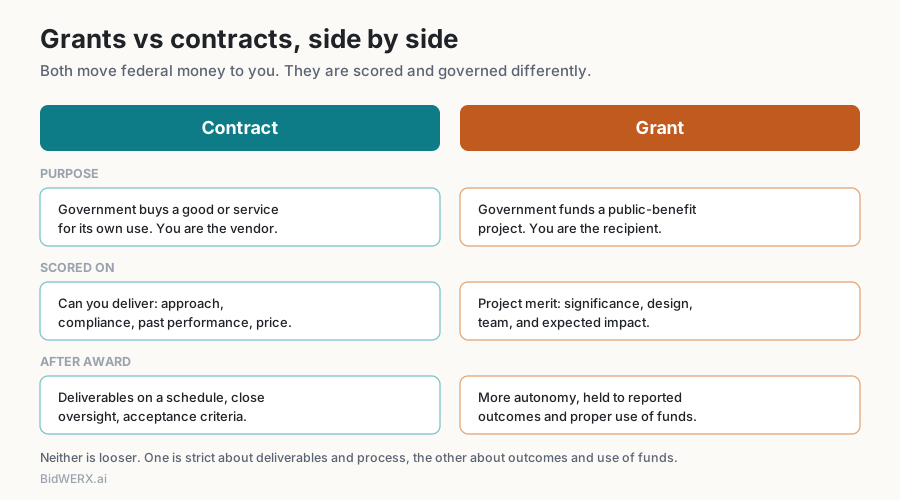
The core difference: buying versus funding
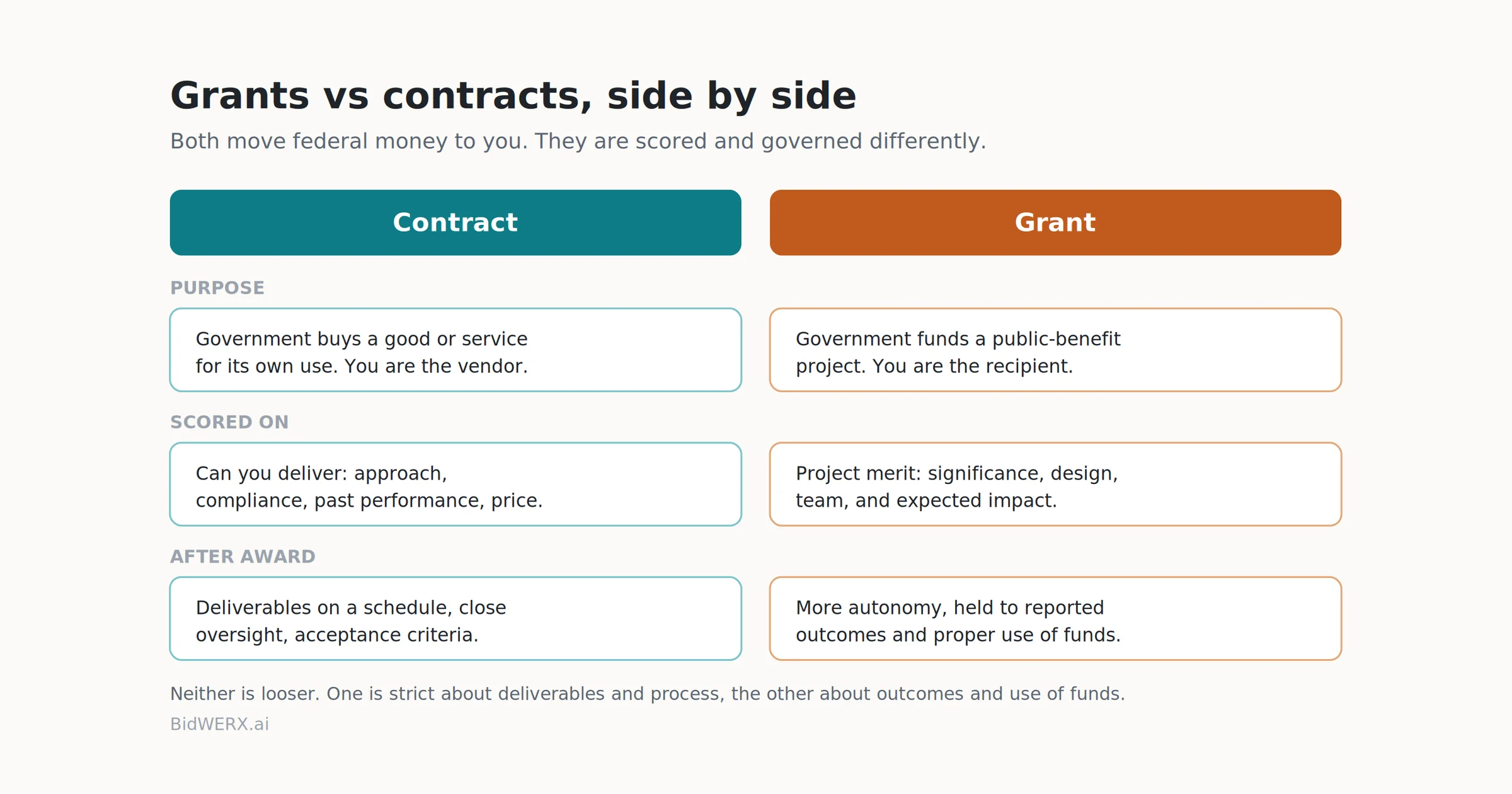
Start with intent, because everything follows from it. A contract exists because the government wants something for its own use, a service performed, a system built, a product delivered. It is a purchase, and you are the vendor. A grant exists because the government wants to advance a public purpose, research, community programs, innovation, and has decided to fund an organization to pursue it. It is assistance, and you are the recipient. That single distinction, buying for itself versus funding for the public, drives every other difference below.
How each is evaluated
Because the purpose differs, so does the scoring. A contract is evaluated on whether you can deliver what the government is buying: is your approach sound, are you compliant with the instructions, do you have the past performance and capacity to execute at acceptable risk, and is your price fair. The evaluator is asking "can this vendor reliably give us what we need."
A grant is evaluated on the merit of the project itself: is the idea significant, is the approach well-designed, is the team qualified, and will the outcome produce meaningful impact. The reviewer is asking "is this project worth funding for the benefit it will create." Delivery credibility still matters, but the center of gravity is the value and quality of what you propose to do, not a good or service being procured.
Deliverables and reporting expectations
After the award, the relationship differs. A contract holds you to specific deliverables on a schedule, with a contracting officer's representative overseeing performance, acceptance criteria, and the terms that govern any change. It is close, and it is exacting. A grant generally gives you more room to run the project as you see fit, in exchange for reporting on progress and outcomes and staying inside the terms of the award. You are trusted with more autonomy and held accountable for results and proper use of funds, rather than managed against a deliverable schedule.
Where the money and oversight come from
Contracts are governed by federal acquisition rules and administered by contracting officers, with the oversight that implies. Grants are governed by assistance rules and administered by program and grants officers, with reporting obligations and audit expectations that reflect the trust placed in the recipient. Neither is looser in an absolute sense; they are strict about different things. A contract is strict about deliverables and process. A grant is strict about how funds are used and whether the promised outcomes materialize.
Which one your capability fits
The practical question is not "which is easier," it is "which one matches what you actually do." If your strength is delivering a defined service or product reliably and on schedule, contracts play to it. If your strength is a compelling project, research, or innovation with a public benefit and a qualified team behind it, grants play to it. Many small firms can pursue both over time, but a single opportunity almost always fits one profile better than the other, and forcing the mismatch shows in the score.
Reading a specific opportunity
Whether an opportunity is a grant or a contract, the real question is the same: does it fit your firm, your capability, your past performance, your capacity, and the competitive field. That is a fit read worth doing before you invest in a proposal. On the contract side, BidWERX FitScore gives you a relative read on how well a specific SAM.gov contract opportunity fits your firm, so you spend your limited pursuit time where your profile actually matches. FitScore is a relative fit indicator to help you prioritize, not a prediction that you will win the award. If you want to weigh a specific contract against your firm's fit, you can start a free BidWERX trial.
Jon Selvaraj is the co-founder of Vista TechWerx and the builder of BidWERX, a readiness and decision tool for small firms pursuing federal work. He writes about the operating discipline behind winning government business.
Related reading: SBIR vs STTR: which fits, and how the phases work · what federal evaluators actually reward.
Frequently Asked Questions
What is the difference between a federal grant and a contract?
A contract is the government buying a specific good or service for its own use, with you as the vendor. A grant is the government funding a project that serves a public benefit, with you as the recipient. The difference in purpose, buying versus funding, drives how each is evaluated, governed, and managed after award.
Are grants and contracts scored the same way?
No. A contract is scored on your ability to deliver what the government is buying: sound approach, compliance, past performance, capacity, and fair price. A grant is scored on the merit and impact of the project you propose: its significance, design, team, and expected outcomes. Delivery credibility matters in both, but the emphasis differs.
Which has more oversight, a grant or a contract?
They are strict about different things. A contract comes with close performance oversight against deliverables, acceptance criteria, and a schedule, managed by a contracting officer's representative. A grant gives more autonomy in running the project but holds you accountable through progress and outcome reporting, proper use of funds, and audit expectations. Neither is simply looser.
Can my company pursue both grants and contracts?
Yes, many organizations do over time. But a single opportunity usually fits one profile better than the other. If your strength is reliable delivery of a defined service or product, contracts fit. If it is a compelling, high-merit project with public benefit, grants fit. Matching the opportunity to your actual strength matters more than pursuing both indiscriminately.