By Jon Selvaraj, co-founder of Vista TechWerx and builder of BidWERX. Last updated August 2026.
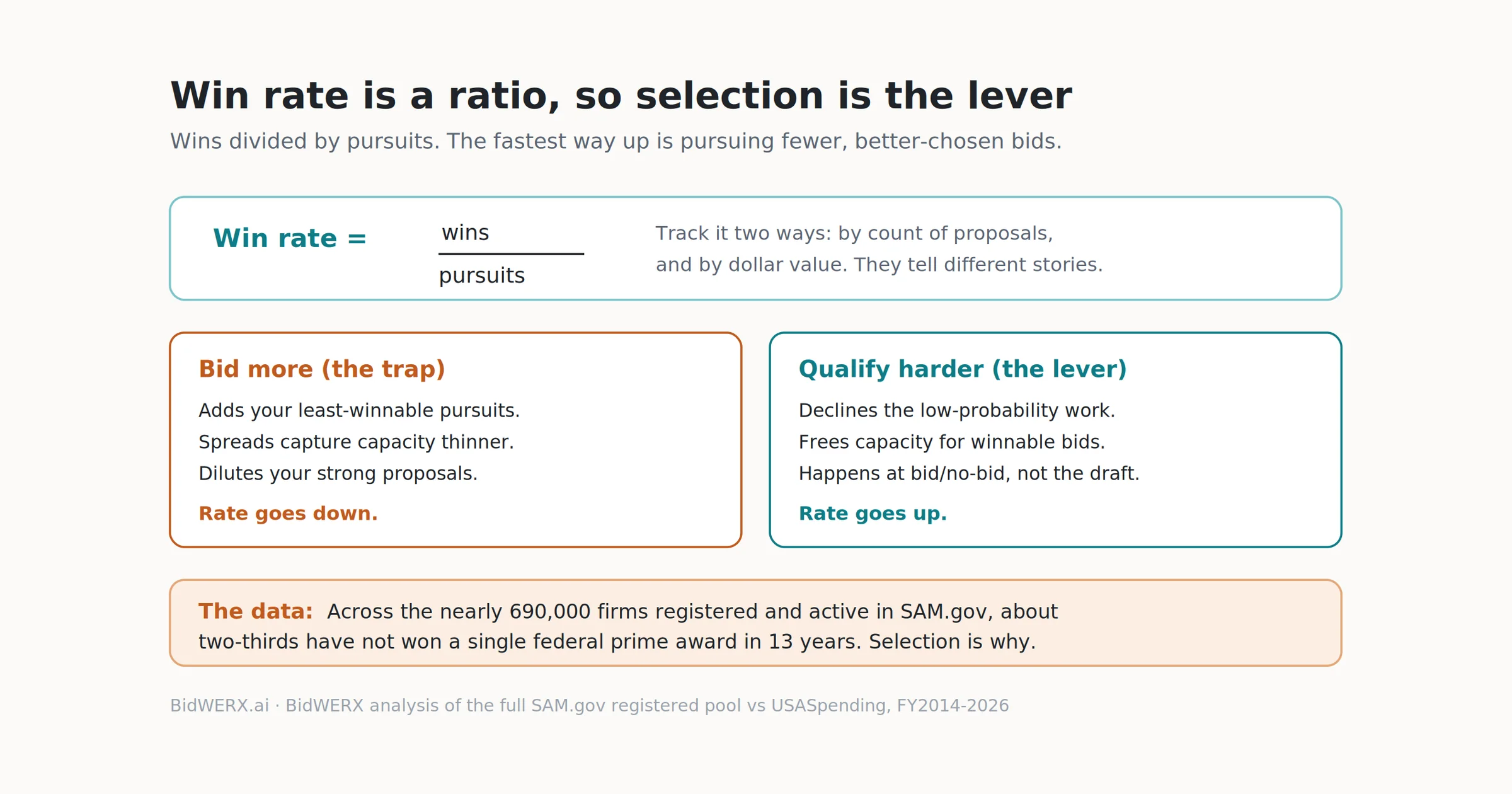
Quick answer: Your federal win rate is wins divided by pursuits, usually measured by number of proposals and by dollar value. Because it is a ratio, the fastest way to raise it is not to write better proposals, it is to pursue fewer, better-qualified opportunities. Measure it honestly over a consistent period, then move it with a disciplined qualification step that stops you from chasing low-probability work.
Key takeaways
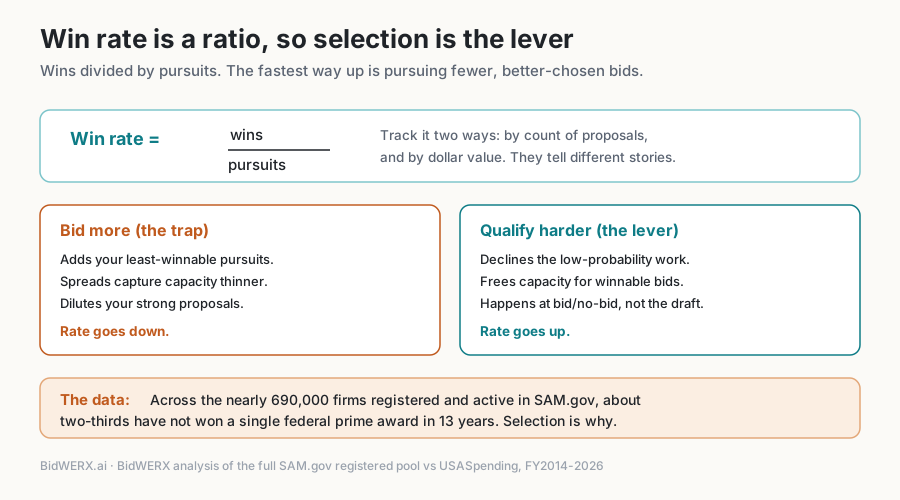
- Win rate is wins divided by pursuits. Track it two ways: by count of proposals and by dollar value, because they tell different stories.
- More pursuits usually lowers your rate, not raises it. Volume spreads a small team thin across work it was never going to win.
- The two levers are pursue fewer and qualify harder. Both point at the bid/no-bid decision, not the proposal itself.
- About two-thirds of the nearly 690,000 firms registered and active in SAM.gov have not won a single federal prime award in the last thirteen years (FY2014 to FY2026). Persistence on the wrong pursuits is a big reason.
Win rate is the number most small firms quote and fewest measure honestly. It is also the number most misunderstood, because the instinct when it is low is to write better proposals, and that is usually the wrong lever. The math points somewhere else. Here is how to calculate it and, more importantly, how to move it.
What win rate actually measures
Win rate is wins divided by pursuits over a period. Simple, but measure it two ways, because they diverge. By count, it is proposals won divided by proposals submitted. By value, it is dollars won divided by dollars pursued. A firm can have a healthy count-based rate and a poor dollar-based one if it wins small and loses big, or the reverse. Both matter. The count tells you about your qualification discipline; the value tells you about where your effort actually pays off.
One honest note on definitions: decide up front what counts as a pursuit. A proposal you submitted is clearly a pursuit. An opportunity you qualified out of before writing is not a loss, it is a decision. Do not punish yourself for good no-bids by counting them as pursuits. Count what you actually competed for.
Why more pursuits usually lowers your rate
Here is the counterintuitive part. When a small firm feels behind, the instinct is to bid more. But every additional pursuit spreads the same limited capture and proposal capacity thinner, which means each proposal gets less attention, which lowers quality across all of them. And the marginal opportunities you add to hit a higher volume are, by definition, the ones you were least sure about. So you add your weakest pursuits and dilute your strongest ones at the same time. Volume is how a lot of firms drive their win rate down while feeling like they are working harder than ever.
The data behind picking better
This is not just theory. In our own analysis of the nearly 690,000 firms registered and active in SAM.gov, about two-thirds, roughly 450,000, have not won a single federal prime award, contract or grant, in the last thirteen years. Registration is easy; winning is not, and the gap is enormous. When you look at what separates the firms that win from the ones that never do, it is rarely raw proposal-writing talent. It is selection. The firms that win are the ones that pursue deliberately, decline more than they chase, and put their limited energy behind the opportunities they are genuinely positioned for.
Measuring yours honestly
Pick a consistent window, a rolling twelve months works well, and count both ways. Proposals won over proposals submitted, and dollars won over dollars pursued. Then look at the losses without flinching. For each, ask whether it was a proposal you should have won and did not, or a pursuit you should never have started. That second category is usually larger than firms expect, and it is the one with the most upside, because those are losses you can prevent for free by not competing.
The two levers that move it
There are really only two. Pursue fewer, by qualifying harder before you commit. And qualify better, by being honest about competitive position before the capture hours pile up. Both levers live in the same place: the bid/no-bid decision, not the proposal. If you improve nothing about your writing but cut your ten least-winnable pursuits a year, your win rate rises and your team has more capacity for the pursuits that remain. That is the cheapest performance gain in the business, and almost nobody takes it, because saying no feels like losing.
Where a Go/No-Go changes the math
The lever is qualification, and qualification is only reliable when it is repeatable. A gut call drifts from person to person and week to week. A structured Go/No-Go scores each opportunity against consistent criteria, competitive position, strategic fit, and delivery capacity, so the marginal pursuits reveal themselves before you spend on them. That is what BidWERX's Go/No-Go is built to do: it is an internal, relative decision aid that makes the qualification call consistent and gives you a record to learn from after the result comes in. It does not predict the award, and it does not replace your team's judgment. It just stops the low-probability pursuits from quietly eating the capacity your winnable ones deserve. If you want to qualify your next pursuit against a repeatable framework, you can start a free BidWERX trial.
Jon Selvaraj is the co-founder of Vista TechWerx and the builder of BidWERX, a readiness and decision tool for small firms pursuing federal work. He writes about the operating discipline behind winning government business.
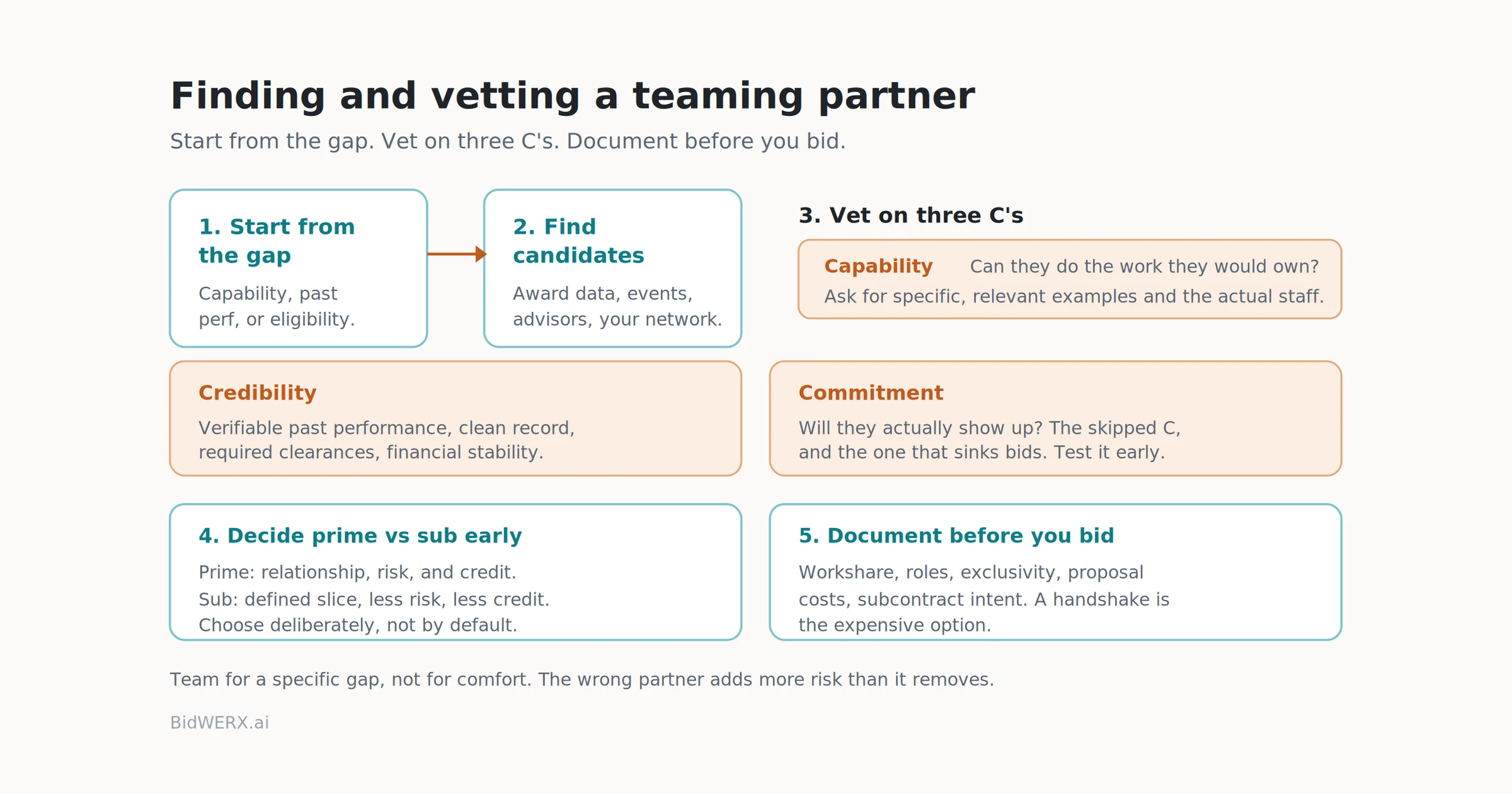
Related reading: the bid/no-bid decision: three questions before you write a word · how to find and vet teaming partners.
Frequently Asked Questions
How do you calculate win rate in government contracting?
Win rate is wins divided by pursuits over a set period. Measure it two ways: by count (proposals won divided by proposals submitted) and by value (dollars won divided by dollars pursued). The two can differ sharply if you win small and lose big, so track both. Count reflects qualification discipline; value reflects where your effort actually pays.
What is a good federal proposal win rate?
There is no single benchmark, because it depends heavily on how selective you are and the type of work. A firm that bids everything will have a low rate; a firm that qualifies hard can run much higher on fewer pursuits. Rather than chase a target number, focus on the trend: is your rate improving as your qualification discipline tightens?
Why is my win rate dropping when I bid on more contracts?
Because win rate is a ratio, and more pursuits usually add your least-winnable opportunities while spreading your capture capacity thinner across all of them. You dilute your strong proposals and pad the denominator with weak ones at the same time. Bidding more is one of the most common ways firms unintentionally lower their win rate.
What is the fastest way to improve win rate?
Qualify harder and pursue fewer. The biggest gains come from not competing for opportunities you were never positioned to win, which frees capacity for the ones you can. That decision happens at the bid/no-bid stage, before any proposal is written. Improving selection typically moves win rate more than improving proposal writing does.