Key takeaways
- Only the contracting officer (CO) can obligate the government or change a contract's price, scope, schedule, or terms. That authority comes from a written warrant, and the warrant has a dollar limit.
- The contracting officer's representative (COR) is your day-to-day technical contact. Under FAR 1.602-2, a COR has no authority to make commitments or changes that affect price, quality, quantity, delivery, or other terms.
- The program manager owns the mission, not the contract. A PM can tell you what the government needs. A PM cannot tell you to do more work and expect the government to pay for it.
- Act on direction from someone without authority and you may have an unauthorized commitment. Getting paid then depends on ratification, which is slow and not guaranteed.
- Before you bid, find out who the contracting officer is.
The short answer: authority lives with the contracting officer
If you are new to defense work, the single most useful thing to learn early is who can actually say yes. The answer is narrow. On a federal contract, the contracting officer is the only person who can bind the government. That is not a custom or a courtesy. It is in the regulation. FAR 1.602-1 says contracting officers may bind the government only to the extent of the authority delegated to them, and that they receive written instructions on the limits of that authority.
Everyone else on the government side has a role. None of those roles includes committing money or changing the contract. Once you hold that distinction, a lot of confusing moments on a program start to make sense.
If you want the plain version of these three roles across any agency, we covered the basics here: the CO, COR, and PM on a federal buy. This piece takes the defense angle: who holds the authority to bind the government on a DoD buy, and who does not.
What a contracting officer actually is
A contracting officer holds a warrant. The formal name is a Certificate of Appointment, and it sets a dollar limit on what that person can sign. Two contracting officers are not interchangeable. One might carry a warrant up to a few million dollars. Another might be unlimited. If your deal is above a CO's warrant, a CO with a higher warrant has to sign it.
Within that limit, the CO is the one who signs the contract, issues modifications, and settles anything that touches price, scope, schedule, or terms. On a DoD program you will often work with a contracting officer during the award, and sometimes an administrative contracting officer after award for day-to-day administration. The title changes. The rule does not. Authority to change the deal stays with a warranted contracting officer.
This is also why a CO can seem slow. They are personally accountable for making sure the action is legal and funded before they sign. FAR 1.602-1 is blunt about it: no contract gets entered into until the contracting officer confirms the requirements of law, executive orders, and regulations have been met. That caution is the job, not an obstacle.
What a COR can and cannot do
The contracting officer cannot be everywhere, so FAR 1.602-2 requires the CO to designate a contracting officer's representative in writing. The COR is usually the technical person who knows the work best. They watch performance, inspect, raise problems early, and often accept deliverables when that is delegated to them. The appointment letter is the thing to read. It spells out exactly what the COR can do on your specific contract.
What a COR cannot do is written into the regulation itself. A COR "has no authority to make any commitments or changes that affect price, quality, quantity, delivery, or other terms and conditions of the contract." So when a COR says "while your team is in there, go ahead and also handle X," that is not a change to your contract. It becomes a change when the contracting officer puts it in a modification. If your contract carries a technical direction clause, that direction has to stay inside the existing scope. It is not a side door for new work.
None of this makes the COR unimportant. The COR is your closest working relationship on most programs, and a good one will protect you by routing real changes to the CO quickly. The point is to know the boundary, not to distrust the person.
Where the program manager fits, and where it does not
The government program manager owns the mission and the requirement. They set priorities, defend the budget, and care most about whether the thing gets done. On a lot of programs the PM is the loudest and most senior voice in the room. It is easy to treat whatever the PM wants as an order.
Here is the part that trips people up. The PM is not a contracting authority. A PM cannot obligate funds and cannot direct a change to your contract. They can tell you what the government needs. They cannot tell you to do more than the contract says and bind the government to pay for it. On a single DoD program you might deal with a PM, a COR, a contracting officer, and a technical lead. The org chart is not the authority chart. Keep the two separate in your head and you will avoid the most expensive mistakes in this business.
"Someone at the agency said yes." Why that is the risky moment
Most of the trouble starts in good faith. A COR or a PM, trying to move the mission forward, asks you to start early, add a little scope, or keep working past the end date, before the contracting officer has modified the contract. You want to be responsive. So you do it.
That is when you can end up with an unauthorized commitment. FAR 1.602-3 defines it as an agreement that is not binding only because the government person who made it did not have the authority to make it. The work might be genuinely useful. The direction might have come from someone senior. It still is not a valid contract action.
To get paid for it, the government has to ratify the commitment after the fact. Ratification is approved high up, by the head of the contracting activity, and not below the chief of the contracting office. It is discretionary. Agencies are specifically told to avoid the need for it, which tells you how little they like doing it. Sometimes it goes through. Sometimes you do the work and absorb the cost. That is a bad position to be in because someone without authority told you to go.
How to protect yourself
You do not need to be difficult to stay safe. You need a few habits.
- Read the award. The contracting officer is named on the contract. The COR appointment letter lists what the COR can and cannot do. Keep both where your team can find them.
- Get changes in writing from the CO. A verbal "go ahead" from a COR or PM is not a modification. Ask for the mod before you act on new scope.
- When in doubt, email the contracting officer and copy the COR. Put the request, the cost, and the schedule impact in writing first.
- Watch two numbers: the period of performance and the funded ceiling. Work past either one without a modification is at-risk work.
- Do not rely on "they told me to." That sentence does not pay invoices.
This is general information, not legal advice. When real money is on the line, talk to your contracts lead or your counsel before you act.
Knowing who you will be dealing with, before you bid
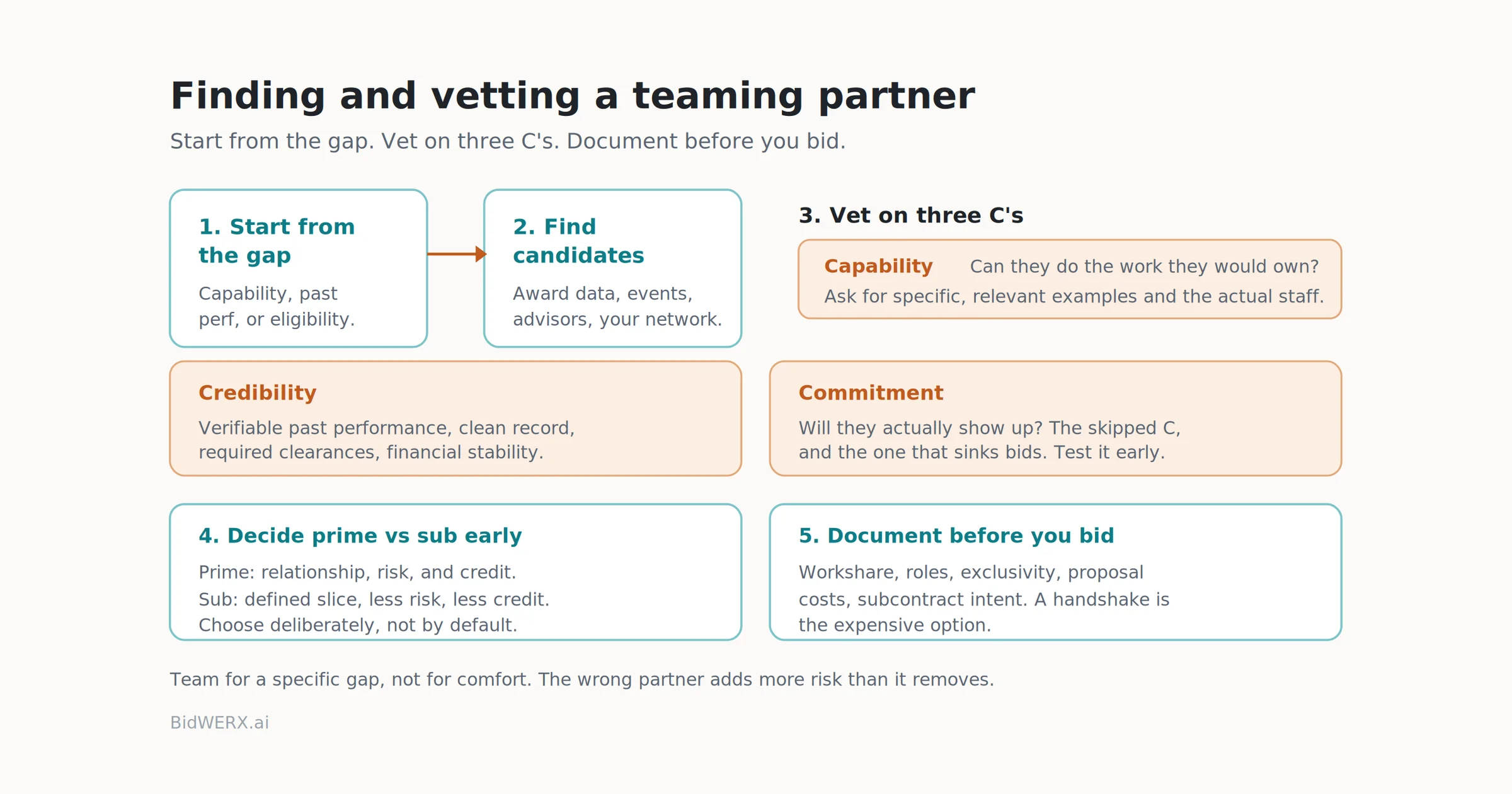
You can learn most of this before you ever submit a response. The solicitation names the contracting office and a point of contact. Past awards on similar work show which office ran the buy and how it tends to operate. That matters because the relationship you are signing up for is with that contracting office, not with the end user who wants the work done. Reading the solicitation closely is its own skill, and we walk through it here: how to read a DoD solicitation.
This is also where a tool earns its place. BidWERX Find surfaces SAM.gov opportunities with the contracting details attached, so you can see the contracting office and the point of contact next to the requirement instead of digging them out of a PDF. On a team, Find is available to Org Admins and Capture Managers. It does not predict who will win. It puts the facts in front of you earlier, so you can decide who you would actually be working with before you spend time on a bid.
The gap here is real. About two-thirds of the nearly 690,000 firms registered and active in SAM.gov have not won a single federal prime award in the last thirteen years, FY2014 to FY2026. A lot of that is firms chasing work they were never positioned to win. Understanding who holds authority, and reading the buy before you commit, is a small part of closing that gap. If you are earlier in the journey than this, start with how to start government contracting.
About the author. Jon Selvaraj is co-founder and COO of Vista TechWERX and leads BidWERX product development. He has spent about 30 years in operations and client delivery across Air Force and GovCon programs and Big Four consulting. He builds BidWERX to give teams without dedicated proposal resources the pursuit intelligence that used to require an enterprise budget.
Last updated: November 18, 2026. Citations refer to the FAR as published. Since February 2026, DoD has operated under a class deviation that reorganizes FAR Part 1, so section numbers in DoD's version differ: 1.602-1, 1.602-2, and 1.602-3 are now 1.402-1, 1.404, and 1.405. The rules described here are unchanged.
Can a COR authorize extra work on a DoD contract?
No. Under FAR 1.602-2 a COR has no authority to make commitments or changes that affect price, quality, quantity, delivery, or other terms. Only the contracting officer can authorize a change, and only in a written modification.
The program manager told me to keep going after the period of performance ended. Am I covered?
Not automatically. Work past the period of performance without a modification from the contracting officer is at-risk work. If a PM or COR directed it without authority, it may be an unauthorized commitment that has to be ratified before you are paid, and ratification is not guaranteed.
What is an unauthorized commitment?
FAR 1.602-3 defines it as an agreement that is not binding only because the government representative who made it did not have the authority to enter into it. The agency can ratify it after the fact, but ratification is approved at a senior level and is discretionary.
How do I know if a contracting officer can actually sign my deal?
Contracting officers hold a warrant with a dollar limit. If your contract value is above a CO's warrant, a CO with a higher warrant has to sign. The contract names the CO, and the appointment sets the limit.
Who do I report to during performance, the COR or the contracting officer?
Day to day, usually the COR. For anything that touches price, scope, schedule, or terms, the contracting officer. Keep the two separate, and route real changes to the CO in writing.