By Jon Selvaraj
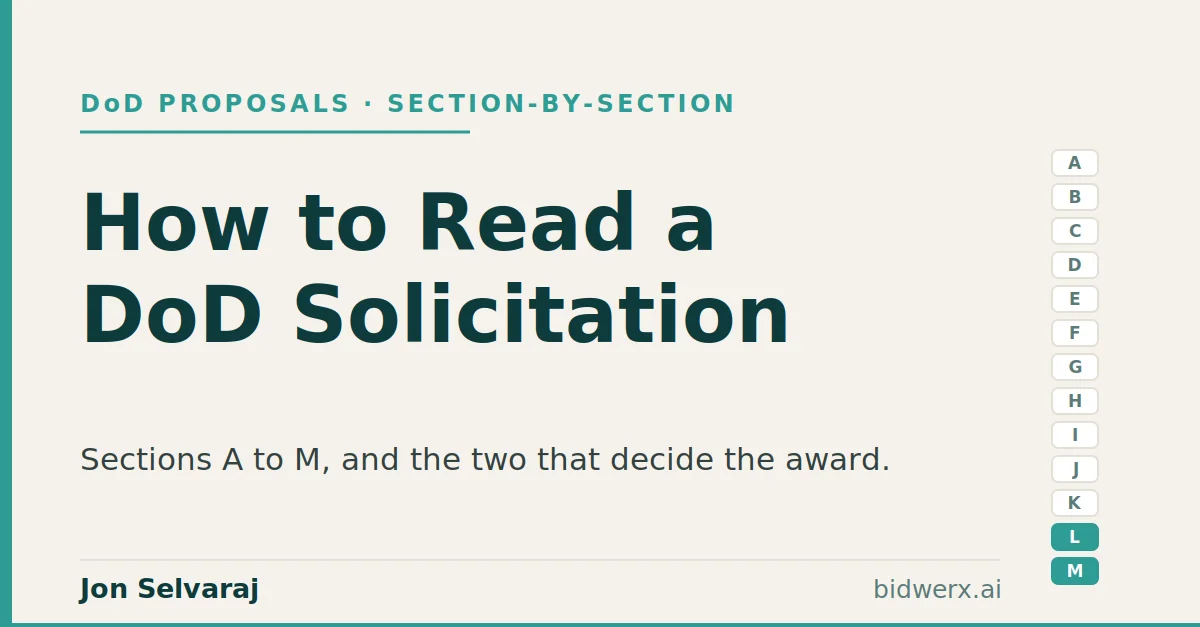
Quick answer. A DoD solicitation follows the Uniform Contract Format, which splits the document into Sections A through M. The Schedule (A to H) says what the government wants and on what terms. Section L tells you how to write your response, and Section M tells you how it gets scored. Read M and L first, then the work description in C, then price it in B.
Key takeaways
- Most of a DoD solicitation is boilerplate. Two sections, L and M, actually decide who wins, so read those before anything else.
- The Uniform Contract Format is standard across federal solicitations, so the letters mean the same thing whether you're reading an Air Force RFP or a civilian one.
- Section M is your grading rubric. If a factor isn't in M, the government can't give you credit for it, no matter how good it is.
- A set-aside you don't qualify for isn't a hurdle. It's a wall. Confirm eligibility before you spend a single hour writing.
- The reading order that saves the most rework is M, then L, then C, then B. Compliance first, story second.
What a DoD solicitation actually is
A solicitation is the government's formal request for offers. For the DoD (operating name: Department of War), it's the document that tells you what a defense agency wants to buy, how it wants you to respond, and how it will decide who gets the award. You'll find these posted on SAM.gov, usually as a Request for Proposals (RFP) for negotiated buys or an Invitation for Bids (IFB) for sealed bidding.
Here's the part that trips up newer firms. A solicitation is not a contract, and it's not a wish list. It's a structured legal document, and most defense solicitations follow the same template. Once you know the template, you can open a 120-page RFP and go straight to the parts that matter instead of reading front to back.
That template is the Uniform Contract Format.
The Uniform Contract Format, section by section
The Uniform Contract Format (UCF) is defined in the Federal Acquisition Regulation at FAR 15.204-1. It organizes a solicitation into four parts and thirteen lettered sections, A through M. Contracting officers use it so that offerors always know where to look. Here's what each one holds.
Part I, the Schedule (Sections A to H). This is the body of the deal.
- A, Solicitation/contract form. The cover sheet. Solicitation number, issuing office, key dates, and where to send your offer.
- B, Supplies or services and prices/costs. The line items (CLINs) and where you enter your pricing. B and C have to agree. If C describes work that has no line in B, something is wrong.
- C, Description, specifications, statement of work. The what. This is the Statement of Work (SOW) or Performance Work Statement (PWS), the technical heart of the requirement.
- D, Packaging and marking. How deliverables get packaged and labeled. Usually light for services, heavier for supplies.
- E, Inspection and acceptance. How the government decides your work is acceptable, and who signs off.
- F, Deliveries or performance. The when and where. Period of performance, delivery schedule, place of performance.
- G, Contract administration data. Invoicing, accounting, and who administers the contract after award.
- H, Special contract requirements. The catch-all for terms that don't fit elsewhere. Read H carefully, because odd but binding requirements hide here, things like key-personnel clauses, security requirements, or organizational-conflict-of-interest rules.
Part II, Contract Clauses (Section I).
- I, Contract clauses. The standard FAR and DFARS clauses that will govern the contract. Mostly incorporated by reference. You skim I to catch anything unusual, like a specific cybersecurity or supply-chain clause.
Part III, List of Documents, Exhibits, and Other Attachments (Section J).
- J, List of attachments. The index of everything attached: the full SOW/PWS if it's an exhibit, wage determinations, data-item deliverables (CDRLs), past-performance forms, pricing templates. J is easy to skim past and expensive to ignore, because the attachments are often where the real requirements live.
Part IV, Representations and Instructions (Sections K, L, M). This is the part that decides the award.
- K, Representations, certifications, and other statements of offerors. The reps and certs. Much of this now lives in your SAM.gov registration, but the solicitation can add certifications specific to this buy.
- L, Instructions, conditions, and notices to offerors. How to write and submit your response. Volume structure, page limits, font and margin rules, what goes in which volume, how to submit, and the deadline. Miss an instruction in L and you can be found nonresponsive before anyone reads your technical approach.
- M, Evaluation factors for award. How the government will score offers. The factors, their relative importance, and whether it's a lowest-price technically-acceptable buy or a best-value tradeoff.
Section L and Section M decide the award
If you take one thing from this, take this: L and M are the two sections that win or lose the work.
Section M is the rubric. It lists the evaluation factors (technical approach, past performance, price, and so on) and tells you how they stack up against each other. If a factor isn't named in M, the government generally can't give you credit for it. So M defines what "good" means for this specific buy. A brilliant management section earns you nothing if management isn't an evaluation factor.
Section L is the format that lets the evaluators find your answers to M. When L says the technical volume is limited to 20 pages and must address the factors "in the order listed in Section M," that isn't a suggestion. Evaluators score with M open in front of them. If your response is organized around M and easy to score, you make their job easy. If it isn't, you make it easy for them to miss your strengths.
The practical move is to build a crosswalk that maps every requirement in L and every factor in M against the work described in C. That crosswalk is your compliance matrix, and it's the single most useful artifact you can build before writing. We walk through building one in how to build a compliance matrix, and the deeper logic of what evaluators actually reward is covered in what federal evaluators actually reward.
The order to actually read it in
Reading a solicitation front to back is how you waste an afternoon. Here's a reading order that surfaces the go/no-go signals first.
- Cover and A. Confirm the due date, the issuing office, and the solicitation type. Note the set-aside status immediately.
- The set-aside line. If it's set aside for a category you don't hold (8(a), SDVOSB, WOSB, HUBZone, small business), and you can't legitimately qualify or team into it, stop. This is a hard gate, not a preference.
- M, evaluation factors. Learn how you'll be scored before you decide whether to bid.
- L, instructions. Learn what you have to produce and by when. Check page limits and submission mechanics.
- C, the SOW or PWS. Now read the actual work, with M and L already in your head so you can see which requirements carry evaluation weight.
- B, pricing, and F, schedule. Confirm you can perform on time and price it to the CLIN structure.
- H, J, and I. Sweep for special requirements, attachments, and unusual clauses.
By the time you finish step three, you usually know whether this is a real pursuit or a pass. That's the point. A disciplined read is a filter, and filtering early is how small teams protect their time.
Red flags worth catching on the first pass
- Amendments. Solicitations get amended. An amendment can change the due date, the requirements, or the evaluation factors. Always check SAM.gov for the latest amendment, and read it, because it supersedes what you already read.
- The questions deadline. Most RFPs set a date for submitting questions, earlier than the proposal due date. If you spot an ambiguity, the window to get it clarified closes fast.
- Mandatory forms and formats. If L requires a specific pricing template or past-performance form from J, using your own format can get you marked down or excluded.
- Page limits that don't match the ask. When M lists more to evaluate than L gives you pages to cover, that tension is the real test. It tells you where to be concise and where to spend your words.
- Set-aside plus NAICS code. The NAICS code sets the small-business size standard for the buy. Confirm your firm fits it.
Why this reading discipline matters
Reading solicitations well is one of the quiet skills that separates firms that win from firms that just bid. The scale of the gap is larger than most people expect. About two-thirds of the nearly 690,000 firms registered and active in SAM.gov have not won a single federal prime award in the last thirteen years, from FY2014 to FY2026. Registration is easy. Reading the document the way the evaluators read it is not, and it's a big part of what stands between a registered firm and an awarded one.
Where BidWERX fits
BidWERX is an intelligence layer, not a generator. It doesn't write your response. What it does is read the solicitation with you.
The Analyze capability takes a DoD solicitation and surfaces what it's really asking. It summarizes the document, surfaces the key questions buried in it, deciphers the instructions in Section L, and documents the evaluation criteria in Section M so you can build your crosswalk from a clean list instead of from a highlighter and a hope. It reads the solicitation. You still make the calls.
Upstream of that, Find scores a SAM.gov opportunity against what your firm actually does, so you spend your reading time on solicitations worth reading. Downstream, once you have a draft, Evaluate reads your response against the agency's published criteria across responsiveness, compliance, persuasiveness, and risk, and returns a Grade. The Grade is a relative, internal readiness indicator. It is not the government's rating, and it is not a prediction that you'll win.
If you want to see it read one of your own solicitations, start a free trial. Trial users get full access for 14 days.
Once you can read the solicitation, the next question is how to turn that read into a submitted offer. That's the subject of a defense-contracting overview we're building next, and this guide will link to it when it's live.
About the author
Jon Selvaraj spent about three decades in and around federal contracting, including Air Force programs and a nine-figure federal services portfolio. He founded Vista TechWERX, the company behind BidWERX, and writes about the mechanics of winning government work for small and mid-size firms.
Published September 22, 2026. Last reviewed September 22, 2026. Note on currency: the Uniform Contract Format described here is current under FAR 15.204-1 (last amended August 2026). A proposed "Revolutionary FAR Overhaul" affecting Part 15 was published for comment in September 2026, with comments due October 19, 2026. It is not final and does not eliminate the Uniform Contract Format. We'll update this page if that changes.
Frequently asked questions
What's the difference between an RFP and an IFB? An RFP (Request for Proposals) is used for negotiated buys where the government evaluates factors beyond price, like technical approach and past performance. An IFB (Invitation for Bids) is used for sealed bidding, where award generally goes to the lowest responsive, responsible bidder. RFPs use Sections L and M for instructions and evaluation. IFBs don't evaluate the same way, because price is the deciding factor.
Do I really have to read all of Sections A through M? No. You have to know what each section holds so you can go straight to the ones that matter for your decision. On a first pass, the cover, the set-aside line, M, and L tell you whether to bid. C, B, and the rest come once you've decided the pursuit is real.
Which section is most important? Section M, closely followed by L. M defines how you'll be scored, and L defines how to present your answer so the evaluators can score it. The work description in Section C matters, but a compliant, well-organized response built around M and L is what actually earns the rating.
Where do I find DoD solicitations? On SAM.gov, the official federal contract opportunities site. You can search by keyword, NAICS code, agency, and set-aside type. Grants, which are a different funding path, are posted on Grants.gov.
Is the DoD really called the Department of War now? A 2025 executive order established "Department of War" as a secondary and operating name for the department. The legal name remains the Department of Defense, since a formal renaming would require Congress. In solicitations and on SAM.gov you'll still see "Department of Defense" and the familiar component names.