By Jon Selvaraj, co-founder of Vista TechWerx and builder of BidWERX. Last updated August 2026.
Quick answer: A federal contract is a legally binding agreement in which the U.S. government buys a good or service for its own use, and you are the vendor. It is different from a grant, which funds a public-benefit project. A federal contractor is any business that holds one of these contracts, from a solo consultant to a large integrator. You do not need a specific business type to compete, but you do need to be registered and eligible.
Key takeaways
- A federal contract is the government purchasing something for itself, and you deliver it. That is what separates it from a grant, which funds a project for public benefit.
- A "federal contractor" is just a business that holds a federal contract. The label covers everything from a one-person LLC to a multinational, and the same rules scale down to the smallest firm.
- You do not need an LLC or any particular entity type to bid, but you do need an active SAM.gov registration and to meet the eligibility the specific opportunity requires.
- The hard part is almost never understanding what a contract is. It is finding the ones that actually fit your firm out of thousands posted.
If you are new to government work, the vocabulary makes it sound more complicated than it is. Strip away the acronyms and a federal contract is a purchase: the government needs something, it agrees to pay you to provide it, and both sides are bound by the terms. Here is the plain version, with real examples and the questions newcomers actually ask.
What a federal contract actually is
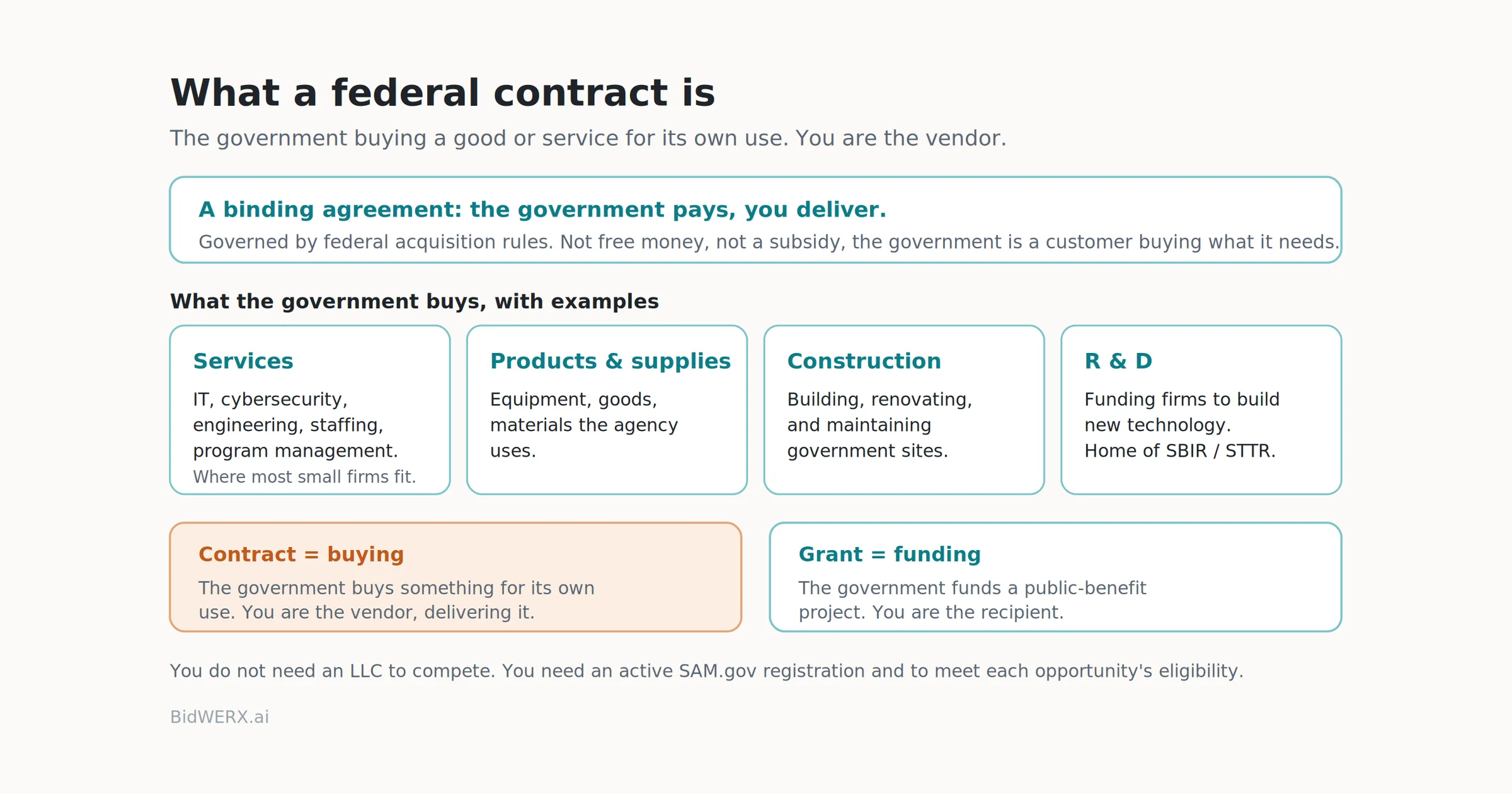
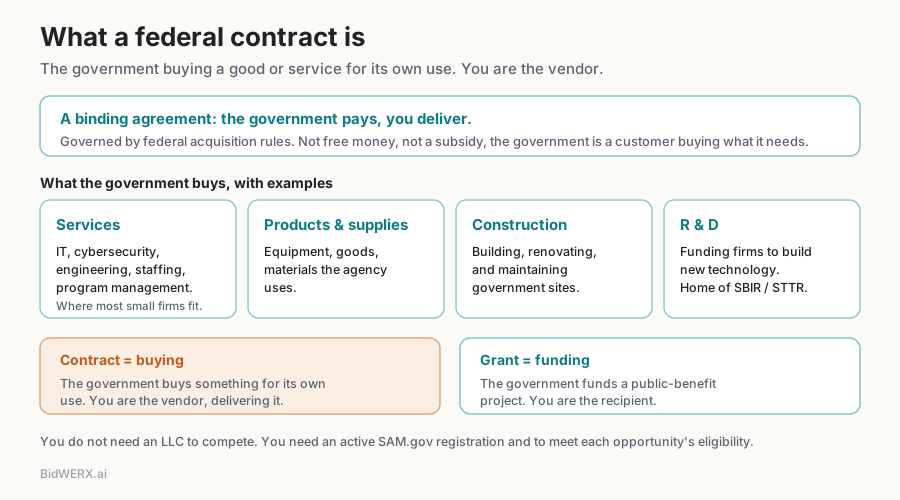
A federal contract is a binding agreement where a federal agency buys a good or service and commits to pay for it, and you commit to deliver it on the agreed terms. The government is the customer. You are the vendor. The whole relationship is a purchase, governed by a body of acquisition rules that exist to keep the spending fair and accountable, but at its core it is the same as any customer paying a supplier to do a job.
That is the distinction that trips people up most: a contract is not free money and it is not a subsidy. The government is buying something it needs for its own mission, and it expects to receive exactly that. This is what separates a contract from a grant. A grant funds a project because the outcome serves a public purpose, research, community programs, and the like. A contract buys a deliverable the government will use. If the government is purchasing for itself, it is a contract. If it is funding you to pursue a public benefit, it is a grant.
What a "federal contractor" means
A federal contractor is simply a business that holds a federal contract. There is nothing more exotic to it. The term covers a solo consultant with a single task order and a global firm with thousands of them. What matters is not the label but the obligations that come attached: once you hold a contract, you agree to the clauses in it, from how you invoice to labor and compliance requirements that scale with the size and type of work.
The reassuring part for a small firm is that the door is genuinely open. The federal government is required to steer a meaningful share of its spending to small businesses, and entire categories of opportunities are set aside specifically for them. Being small is often an advantage in this market, not a barrier.
Real examples of federal contracts
Federal contracts cover almost anything the government uses. A few concrete examples make it click:
Services are the largest category for most small firms: IT support, cybersecurity, engineering, staffing, training, logistics, program management, research and analysis. If your firm does professional or technical work, this is usually where you fit. Products and supplies are the government buying goods, from laptops and medical supplies to specialized equipment. Construction and facilities covers building, renovating, and maintaining government sites. And research and development funds firms to create new technology, which is where programs like SBIR and STTR live.
The point is that "federal contractor" is not a narrow club. If a business sells something the government uses, there is probably a contract vehicle for it.
Do you need an LLC to win federal contracts?
This is one of the most common newcomer questions, so here is the direct answer: no, you do not need an LLC specifically. The government contracts with many entity types, sole proprietors, LLCs, partnerships, corporations, and your registration captures whichever you are. What you actually need is to be a real, registered business with an active SAM.gov registration and the eligibility the opportunity calls for.
That said, many small firms choose an LLC or a corporation for reasons that have nothing to do with the government: liability protection, cleaner separation of business and personal finances, and a more credible footprint. Those are worth discussing with an accountant or attorney. Just do not treat "form an LLC" as a required first step to bidding, because it is not. The required first step is registration.
What you actually need to start
Being eligible to hold a federal contract comes down to a short list. You need a legal business and an Employer Identification Number. You need an active registration in SAM.gov, which issues your Unique Entity ID and assigns your CAGE code at no cost. You need to identify the NAICS codes that describe your work. And for a given opportunity, you need to meet whatever that specific solicitation requires, which can include size standards, socioeconomic set-aside status, clearances, or certifications. None of this requires a particular corporate structure. It requires being registered and being honest about what you are eligible for.
The part that is actually hard
Understanding what a federal contract is takes about five minutes. Finding the ones worth your time takes real work, and it is where most new firms stall. Once you are registered, you are looking at thousands of opportunities posted across the government, most of which are wrong for you, and no obvious way to tell the few that fit from the many that do not.
That is the problem BidWERX Find is built for. It surfaces the opportunities that match your firm, and FitScore gives you a relative read on how well each one fits, so you spend your limited pursuit time on the handful worth pursuing instead of scrolling every notice. FitScore is a relative fit indicator to help you prioritize, not a prediction that you will win. If you want to see which federal contracts fit your firm, you can start a free BidWERX trial.
Jon Selvaraj is the co-founder of Vista TechWerx and the builder of BidWERX, a readiness and decision tool for small firms pursuing federal work. He writes about the operating discipline behind winning government business.
Related reading: how to register in SAM.gov · how to find and search federal contract opportunities.
Frequently Asked Questions
What is a federal contract?
A federal contract is a legally binding agreement in which a federal agency buys a good or service for its own use and agrees to pay for it, while the vendor agrees to deliver it on the stated terms. It is a purchase, governed by federal acquisition rules. It differs from a grant, which funds a project for a public benefit rather than buying something the government will use.
What does "federal contractor" mean?
A federal contractor is any business that holds a federal contract, from a single-person firm to a large corporation. The term describes the relationship, not the size or type of company. Holding a contract means agreeing to its clauses and requirements, which scale with the size and nature of the work.
What are examples of federal contracts?
Common examples include services (IT, cybersecurity, engineering, staffing, program management), products and supplies (equipment, goods), construction and facilities work, and research and development such as SBIR and STTR awards. Services are where most small firms compete, because professional and technical work is in constant demand across agencies.
Do I need an LLC to bid on federal contracts?
No. The government contracts with sole proprietors, LLCs, partnerships, and corporations alike, and your SAM.gov registration records whichever you are. Many firms choose an LLC for liability and tax reasons, but it is not a requirement to compete. The real prerequisite is an active SAM.gov registration and meeting each opportunity's eligibility.